Clear Sky Science · en
Sir proteins impede, but do not prevent, access to silent chromatin in living Saccharomyces cerevisiae.
How cells keep some genes quiet
Inside every cell, long strands of DNA are wrapped around proteins and folded into chromatin. Some stretches of this chromatin are kept especially quiet, with genes that rarely turn on. This study asks a basic question with wide relevance: are those “silent” regions truly locked away, or are they still physically reachable by other molecules moving through the cell?
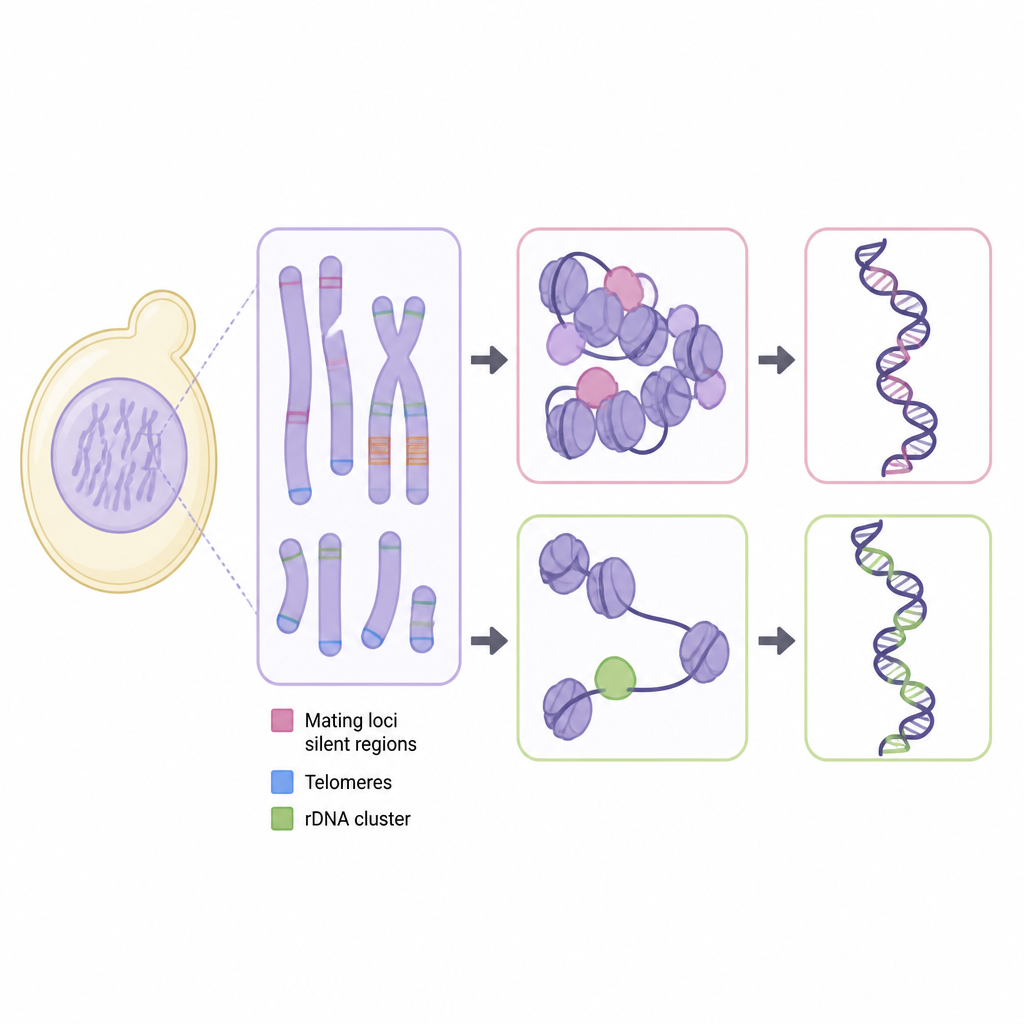
Quiet DNA and the proteins that guard it
Budding yeast is a popular model for studying how cells control access to their DNA. In yeast, certain chromosome regions near mating-type genes, chromosome ends, and ribosomal DNA clusters form silent zones. A family of proteins called Sir proteins helps establish these quiet areas. Classic models suggested that Sir proteins act like a tight shield around DNA, blocking other proteins from getting in. The authors set out to test just how effective this shield really is inside living cells.
Using a molecular paintbrush to track access
To measure physical access to DNA, the researchers used a bacterial enzyme that adds a small chemical mark to specific DNA letters whenever it can reach them. They engineered yeast cells so this enzyme turns on at a chosen time, then followed how quickly millions of sites across the genome picked up these marks using nanopore sequencing. Faster marking means easier access. They compared normal cells with cells lacking each of the four Sir proteins in turn, focusing on silent mating-type regions, chromosome ends, and ribosomal DNA repeats.
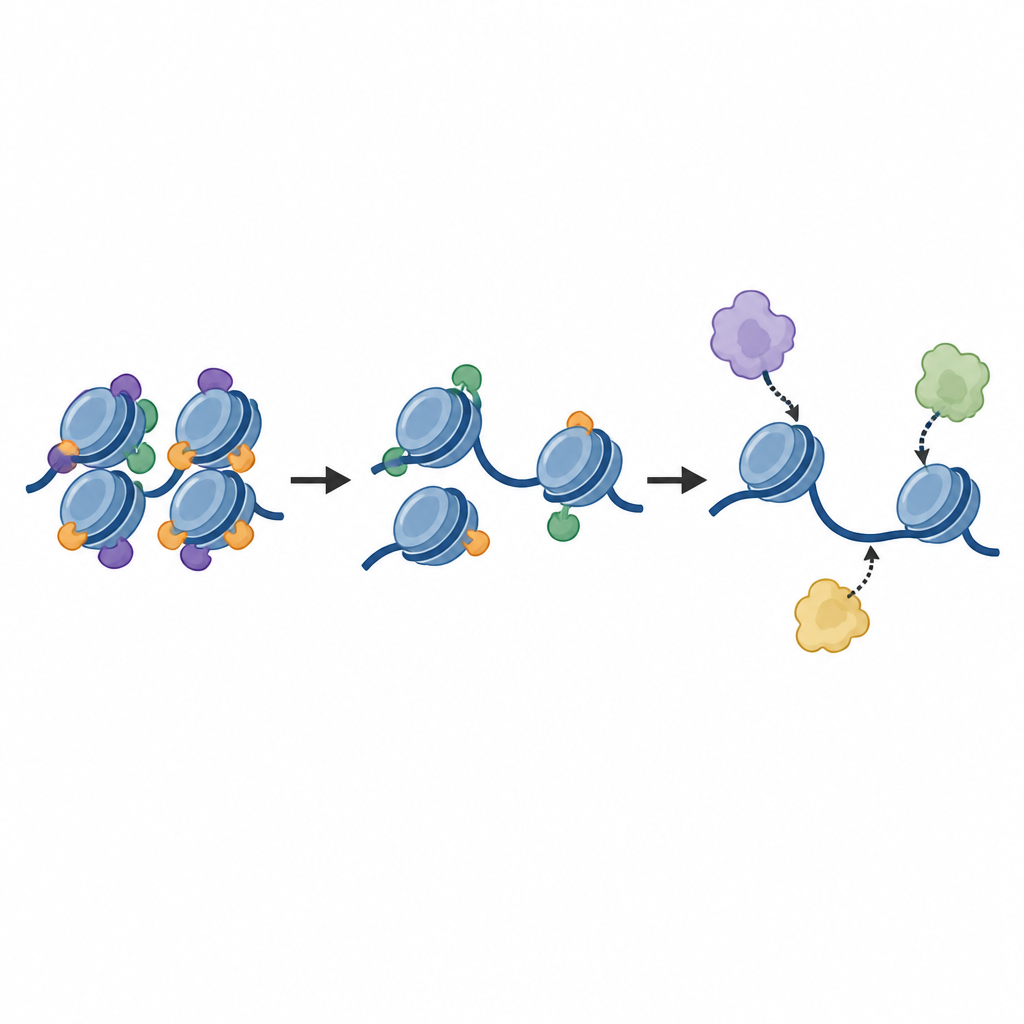
Silent regions are slowed, not sealed
The team found that most of the genome remained quite accessible, matching their earlier work. However, the silent mating-type regions and specific elements near chromosome ends were marked more slowly than typical DNA, showing that access there is reduced. When Sir2, Sir3, or Sir4 were removed, those same silent stretches became marked much faster, reaching rates similar to active regions. Sir1 played a more selective role, influencing one of the two mating-type regions but not the other, and having little effect on chromosome ends or ribosomal DNA. These results show that core Sir proteins do hinder the enzyme’s approach to DNA, but do not fully block it.
Different rules at chromosome ends and ribosomal DNA
At chromosome ends, the authors saw that the Sir proteins slowed access mainly at specific segments called X-elements and at a small group of nearby genes already known to be silenced. Not all chromosome ends behaved the same, suggesting that local structure and distance from the tip matter. In the ribosomal DNA cluster, where many near-identical copies of a key gene are arranged in tandem, Sir2 and Sir3 slowed marking within these repeats, while Sir4 and Sir1 had little effect. Interestingly, neighboring copies did not always show similar marking levels in normal cells, indicating that active and inactive copies are mixed rather than neatly grouped. When Sir2 or Sir3 were missing, adjacent repeats tended to behave more alike, hinting that these proteins help maintain a patchwork of differently active repeats.
What these findings mean for gene control
By watching how a small enzyme paints the genome over time, this study reveals that so-called silent chromatin in yeast is not completely off-limits. Sir proteins make DNA harder to reach and appear to slow the movement or rearrangement of the underlying chromatin, but they do not create an absolute barrier. For a lay reader, the key takeaway is that gene silencing in cells is more like turning down a dimmer switch than snapping a padlock shut. This gentler form of control may give cells the flexibility to adjust gene activity when needed, while still keeping certain genetic instructions mostly in the background.
Citation: Wu, K.Y., Xu, Z., Prajapati, H.K. et al. Sir proteins impede, but do not prevent, access to silent chromatin in living Saccharomyces cerevisiae.. Sci Rep 16, 14730 (2026). https://doi.org/10.1038/s41598-026-44518-0
Keywords: chromatin, gene silencing, yeast, Sir proteins, DNA accessibility