Clear Sky Science · en
Design and characterization of quad port dual band MIMO antenna for 5G V2X connectivity
Smarter car antennas for safer roads
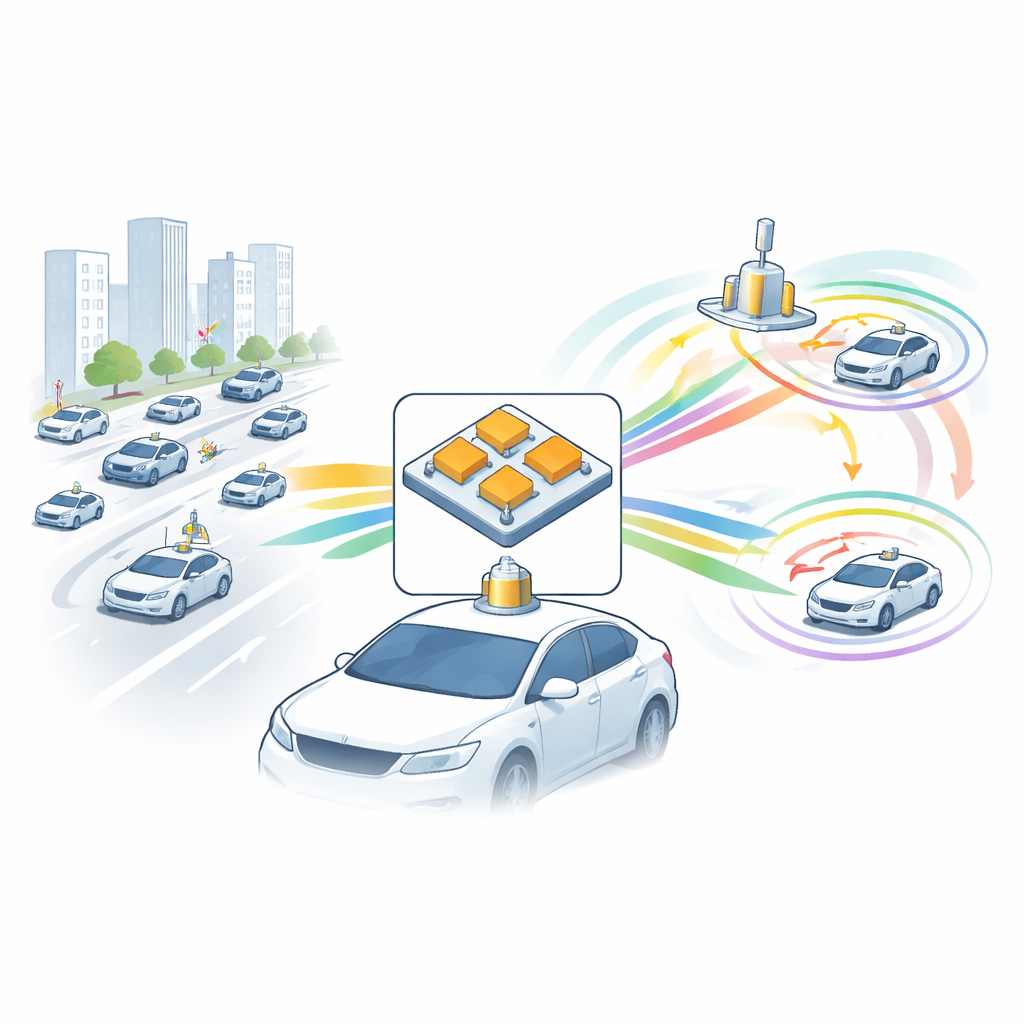
Modern cars are turning into rolling computers that constantly talk with other vehicles, traffic lights and the mobile network. To make this vehicle-to-everything (V2X) communication fast and reliable, we need antennas that can handle huge amounts of data without dropping signals, even in busy city streets full of reflections and interference. This study introduces a compact new antenna design that fits on a car roof, talks over two key 5G-related frequency bands at once and keeps connections stable while the vehicle moves through complex traffic environments.
Why cars need better wireless links
Future transport systems rely on cars sharing information such as road hazards, sudden braking, or changing traffic lights in real time. To do this, many countries are turning to two important wireless bands: one around 3.5 gigahertz used by 5G networks, and another around 5.9 gigahertz reserved for intelligent transportation systems. Traditional car antennas, like shark-fin housings or spiral shapes, often bundle several separate antennas together and struggle to provide clean coverage, strong isolation between elements and consistent patterns around the vehicle. As a result, links can fade or interfere with each other just when reliability matters most.
A small but powerful four-in-one antenna
The authors present a new antenna that squeezes four identical elements into a flat square about the size of a matchbox, while working efficiently at both 3.5 and 5.9 gigahertz. Each element uses a simple metal pattern with several short “stub” branches on one side and a carefully cut ground plane on the other. These details shape how radio waves flow on the metal and allow the same element to ring strongly at two different frequencies. Four copies of this element are then arranged at right angles to each other, forming a four-port multiple-input-multiple-output (MIMO) array that can send and receive several data streams at once without needing extra layers, vias or bulky isolation structures.
How the design stays fast and interference-free
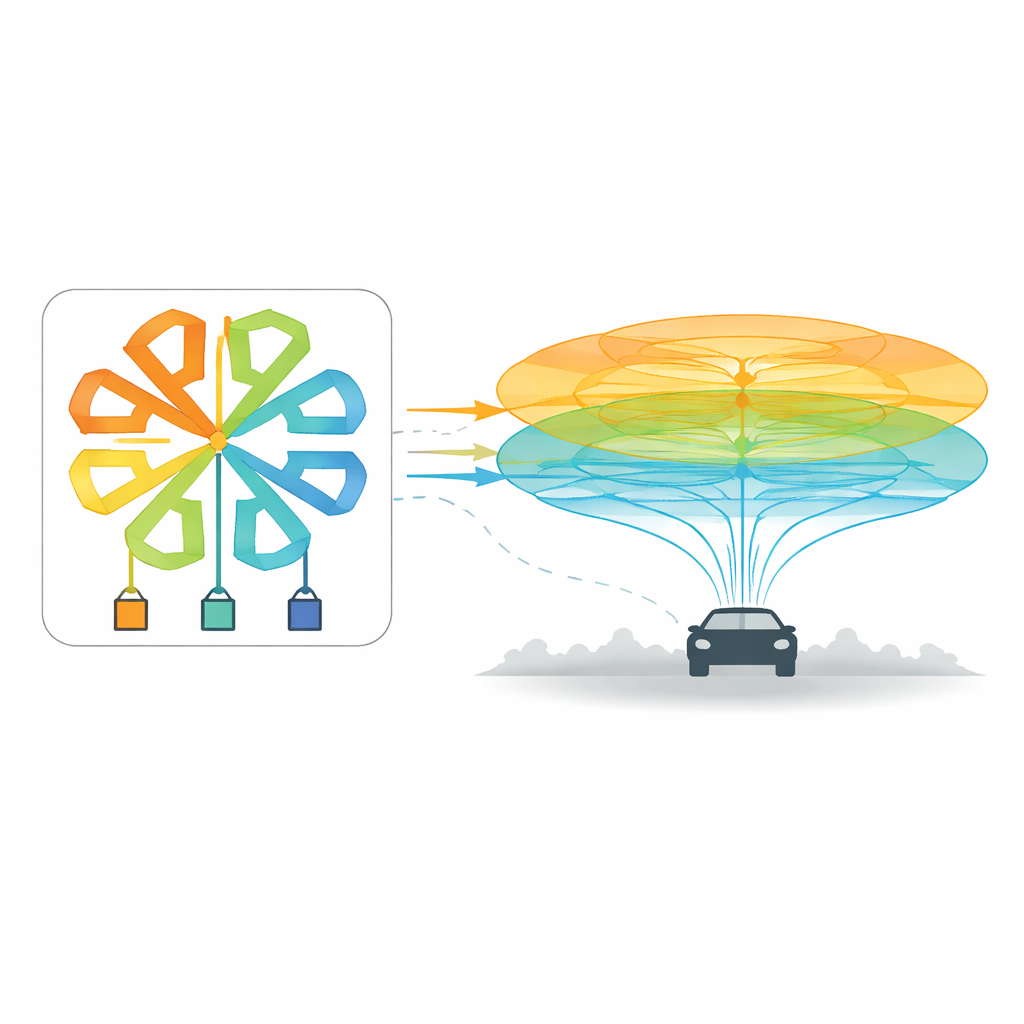
In many multi-antenna systems, nearby elements leak energy into each other, causing unwanted coupling and shrinking the independent data paths that MIMO relies on. Here, the orthogonal layout of the four elements and the tailored ground pattern naturally confine the currents to their intended paths. Measurements show that the elements remain largely isolated, with very little power flowing from one port into another. The antenna covers roughly 680 megahertz around 3.5 gigahertz and 670 megahertz around 5.9 gigahertz—wide enough for modern 5G and V2X standards—while maintaining more than 83 percent efficiency and modest gain increases that help signals reach further without sacrificing the smooth, almost circular coverage needed around a moving car.
Proving performance in real driving conditions
To move beyond lab simulations, the researchers built a prototype and tested it using standard measurement equipment and anechoic chambers that mimic open space. They examined how the four ports share or separate signal paths, how much the overall data capacity is reduced by mutual influence and how stable the patterns remain as frequency changes. Importantly, they also studied the “housing effect” by placing the antenna above large metal plates and on a full 3D model of a car roof. The metal body slightly redirects the radiation, increasing directivity by about 3 decibels, but does not spoil the bandwidth or the all-around coverage. On the vehicle roof, the antenna still radiates nearly uniformly in all directions, meaning nearby cars and roadside units can be reached reliably.
What this means for connected vehicles
In simple terms, this work shows that a thin, single-layer antenna module can handle two crucial 5G-related bands at once, provide four largely independent channels and remain robust when mounted on a real car. By avoiding complicated resonators, cavities and stacked layers, the design stays easier and cheaper to manufacture while still matching or surpassing the performance of more complex alternatives. For everyday drivers, antennas like this could help make future cars better at “seeing” their surroundings through radio waves, supporting safer, quicker and more dependable V2X communication without demanding bulky hardware.
Citation: Arumugam, S., Manoharan, S., Abbas, M.A. et al. Design and characterization of quad port dual band MIMO antenna for 5G V2X connectivity. Sci Rep 16, 14117 (2026). https://doi.org/10.1038/s41598-026-44515-3
Keywords: 5G V2X, vehicular antennas, MIMO, dual-band wireless, connected cars