Clear Sky Science · en
Interactive effects of electrical conductivity and light intensity on growth, yield, and nutrient dynamics of hydroponic lettuce
Why indoor lettuce growers should care
As cities turn to indoor farms and vertical racks to grow fresh lettuce year round, growers face a tricky puzzle: how much fertilizer should go into the water, and how bright should the lights be, to get the biggest harvest without loading leaves with unwanted chemicals. This study looks closely at that puzzle in a real hydroponic setup and shows that “stronger” nutrient solutions can actually work against plant growth, while light has benefits only when salts stay in check. 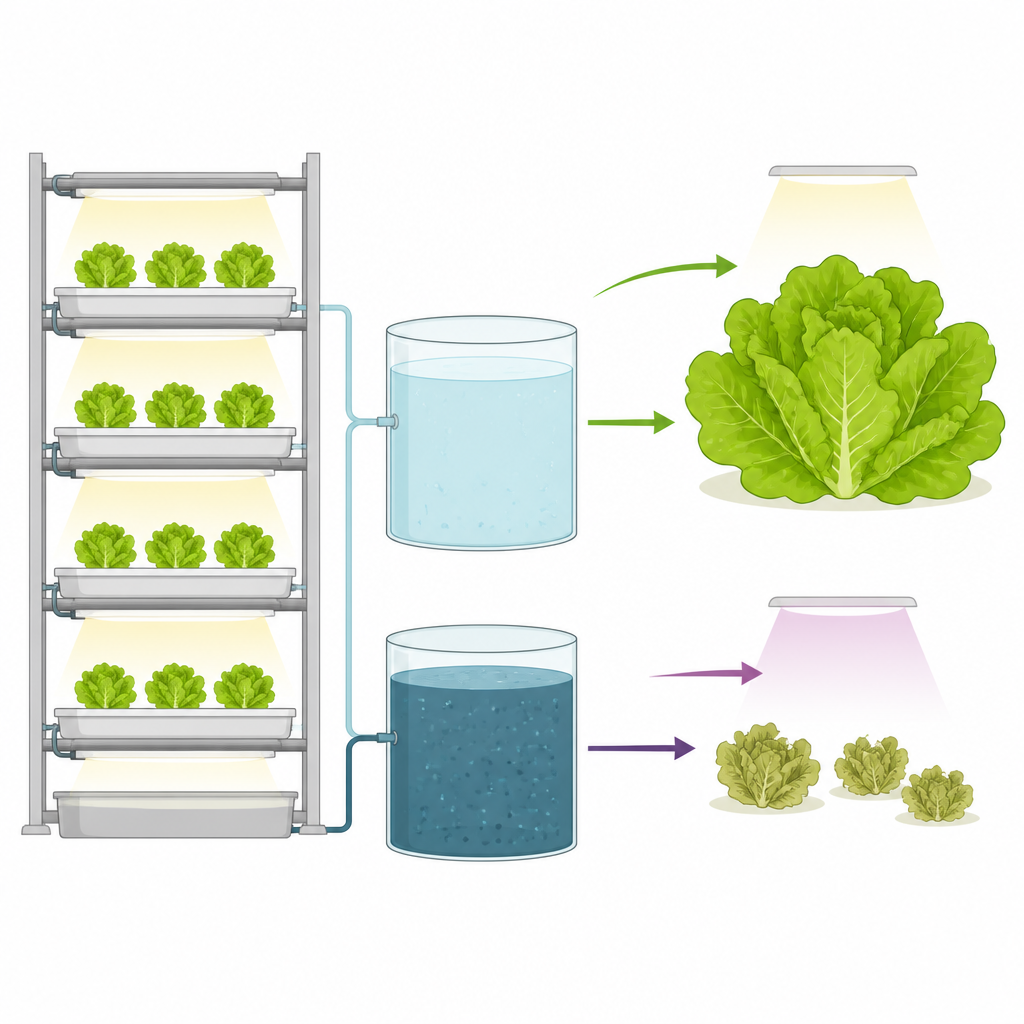
Growing lettuce without soil
The researchers grew butterhead lettuce in a climate controlled chamber using deep water hydroponics, where plant roots float in a recirculating nutrient solution. They compared two levels of overall saltiness in the water, measured as electrical conductivity: a moderate range similar to what many growers already use, and a much higher, stressful range. At the same time, they tested three light levels typical of indoor farms, all supplied by white LED lamps. Over several weeks they carefully recorded plant size, leaf area, root length, fresh and dry weight, and then analyzed the leaves for minerals and nitrate, the form of nitrogen that can accumulate in leafy greens.
When salty water shrinks plants
The results showed that the saltiness of the solution had a much stronger effect on plant growth than light alone. Under the moderate salt level, lettuce formed broad canopies, long roots, and heavy heads. When paired with the brightest light tested, this treatment produced the largest leaf area and nearly four times the fresh weight of plants grown in the high salt solution at the same light level. In contrast, the more concentrated solution stunted both shoots and roots: leaves were fewer and smaller, roots were short, and plants stayed light and compact regardless of how bright the lights were. In other words, high salt conditions cancelled out the growth gains that extra light would normally provide. 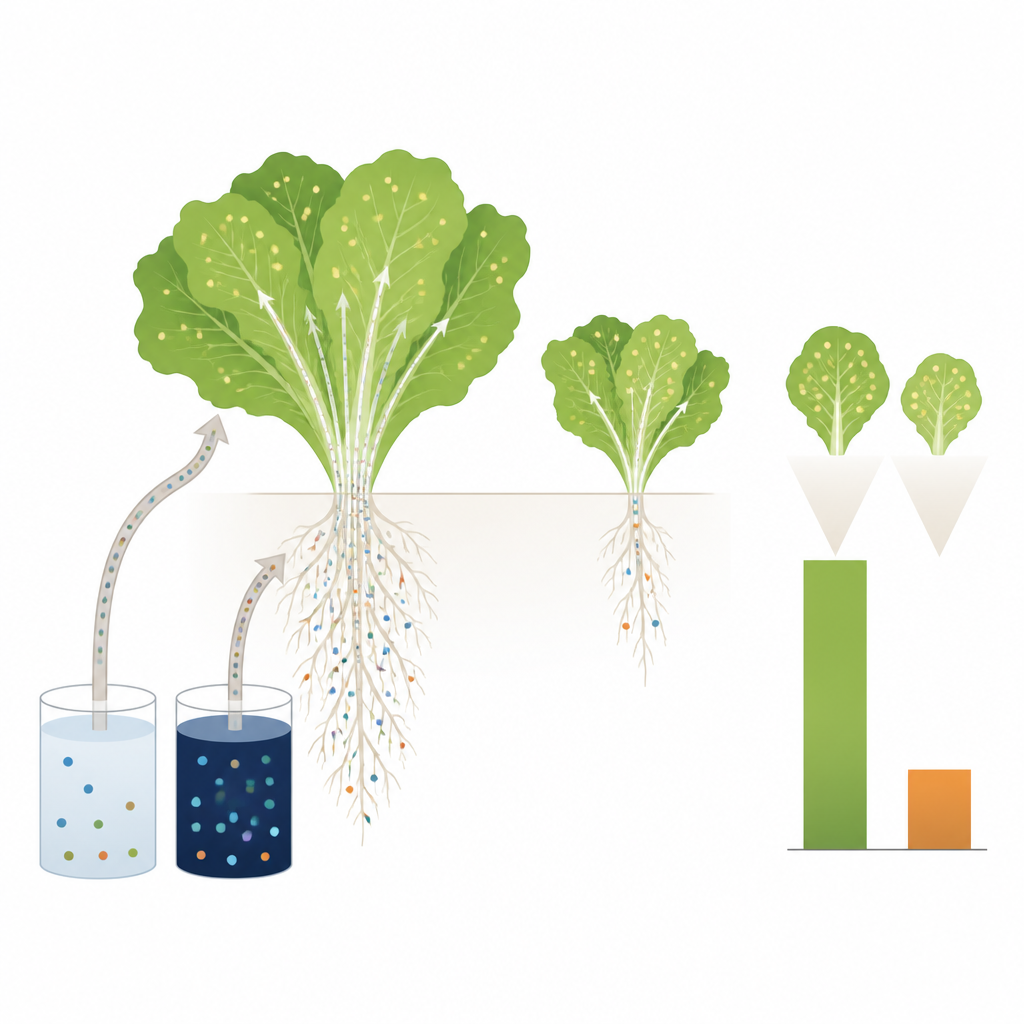
What happens to nutrients inside the plant
Leaf tests revealed that the concentrated solution did not feed the plants better; it actually reduced the uptake of key nutrients. Lettuce grown in the moderate solution contained more nitrogen, phosphorus, potassium, calcium, magnesium, sulfur, iron, and copper than plants in the salty solution. Light level, by itself, barely changed mineral content. The team also tracked nitrate in both the solution and the leaves. As expected, the high salt treatment held more nitrate in the water, but surprisingly, leaf nitrate stayed low across all treatments and did not rise with increasing external supply. A statistical analysis even showed a negative relationship between solution nitrate and leaf nitrate, suggesting that stressed roots and slowed enzymes were holding back uptake and processing when the solution became too salty.
Light helps only when salts are in the comfort zone
Within the moderate salt range, turning up the light clearly paid off. Brighter lighting led to greater fresh and dry weight, larger leaves, and longer roots, as plants could use the extra photons to power photosynthesis and build tissue. However, the energy return per unit of light gradually declined at the highest light level, hinting at a point of diminishing returns. Under the salty treatment, the same increase in light intensity failed to boost yield, and the efficiency with which plants converted light into biomass dropped sharply. This shows that simply adding more light cannot overcome the basic water and ion stress that comes with an overly concentrated nutrient mix.
What this means for indoor farming
For growers running closed loop hydroponic or vertical systems, the message is straightforward: keep the nutrient solution within a moderate electrical conductivity range and pair it with reasonably high light to get the best balance of yield and quality. In this study, an electrical conductivity between about 1.5 and 2.0 dS per meter together with the highest tested light level gave the biggest, healthiest lettuce heads without pushing nitrate in the leaves anywhere near regulatory limits. Increasing the solution strength beyond that point did not improve nutrition or safety; instead it starved plants of water, limited nutrient uptake, and wasted light. Careful monitoring and adjustment of solution strength may therefore offer one of the simplest and most effective levers for making indoor lettuce production both productive and resource efficient.
Citation: Akter, N., Cammarisano, L. & Ahamed, M.S. Interactive effects of electrical conductivity and light intensity on growth, yield, and nutrient dynamics of hydroponic lettuce. Sci Rep 16, 14803 (2026). https://doi.org/10.1038/s41598-026-44508-2
Keywords: hydroponic lettuce, electrical conductivity, light intensity, vertical farming, nitrate accumulation