Clear Sky Science · en
Enhanced Red-billed Blue Magpie Optimizer for engineering optimization problems
Smarter Search for Better Designs
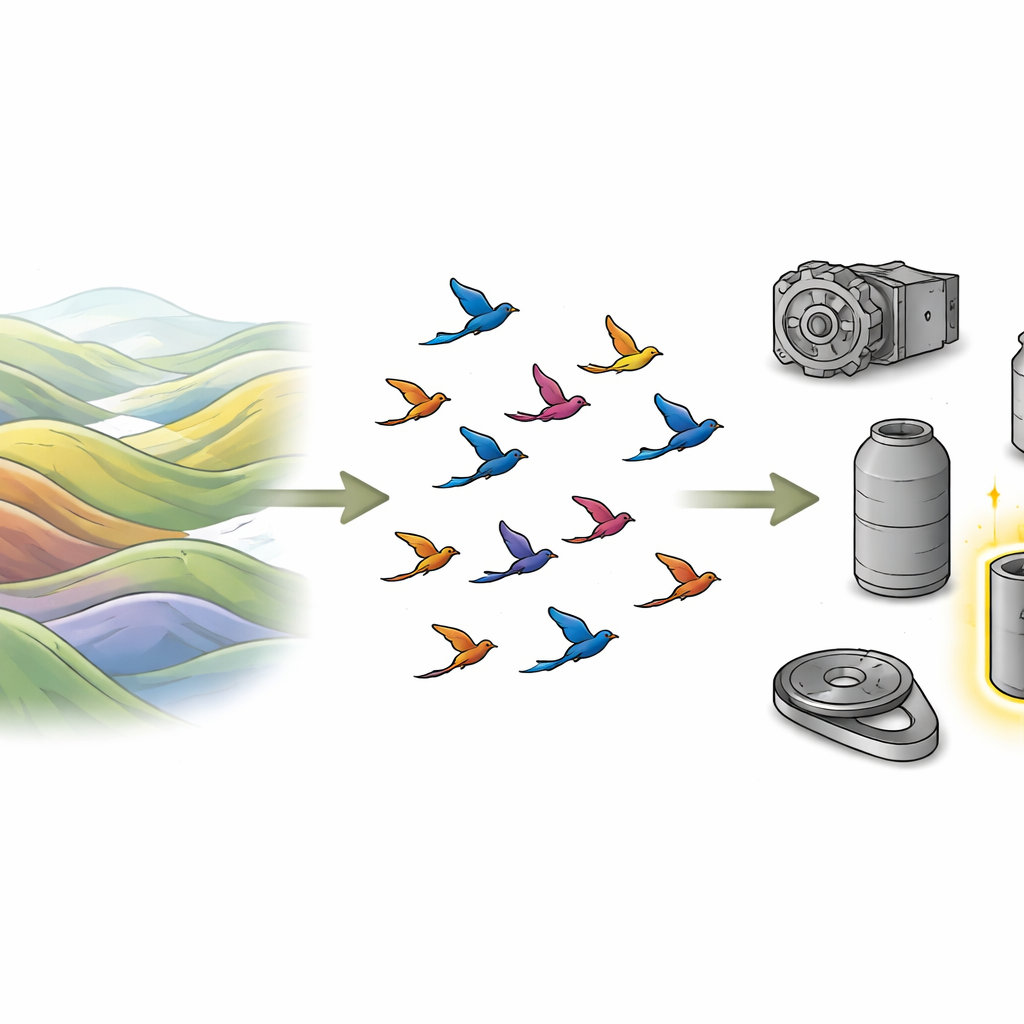
Whenever engineers design a gear box, a pressure vessel, or a bearing, they face a puzzle: among countless possible shapes and sizes, which one works best, is safe, and costs the least? Traditional math tools often get lost in this maze of possibilities. This paper introduces a new computer-driven search method, inspired by the behavior of birds, that can navigate these tangled design landscapes more reliably and find high‑quality solutions for tough engineering problems.
How Virtual Birds Explore Design Space
The method is called the Enhanced Red-billed Blue Magpie Optimizer (ERBMO). It belongs to a family of techniques known as metaheuristic algorithms, which mimic natural processes such as evolution or animal swarms to search for good answers without needing detailed formulas for every twist and turn of a problem. ERBMO is based on the foraging habits of red-billed blue magpies, social birds that explore in groups, close in on food, and store what they find. In the algorithm, many "agents" play the role of birds. Each agent represents one candidate design in a high‑dimensional space; together they wander, cooperate, and gradually move toward better solutions, trying to avoid getting stuck in merely "good enough" spots.
Keeping the Flock Curious and Focused
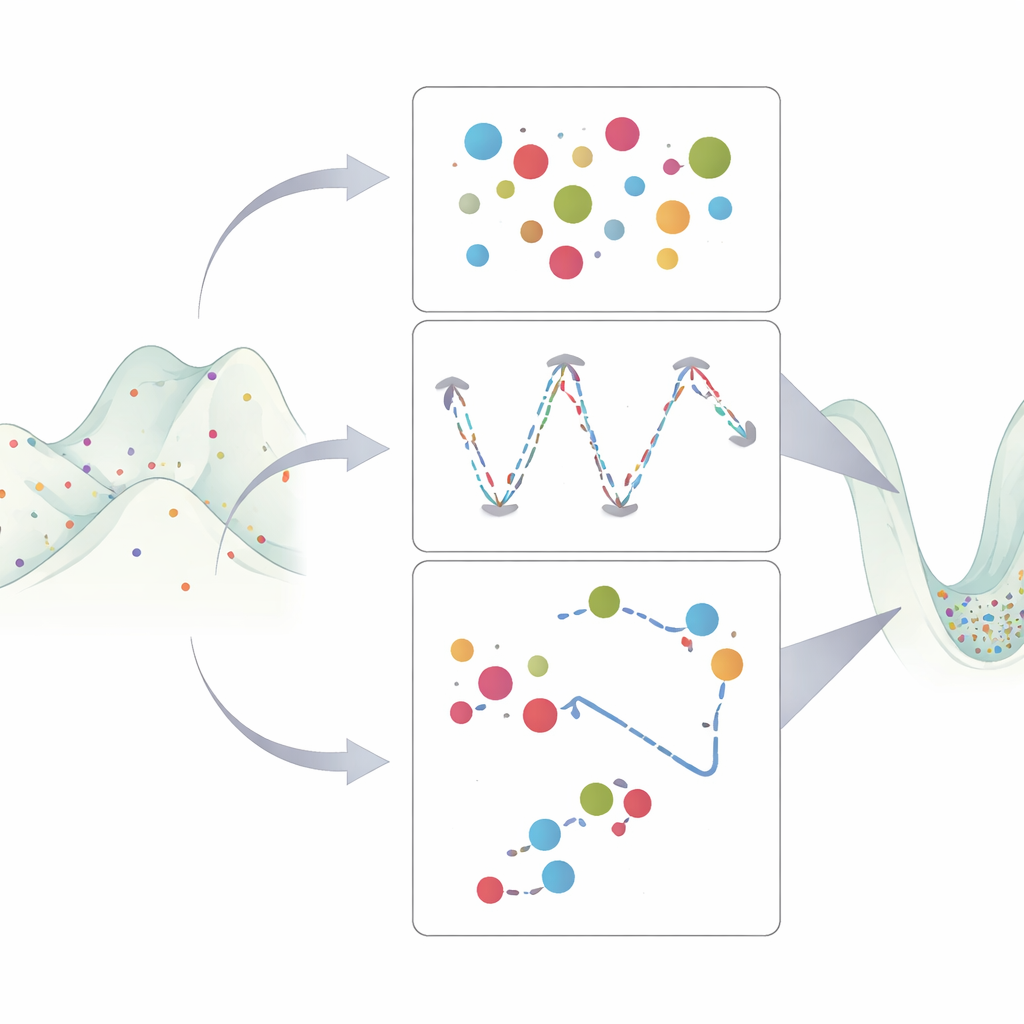
The authors identify a key difficulty for such bird‑inspired searches: balancing curiosity (exploration of new areas) with focus (exploitation of promising regions). ERBMO tackles this with three coordinated strategies. First, a diversity‑adaptive weighting scheme constantly adjusts how boldly the virtual birds move, based on how different their current designs are and how quickly the best design is improving. If progress slows or the flock spreads widely, the algorithm encourages broader searching; if the birds are already homing in on something good, it sharpens their focus. Second, a periodic pattern search kicks in every so often, temporarily changing how the agents probe the design space. This targeted probing helps them refine promising regions more thoroughly and escape from deceptive local traps.
Mixing Small Tweaks with Big Leaps
The third strategy adds a layer of controlled randomness. ERBMO uses a probabilistic mutation step that sometimes nudges designs slightly and sometimes throws them far across the search space. Small "Gaussian" tweaks let the algorithm fine‑tune a design already close to optimal, while larger uniform jumps allow it to leap out of dead ends and discover entirely new regions. The chance of triggering these mutations changes over time, gradually shifting from broad experimentation toward careful polishing. Together, these three ideas help the virtual magpies keep a healthy mix of diversity and convergence throughout the run.
Putting the Algorithm to the Test
To see whether ERBMO’s smarter flocking really pays off, the authors tested it on demanding benchmark collections widely used in the optimization community. These synthetic problems include smooth valleys, rugged landscapes with many false peaks, and stitched‑together hybrid terrains. Across many problem sizes, ERBMO consistently ranked first among a dozen or more modern algorithms, including its own predecessor and several well‑known methods such as particle swarm optimization, differential evolution, and covariance‑matrix evolution strategies. The new method was especially strong in higher‑dimensional cases, where the search space becomes extremely large and many competing methods falter.
Real Engineering Designs in the Crosshairs
The study then moved beyond test functions to real engineering tasks. ERBMO was asked to minimize the weight of a speed reducer, cut the cost of a pressure vessel, slim down a step‑cone pulley, and reduce power loss in a hydrostatic thrust bearing, all under strict safety and performance constraints. In each case, the new optimizer either matched or beat the best known designs, and it did so reliably over repeated runs. Although ERBMO requires somewhat more computing time than some simpler rivals, the authors argue that its gains in accuracy and robustness make this a worthwhile trade‑off for high‑stakes applications.
What This Means for Future Designs
In everyday terms, this work shows how a carefully engineered “swarm of virtual birds” can help engineers sift through vast numbers of design options and land on better, safer, and more efficient solutions. By automatically adjusting how it explores and refines possibilities, ERBMO avoids common pitfalls that trap simpler methods. As these kinds of intelligent search tools continue to mature, they promise to speed up product development and improve performance in fields ranging from energy systems to transportation and manufacturing.
Citation: Wang, H., Xin, Z., Qi, X. et al. Enhanced Red-billed Blue Magpie Optimizer for engineering optimization problems. Sci Rep 16, 10619 (2026). https://doi.org/10.1038/s41598-026-44507-3
Keywords: metaheuristic optimization, swarm intelligence, engineering design, global search algorithms, computational optimization