Clear Sky Science · en
Optimized production and characterization of ulvan from Ulva Lactuca with in vitro biological activities
Sea Lettuce as a Quiet Health Ally
Seaweed may seem like little more than slippery greenery on the shoreline, but some species quietly manufacture complex sugars with surprising effects on human health. This study focuses on ulvan, a natural sugar-rich compound from the common green seaweed Ulva lactuca, also called sea lettuce. The researchers set out to produce ulvan efficiently, understand its structure, and test how well it can slow cancer cells, mop up harmful molecules, and interfere with viruses in the lab. Their findings suggest that this humble marine plant could help inspire future treatments or supplements—especially against pancreatic cancer and oxidative stress.
From Beach Harvest to Careful Extraction
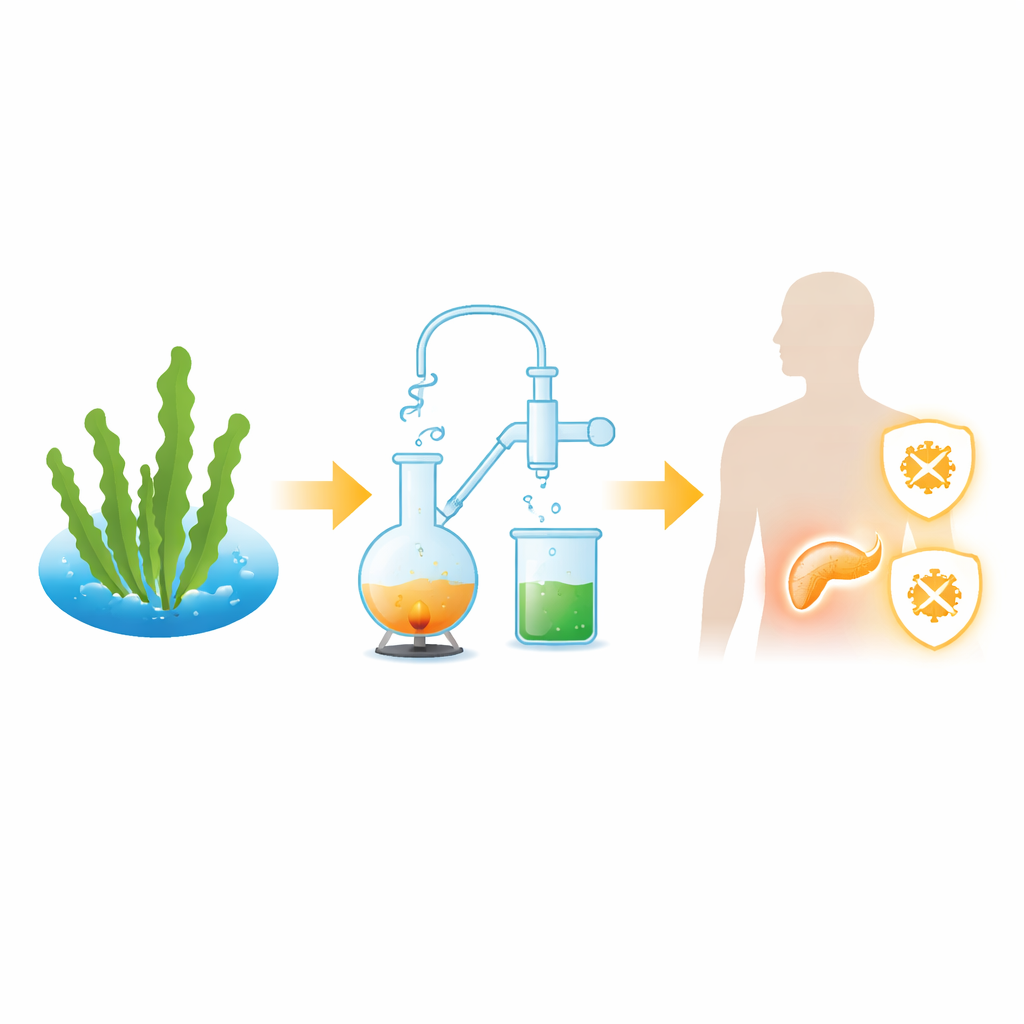
The team collected Ulva lactuca from the Gulf of Suez in Egypt, cleaned and dried it, and then ground it into a fine powder. They used a straightforward hot-water process, fine-tuning temperature, acidity, extraction time, and the ratio of seaweed to water to squeeze out as much ulvan as possible. By systematically changing one factor at a time, they discovered that 120 °C for 50 minutes at a mildly acidic pH, with a moderate seaweed-to-water ratio, gave the best results. Under these conditions, they recovered nearly a quarter of the seaweed’s dry weight as ulvan—about twice the yield of several earlier methods—while still relying on relatively simple, scalable equipment.
Peeking Inside the Seaweed Sugar
To find out what they had actually made, the scientists subjected the ulvan to a suite of analytical tests more familiar to materials science than to beachcombing. They measured its basic ingredients, showing that it was rich in sugar and sulfate groups, with rhamnose as the main building-block sugar. They examined its chemical bonds with infrared light, its internal order with X-ray diffraction, and its behavior when heated to high temperatures. These tests revealed that the ulvan has a semi-crystalline structure and remains stable up to very high temperatures before it begins to break down, properties that matter if it is to be used in medical materials or processed foods. Electron microscopy showed a rough, granular surface, while elemental analysis confirmed substantial sulfur, which is thought to play a key role in its biological effects.
Testing Cancer, Antioxidant, and Virus Effects
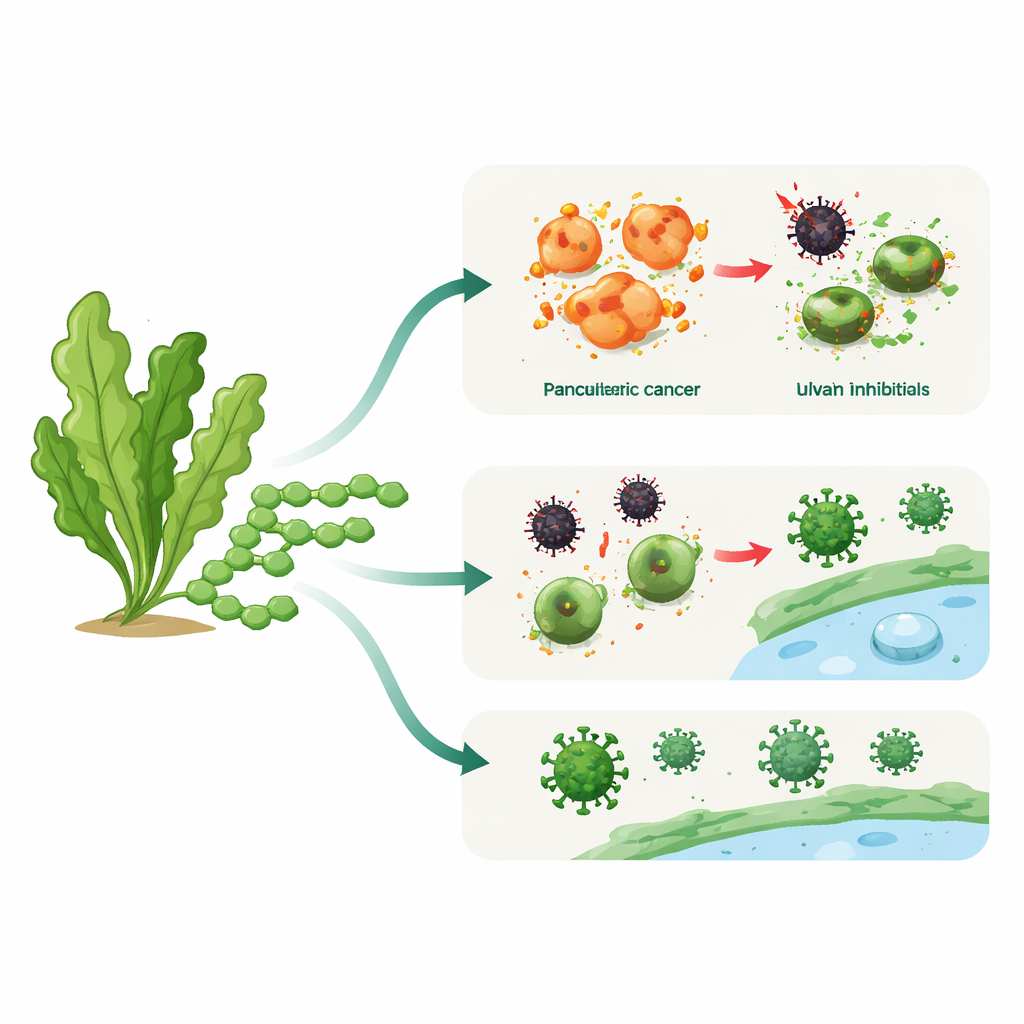
With its composition mapped out, the ulvan—referred to as ULU in the study—was tested against living cells in the lab. In pancreatic cancer cells, increasing doses of ULU sharply reduced cell growth, with high doses halting more than four-fifths of cell proliferation. At the same time, normal cells tolerated considerably higher levels before showing signs of damage, hinting at a useful safety window. When the team exposed a common laboratory free radical to ULU, the compound showed moderate antioxidant power: it could neutralize a large share of these damaging molecules, although not as strongly as pure vitamin C. Finally, ULU was tested against the Hepatitis A virus in cell culture. It showed only modest success at limiting viral activity, with a moderate margin between helpful and harmful doses, suggesting that its antiviral potential is real but not yet impressive on its own.
How Ulvan’s Structure Links to Its Power
An important thread running through the study is the connection between how ulvan is extracted, what its structure looks like, and how it behaves biologically. The optimized hot-water method not only boosted the amount of ulvan recovered but also produced material with a relatively high level of sulfate groups and sugars, both of which are believed to strengthen anticancer and antioxidant actions. Comparing their results to previous work, the authors note that more complex extraction technologies can sometimes yield more material, but they risk damaging sensitive structures or raising costs. Their simplified process instead balances practicality, purity, and performance, making it more suitable for future large-scale production.
What This Means for Future Treatments
Put in everyday terms, this study shows that a common green seaweed can be turned into a concentrated, well-characterized natural product that slows the growth of pancreatic cancer cells in the lab, offers solid antioxidant protection, and shows a hint of antiviral activity. The work does not mean that sea lettuce is a ready-made cure, but it demonstrates that careful extraction and testing can turn a familiar marine plant into a promising source of bioactive ingredients. With further research—especially exploring combinations with other drugs or natural compounds—ulvan from Ulva lactuca could one day contribute to gentler cancer therapies, protective antioxidant supplements, or improved antiviral strategies.
Citation: Abu-Resha, A.M., El-Sheekh, M.M., Abou-El-Souod, G.W. et al. Optimized production and characterization of ulvan from Ulva Lactuca with in vitro biological activities. Sci Rep 16, 11374 (2026). https://doi.org/10.1038/s41598-026-44503-7
Keywords: ulvan, Ulva lactuca, seaweed polysaccharides, pancreatic cancer, antioxidant activity