Clear Sky Science · en
Zeptosecond electron pulse train via multiphoton inelastic Cherenkov diffraction
Why blink-of-an-eye time is not fast enough
Modern technology already lets us watch atoms move using flashes of light that last just billionths of a billionth of a second, called attoseconds. But many events inside matter happen even faster. This paper explores how to create and control electron pulses that last only zeptoseconds—thousand times shorter than attoseconds—opening a path to watch and steer some of the fastest processes in nature.

Turning a glow of electrons into a strobe light
Instead of dealing with light pulses alone, the authors focus on the “matter waves” of electrons. Just as light can come in short bursts, electrons also behave like waves that can be shaped in time. Today’s techniques can already carve an electron beam into a train of attosecond flashes, but pushing into the zeptosecond range has proved very difficult. The challenge is to imprint a very fine, very regular pattern on the electron wave without destroying it or requiring huge accelerator facilities.
Riding the blue shock wave of light
The key ingredient is the Cherenkov effect, better known from the eerie blue glow in nuclear reactors. Cherenkov light appears when a charged particle moves through a material faster than light can travel in that material. Here, a laser pulse is slowed down slightly by passing through a gas, while electrons race through at relativistic speeds. When the electron speed and the slowed light wave match in just the right way, the traveling light wave looks to the electrons like a stationary “phase lattice” – a regular pattern of peaks and valleys they pass through.
Many tiny kicks that add up
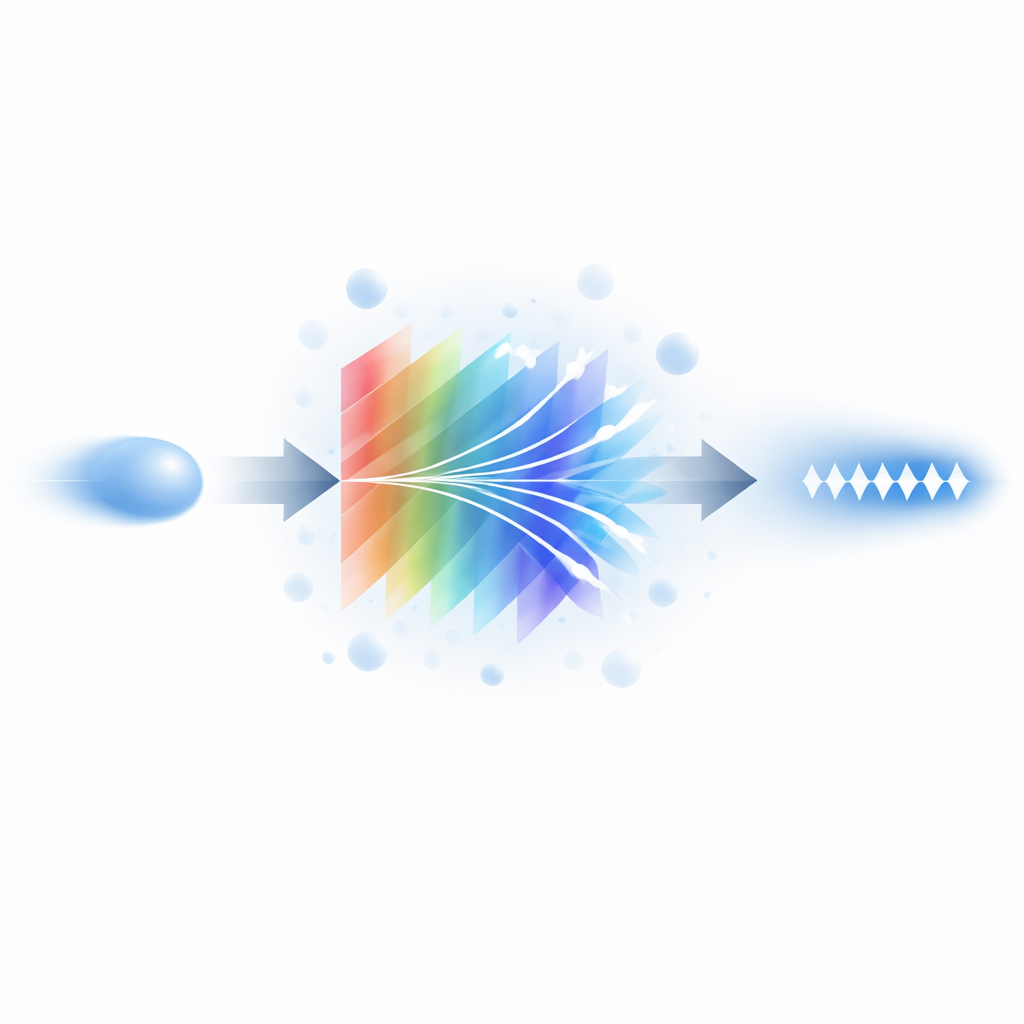
As an electron wave packet crosses this light lattice, it can absorb and emit many laser photons in quick succession. Each exchange gives the electron a tiny “kick” in momentum. Using a detailed quantum theory and direct simulations of the Dirac equation, the authors show that under the right conditions the electron can coherently exchange on the order of ten thousand photons. Rather than smearing the electron out, these ordered kicks carve its wave into many distinct pieces, each corresponding to a different number of exchanged photons. In momentum space this looks like a comb of sharp peaks, symmetrically spread around the original energy.
Letting the pattern sharpen itself
After the interaction with the laser, the electron pieces drift freely in space. Because they were created in a highly regular way, their phases line up again at specific times and places. The calculations show that this self-organized interference compresses the electron density into a train of extremely short pulses, each lasting on the zeptosecond scale and separated in space roughly by the laser wavelength. The effect is quite robust against how long the laser pulse itself lasts, but it is sensitive to how sharply tuned the electron beam is: if the spread in electron momenta becomes too large, the pulses broaden and eventually wash out.
Building a tabletop zeptosecond electron source
The study also examines more realistic laser pulses of finite length and includes subtle effects such as quantum recoil and possible spin flips. Even then, the basic mechanism survives: with around ten to twenty cycles in the laser pulse and electron energies of a few tens of mega–electron-volts, the resulting pulse trains still reach the zeptosecond range. Because the scheme uses a gas target and a focused laser rather than nanostructured materials, it can in principle be realized with compact, tabletop accelerators known as microtrons.
What this means for future microscopes
In simple terms, the authors show how to turn a smooth, fast-moving electron beam into an ultra-fine time ruler made of zeptosecond spikes. Such structured beams could revolutionize ultrafast electron microscopy and spectroscopy, allowing scientists to probe how charges rearrange, how fields fluctuate, and how quantum states evolve on unprecedented timescales. If realized in the lab, this Cherenkov-based approach would extend the reach of ultrafast science from light waves to matter waves, letting us watch and ultimately control some of the quickest processes in the quantum world.
Citation: Avetissian, H.K., Mkrtchian, G.F. Zeptosecond electron pulse train via multiphoton inelastic Cherenkov diffraction. Sci Rep 16, 13939 (2026). https://doi.org/10.1038/s41598-026-44500-w
Keywords: zeptosecond electron pulses, Cherenkov diffraction, ultrafast electron microscopy, multiphoton interactions, attosecond and zeptosecond science