Clear Sky Science · en
Calcium-enriched mesoporous silica/PLGA scaffolds enhance bone repair in a rabbit femoral condylar defect model
Why fixing broken bone gaps is so hard
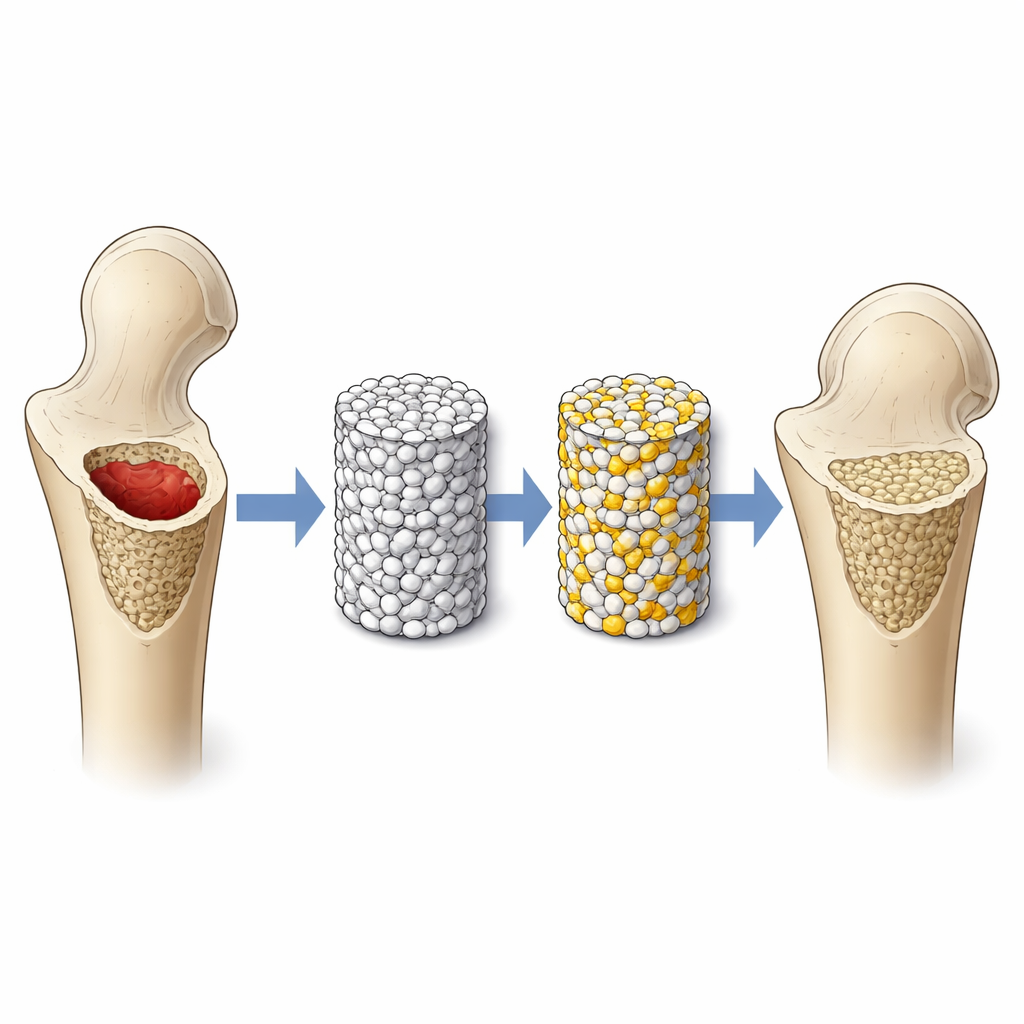
When a bone is badly damaged by an accident, tumor, or infection, the body cannot always bridge the gap on its own. Surgeons often have to fill these defects with grafts taken from the patient or from donors, but these options come with pain, limited supply, and risks of rejection or disease. This study explores a new kind of tiny, sponge-like implant that aims to help bones regrow faster and more safely, using a clever mix of plastics, glass-like minerals, and calcium powder.
Building a better bone-friendly scaffold
The researchers focused on three ingredients. The first is a medical-grade biodegradable plastic called PLGA, already used in dissolving stitches and drug-delivery devices. On its own, PLGA does not interact with bone cells very well and can create an overly acidic environment as it breaks down. To improve this, the team added mesoporous silica, a glassy material full of nano-sized pores that increases surface area and can hold water, proteins, and signaling molecules. Finally, they mixed in calcium carbonate, a familiar mineral found in shells and coral, which can gently neutralize acidity and release calcium ions that bone cells use as growth signals.
Using a single-emulsion process, the team formed microscopic spheres containing these ingredients, then lightly melted them together to form solid but porous cylinders, known as scaffolds. They made two versions: one with silica and PLGA only, and one enriched with calcium carbonate. Under the electron microscope, both looked like interconnected beads with open spaces between them, resembling the porous structure of natural spongy bone. Chemical analysis confirmed that the calcium-enriched version carried the expected calcium component.
Testing how cells respond in the lab
To see how living cells would behave on these materials, the scientists seeded the scaffolds with mesenchymal stem cells, a type of cell that can turn into bone-forming cells. They measured how many cells grew over a week and how strongly the cells switched on early bone-building activity. The calcium-enriched scaffold adsorbed more protein from its surroundings, giving cells more spots to latch onto. Stem cells grew more quickly on this material and showed higher activity of alkaline phosphatase, an enzyme closely tied to early bone formation. Importantly, the scaffold kept high porosity while having greater density, meaning it offered both open channels for nutrients and sturdier mechanical support.
Healing real bone defects in rabbits
Promising lab results are only a first step, so the team moved to an animal model. They created a standardized cylindrical defect in the femoral condyle, a weight-bearing region near the rabbit knee. Some defects were left empty, some were filled with the silica–PLGA scaffold, and others with the calcium-enriched version. After 4 and 8 weeks, they examined bone regrowth using high-resolution micro-CT scans and a series of tissue stains that highlight new bone, collagen fibers, and the overall architecture of the healing area. The calcium-enriched scaffolds produced the most new bone volume, with dense, well-organized trabecular (spongy) bone that blended into the surrounding tissue. The simpler scaffold did better than leaving the defect empty, but clearly lagged behind the calcium-containing design.
Safety and what makes the scaffold work
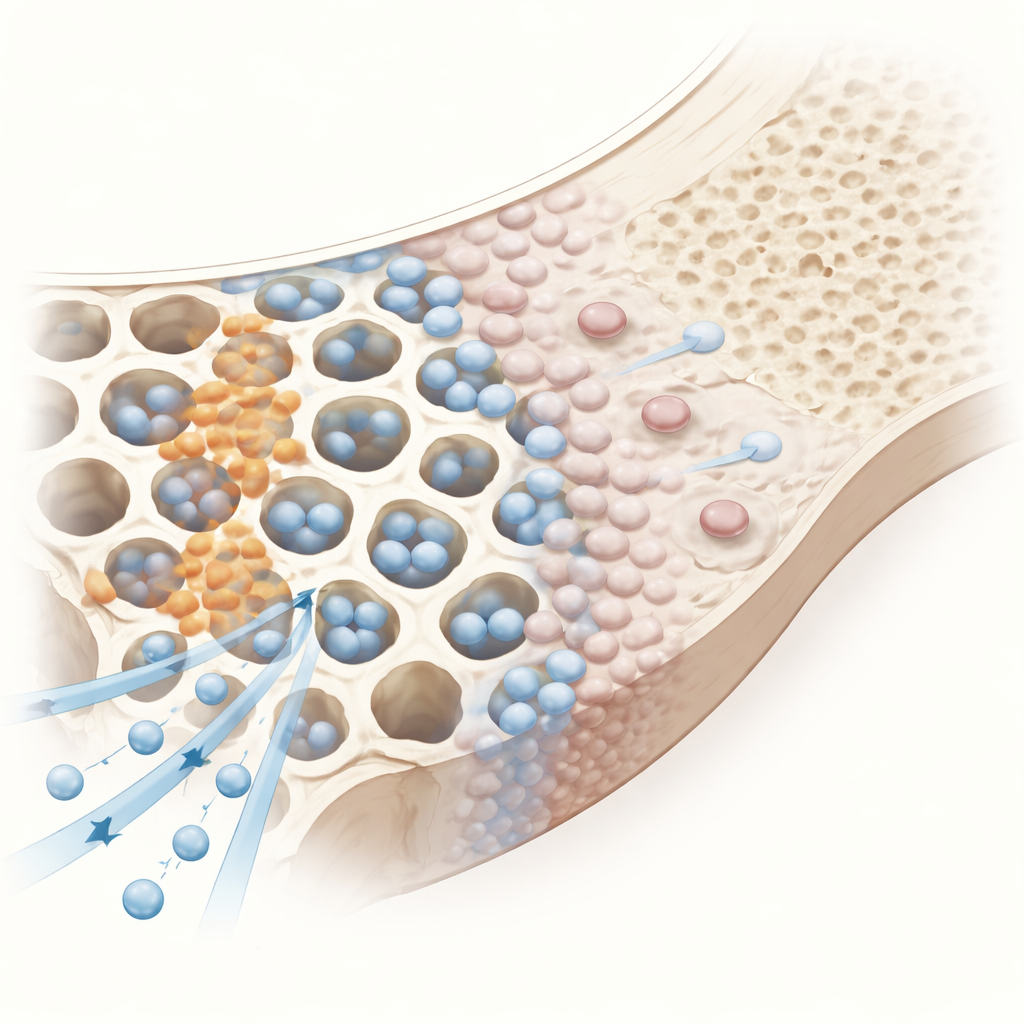
Because any implanted material must be safe for the whole body, the researchers also checked blood counts and liver and kidney function. They saw no meaningful differences between groups, and microscopic examination of these organs revealed no signs of inflammation or damage, suggesting that the materials and their breakdown products were well tolerated. The authors argue that the success of the calcium-enriched scaffold comes from several combined effects: the porous, bone-like structure that lets cells and blood vessels grow in; the buffering action of calcium carbonate, which prevents harmful acid build-up as PLGA degrades; and the slow release of calcium and silicon ions, which act as local signals nudging stem cells toward bone formation and supporting the buildup and mineralization of new matrix.
What this could mean for future patients
In simple terms, this study shows that a carefully engineered, dissolving “bone sponge” made from plastic, silica, and calcium can help rabbits repair sizable bone defects more completely than a similar scaffold without calcium, and do so without obvious side effects. While longer studies and tests in larger animals are still needed, the work points toward a new class of artificial bone grafts that do more than just fill a gap: they actively guide the body through the early stages of healing, then quietly disappear as strong, living bone takes their place.
Citation: Wu, H., Wu, J., Tang, H. et al. Calcium-enriched mesoporous silica/PLGA scaffolds enhance bone repair in a rabbit femoral condylar defect model. Sci Rep 16, 13924 (2026). https://doi.org/10.1038/s41598-026-44490-9
Keywords: bone regeneration, biodegradable scaffold, calcium-enriched biomaterial, bone defect repair, tissue engineering