Clear Sky Science · en
Evaluation of water-economy-ecology system development level and coupling coordination degree: a case study of China’s central plains urban agglomeration
Why balancing water, cities, and nature matters
In many fast-growing regions, rivers, booming economies, and fragile ecosystems are tightly intertwined. China’s Central Plains Urban Agglomeration—home to more than 160 million people—faces serious pressure on limited and unevenly distributed water resources while trying to grow its cities and protect its environment. This study asks a simple but vital question: are water use, economic development, and ecological health moving in step, or pulling against one another? The answer helps local and national leaders understand whether current development paths are sustainable. 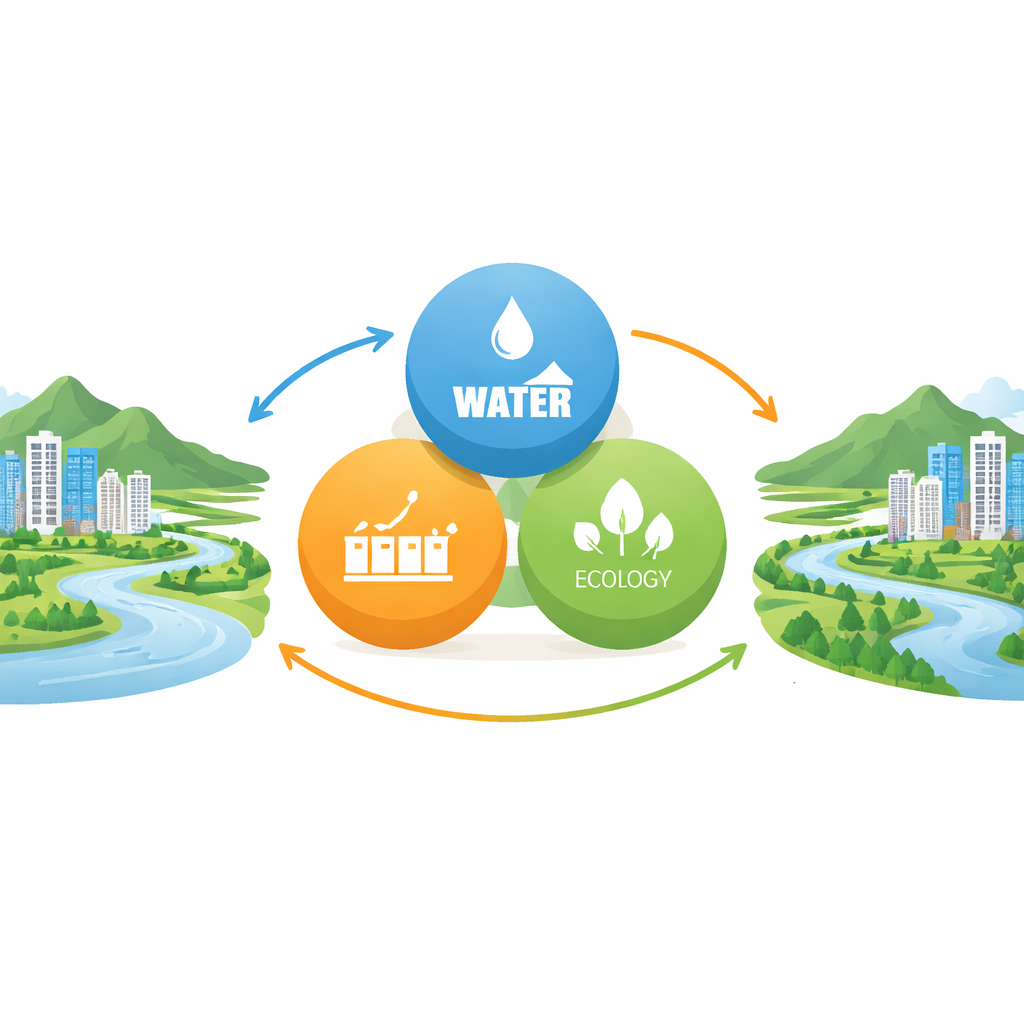
A three-part system that must move together
The authors treat the region as a single, connected system made of three parts: water (rivers, groundwater, and how they are used), economy (population and industry), and ecology (green space, pollution control, and waste treatment). Instead of looking at each part in isolation, they measure how well these three subsystems develop together. They call this the “coupling coordination degree,” which captures both how strongly the subsystems influence one another and how balanced their progress is. A high score means growth in cities and industry is being supported by available water and does not come at the cost of environmental decline.
How the team measured balance over time and space
To track this balance, the researchers built an index system with 25 specific indicators, such as per-person water resources, water use per unit of economic output, greening coverage in built-up urban areas, sewage treatment rates, and investment in water projects. They combined expert judgment with a sensitivity analysis method to decide how important each indicator should be in the overall score. A cloud-based statistical approach was then used to turn raw data from government yearbooks and water bulletins (covering 2011–2020) into a single development index for each subsystem and for the combined water–economy–ecology system. Finally, a coordination model calculated how tightly linked and how harmonious these subsystems were across 30 cities and several functional zones within the region.
What is improving and where the gaps remain
The results show a generally encouraging story. From 2011 to 2020, the combined index for water, economy, and ecology rose in almost all cities, indicating overall progress. Ecological conditions improved the most, followed by the economy, while water conditions rose more slowly and remained a constraint in some places. The coordination score also increased, meaning that on the whole, cities are becoming better at aligning economic growth with ecological protection and water realities. Core cities and central areas tended to perform better than outlying zones, and places like Zhengzhou, Jiyuan, and Huaibei emerged as leaders, either because of strong economies, relatively abundant water, or effective environmental management. Yet some cities with poor water endowment and weaker economies still lag behind, showing that progress is uneven. 
Patterns of clustering and regional influence
Looking at maps over time, the authors found that neighboring cities’ coordination scores increasingly influenced one another. Although the overall pattern remains mixed—many low-performing cities still cluster together—the strength of connections between cities has grown, especially around Zhengzhou, which acts as a gravitational center for the whole urban group. The “center of gravity” of coordination shifted only a short distance over the decade and stayed within Zhengzhou’s area, suggesting that the regional pattern is becoming more stable. At the same time, areas taking on new industries and improving environmental facilities have seen visible gains, while some water-poor or rapidly expanding areas still struggle to keep ecology and economy in balance.
What this means for future regional development
For non-specialists, the key takeaway is that it is possible to grow large city clusters in a way that does not exhaust water resources or wreck local ecosystems—but it requires careful measurement and planning. This study shows that the Central Plains region has been moving toward a more coordinated path, with greener cities, more efficient water use, and stronger ties among neighboring urban areas. However, the authors also highlight that progress is fragile: drought years can quickly expose weaknesses, and lagging cities need tailored support. Their framework offers a practical tool for governments to spot where water, economy, and ecology are out of step and to adjust policies before problems become crises.
Citation: Yang, H., Shi, J., Lü, C. et al. Evaluation of water-economy-ecology system development level and coupling coordination degree: a case study of China’s central plains urban agglomeration. Sci Rep 16, 14317 (2026). https://doi.org/10.1038/s41598-026-44489-2
Keywords: urban water management, sustainable city clusters, regional development, eco-economic balance, China Central Plains