Clear Sky Science · en
Multi-model forecasting of $$\text {NO}_{2}$$ and $$\text {O}_{3}$$ in Abu Dhabi: benefits of correlation-based feature augmentation
Why cleaner air forecasts matter
People living in growing cities like Abu Dhabi breathe air that is constantly shaped by traffic, industry, and weather. Two invisible gases, nitrogen dioxide and ground-level ozone, play a big role in smog and respiratory problems. This study asks a practical question with real-world consequences: how accurately can we predict these pollutants hours to days in advance using modern artificial intelligence, and can we do better by teaching the models how these two gases influence each other?
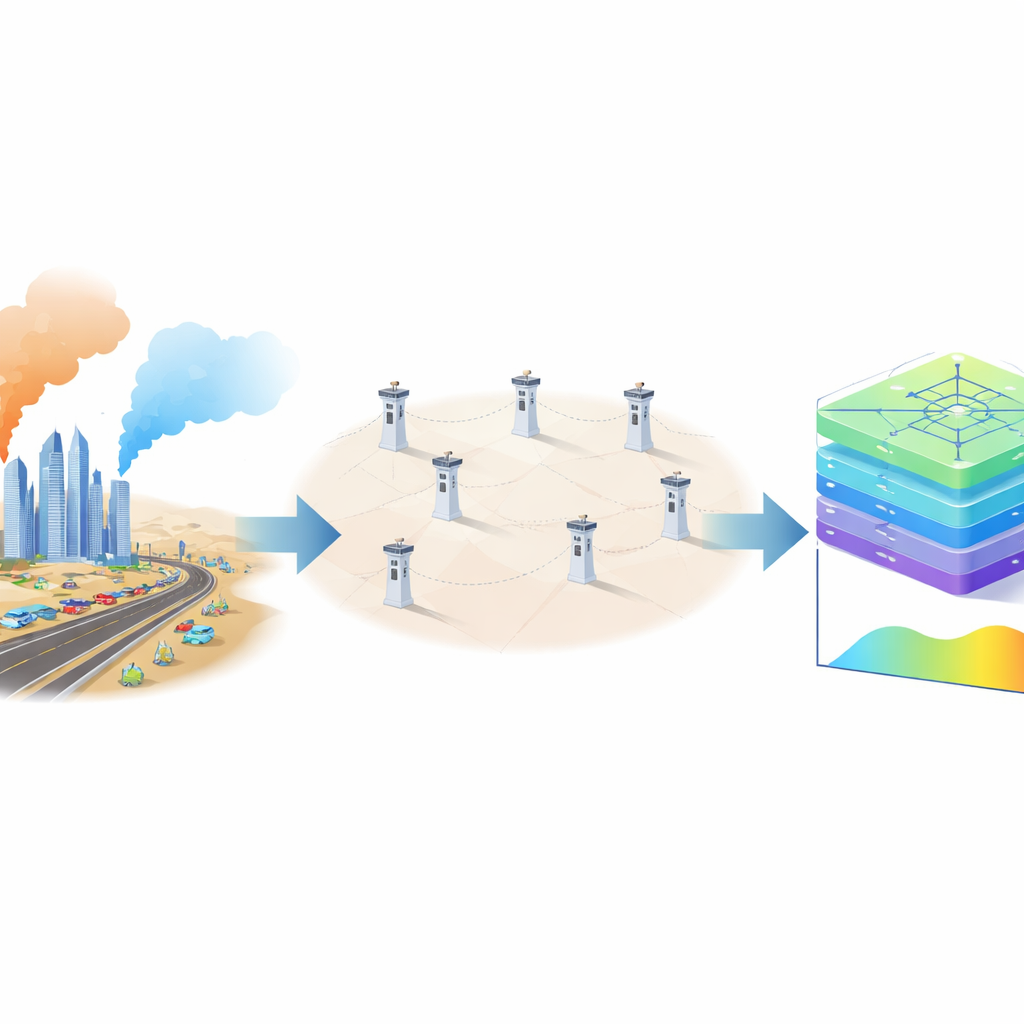
The twin troublemakers in city air
Nitrogen dioxide and ozone are closely linked in the atmosphere. Nitrogen dioxide largely comes from vehicle exhaust and other combustion sources; in sunlight, it helps create ozone, which is a major ingredient of smog. During the day, ozone levels rise while nitrogen dioxide often falls, and at night the pattern can reverse. In Abu Dhabi, rapid urban growth, heavy traffic, and desert conditions that limit natural “air cleaning” make these pollutants a particular concern. Accurately anticipating their swings allows authorities to warn vulnerable people, adjust traffic flows, or plan industrial activity to reduce health risks.
A rich view of Abu Dhabi’s air
The researchers drew on an unusually large and detailed dataset: five years of hourly measurements of nitrogen dioxide and ozone from seven fixed monitoring stations spread across deserts, suburbs, coastal districts, and an industrial zone in the Emirate of Abu Dhabi. This long record, covering 2018 through 2022, avoids the distorted conditions seen during COVID-19 lockdowns that affected earlier studies. The team carefully cleaned the data, filling occasional gaps by averaging values from similar dates and hours in other years, and applied mathematical steps to handle sharp spikes while preserving genuine pollution extremes. They then split the timeline into successive training and testing blocks, mimicking how a real forecasting system would learn from the past and be judged on future, unseen periods.
Putting many forecasting methods to the test
To see which tools work best, the study compared a wide range of approaches. Simpler methods included decision trees, random forests, and support vector machines, which look for patterns in past measurements. More advanced deep learning methods included convolutional neural networks, which excel at spotting local shapes in time series, and LSTM networks, which are designed to remember long-term patterns. The researchers also used Prophet, a model tailored to capture repeating daily and seasonal cycles, and a Transformer model, a newer architecture that uses an “attention” mechanism to weigh how different past moments influence each forecast. All models were asked to predict pollutant levels 1 hour, 2 hours, 1 day, and 1 week ahead, and their errors were scored using several complementary measures.
Learning from how pollutants move together
Because nitrogen dioxide and ozone are chemically entangled, the team explored whether each pollutant’s history could help predict the other. They first measured how tightly the two gases were linked at each station and confirmed a generally strong inverse relationship: when one was high, the other tended to be low. Then they built two versions of every model. In the basic version, the model saw only the past values of the pollutant it aimed to predict. In the enhanced version, it also saw lagged values of the other pollutant, effectively giving it an extra hint about the current state of city air. This allowed the researchers to test whether “feature augmentation” – adding correlated information – produces more accurate forecasts without sneaking in any knowledge from the future.
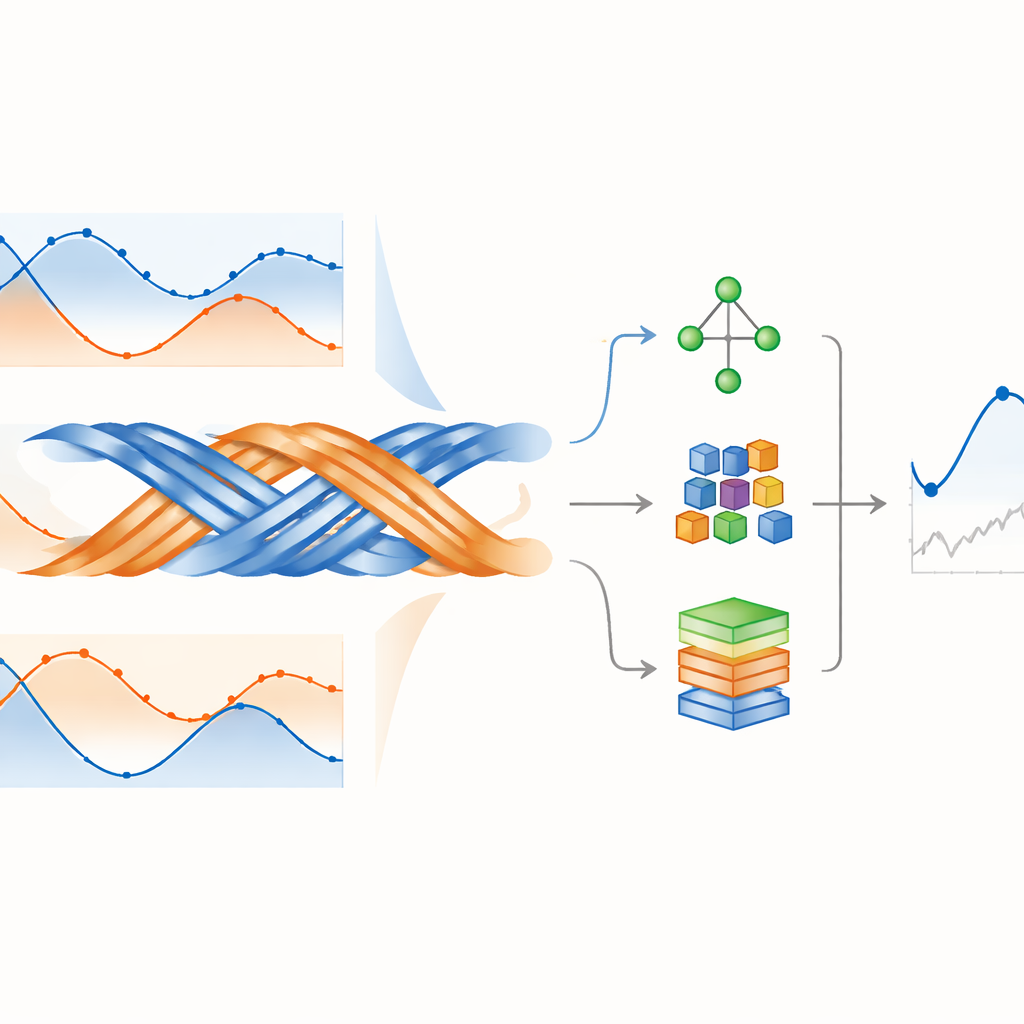
Which models won, and why it matters
Across nearly all stations, pollutants, and lead times, the Transformer model clearly outperformed the others, delivering the lowest average errors and the most stable behavior over time. For nitrogen dioxide, its typical percentage error ranged from about one quarter to one third, and for ozone it did slightly better still. Convolutional networks were close behind for very short-term forecasts, especially within the first couple of hours, while Prophet proved useful at the week-long horizon thanks to its strong handle on recurring patterns. Importantly, giving the models extra information about the partner pollutant consistently shaved down forecast errors, most notably for 1-hour nitrogen dioxide and for ozone predictions up to a full day ahead. In everyday terms, this work shows that advanced attention-based AI, fed with a rich, multi-year record and taught to exploit the chemical “conversation” between key pollutants, can provide more dependable air quality forecasts. Such tools can help city planners and health agencies in Abu Dhabi and similar regions act earlier and more precisely to protect public health, particularly for children, the elderly, and people with lung or heart conditions.
Citation: Abuouelezz, W., Ali, N., Aung, Z. et al. Multi-model forecasting of \(\text {NO}_{2}\) and \(\text {O}_{3}\) in Abu Dhabi: benefits of correlation-based feature augmentation. Sci Rep 16, 13825 (2026). https://doi.org/10.1038/s41598-026-44485-6
Keywords: air pollution forecasting, nitrogen dioxide, ground-level ozone, deep learning models, Abu Dhabi air quality