Clear Sky Science · en
Mantle melting and lithospheric structure beneath eastern Australia’s Cenozoic volcanoes from 3D magnetotellurics
Why volcano chains far from plate edges matter
Eastern Australia is dotted with young volcanoes stretching more than 3,000 kilometers from north to south. Unlike classic volcanic island chains such as Hawaii, these eruptions show almost no orderly march in age along the continent, even though Australia has been drifting over the underlying mantle for tens of millions of years. This puzzling pattern raises a big question: what keeps feeding lava to the same broad region of a moving continent without a clear hotspot trail? The study behind this article uses sensitive measurements of Earth’s electrical properties to peek deep beneath eastern Australia, uncovering how hidden structures in the crust and mantle help control when and where these volcanoes come to life.
Looking inside the continent with natural signals
Instead of drilling deep into the planet, the researchers used a method called magnetotellurics, which listens to how Earth’s surface rocks respond to natural variations in the planet’s magnetic field. Over four decades, scientists deployed more than 800 stations across eastern Australia, recording how easily the subsurface conducts electricity. By inverting these data into a three-dimensional model, the team produced a kind of electrical X-ray of the crust and upper mantle down to about 250 kilometers. Regions that conduct electricity well typically signal hotter rock, the presence of fluids, or certain minerals, while highly resistive zones tend to be cooler and drier. This continent-scale picture allows the authors to compare areas beneath volcanoes with those that have stayed quiet.
Hidden steps and warm roots beneath the volcano belt
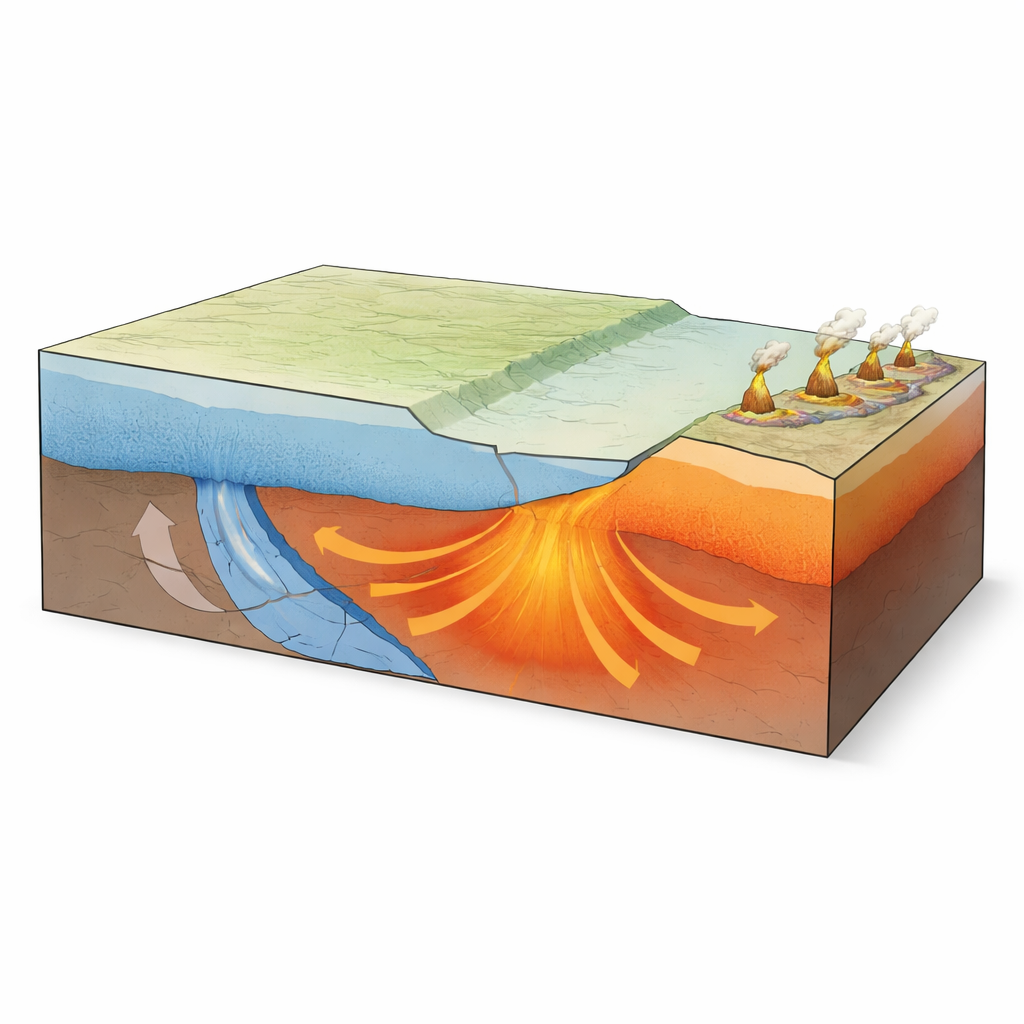
The new electrical map reveals that the mantle just beneath the main belt of Cenozoic volcanoes is unusually conductive below about 125 kilometers depth, with values consistent with very hot but mostly dry rock at roughly 1,400 °C. Inland from the volcanic belt, the lithosphere—the rigid outer shell of the planet—thickens abruptly, forming a step where cooler, thicker mantle meets warmer, thinner mantle to the east. This step matches independent seismic images and marks a sharp boundary in physical properties rather than a smooth transition. The youngest eruptions in the New Volcanic Province, as well as unusual leucite-rich lavas along the Cosgrove Track, cluster near this boundary, hinting that changes in thickness and temperature at depth help concentrate magma generation and its path toward the surface.
A wet lower crust above a dry, hot mantle
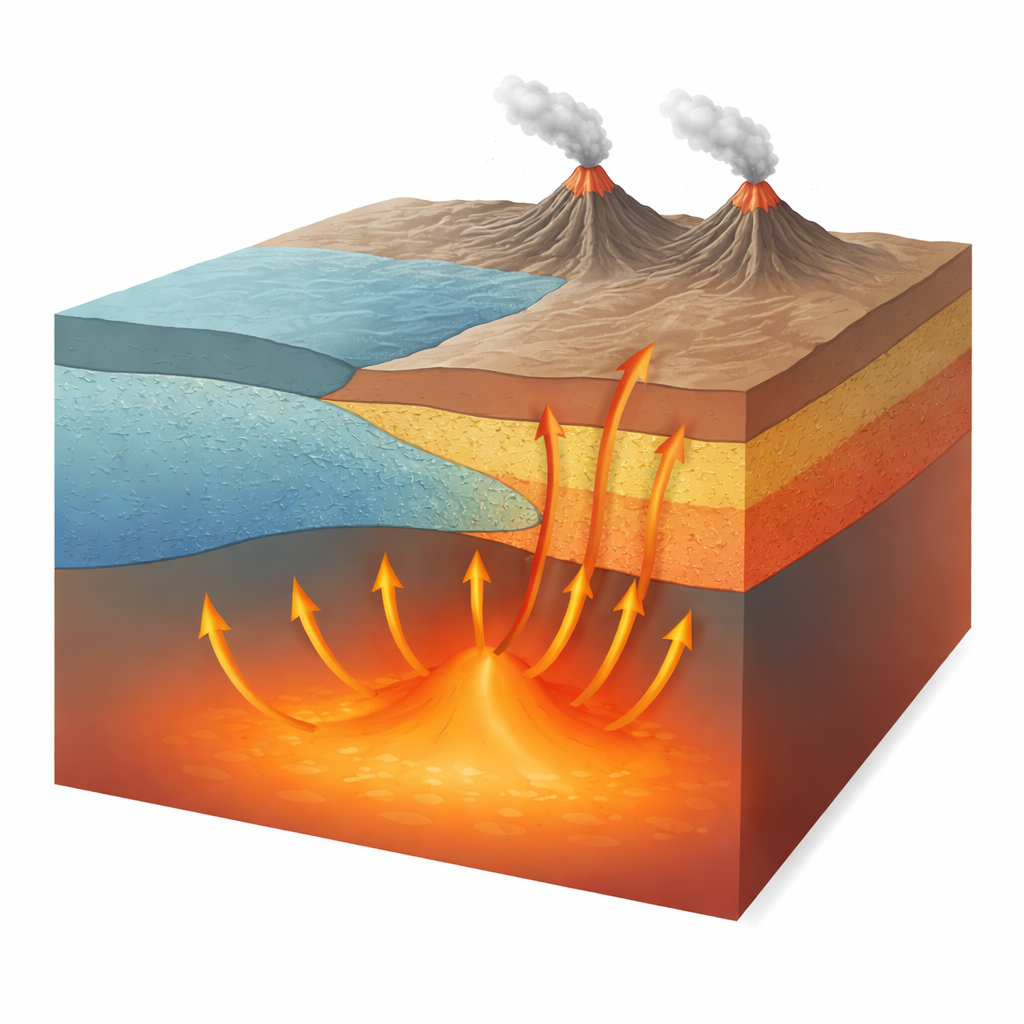
While the mantle beneath eastern Australia appears very hot, the electrical data and thermal models suggest it is surprisingly dry: its conductivity is best matched by nearly water-free rock, rather than by water-rich minerals or widespread partial melt. This implies that when mantle rock begins to melt, most of the water and other volatile components are efficiently stripped out and carried upward. The electrical properties of the lower crust beneath volcanoes tell a complementary story. At around 40 kilometers depth, rocks there are moderately conductive and hot—about 800–1,000 °C—which requires a small but significant amount of water or hydrous minerals. These hydrated lower-crustal layers act as a storage and transfer zone, where melts and fluids accumulate and move laterally before feeding volcanoes at the surface. In contrast, non-volcanic areas generally lack such strongly hydrated lower crust, or show different, more complex conductive signatures.
Competing ideas for volcano origins put to the test
Several ideas have been proposed to explain why eastern Australia’s volcanoes do not form a neat age progression. One invokes material rising from the mantle transition zone, where an old subducted slab has stalled and releases volatiles that promote melting as the mantle slowly rises and decompresses. Another focuses on edge-driven convection, in which the step in lithospheric thickness sets up swirling flow that brings hotter material upward along the boundary. A third suggests that shear within a weak layer of the mantle might generate local melting. By comparing their resistivity model with temperature estimates, mantle rock compositions, and the distribution of eruptive centers, the authors find that decompression melting above a deep, stagnant slab and the lithospheric step’s influence on mantle flow best explain the observations. The data offer little support for widespread melt driven purely by shear in an unusually weak layer.
What this means for Australia’s volcanic future
To a non-specialist, the main message is that eastern Australia’s volcanoes are the surface expression of a long-lived, deep-seated thermal anomaly rather than a simple moving hotspot. A step in the thickness of the continent’s base separates cooler, thicker interior mantle from warmer, thinner mantle nearer the coast. Hot, mostly dry mantle upwells from great depth, loses its water as it melts, and passes that moisture into the lower crust, where modest changes in temperature or composition can tip the balance toward renewed melting and eruption. Because this process is spread over a wide region and is not tied to a narrow plume, volcanoes can appear at scattered points and at different times along the belt, without a clear age progression. The study shows how subtle structure deep beneath our feet can shape the landscape and volcanic hazards we see at the surface today.
Citation: Margiono, R., Heinson, G. Mantle melting and lithospheric structure beneath eastern Australia’s Cenozoic volcanoes from 3D magnetotellurics. Sci Rep 16, 14214 (2026). https://doi.org/10.1038/s41598-026-44483-8
Keywords: intraplate volcanism, eastern Australia mantle, lithosphere structure, magnetotelluric imaging, Cenozoic volcanoes