Clear Sky Science · en
Impact of Alumina-Graphene nanoplatelets on the microstructure, corrosion behaviour, & mechanical properties of cast aluminium nanocomposite by Vortex technique
Turning Scrap Metal into Stronger Parts
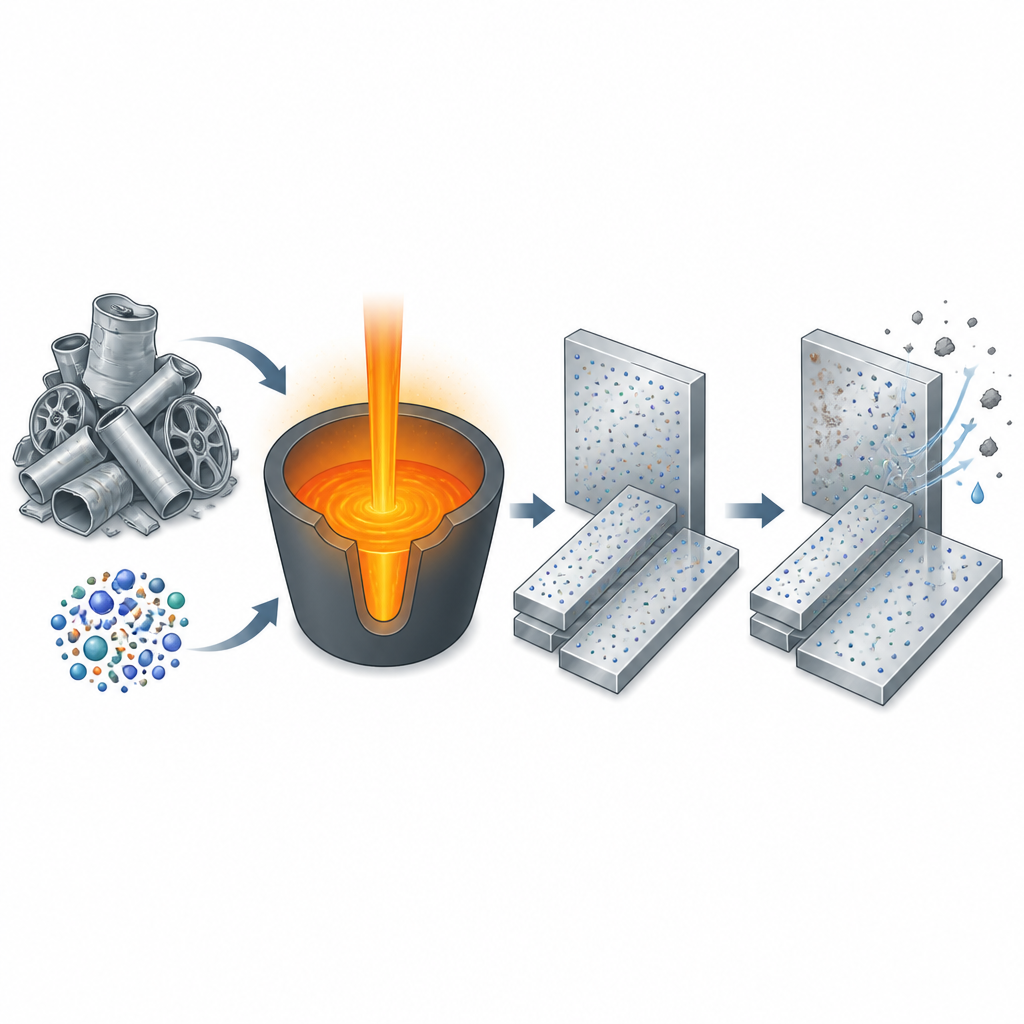
Aluminum is everywhere, from car wheels to aircraft parts, but much of it ends up as scrap that is melted and reused with only modest performance. This study explores how to turn discarded aluminum chips into tougher, longer lasting metal by carefully adding tiny ceramic and carbon flakes, offering a way to recycle more smartly rather than simply remelt and repeat.
Why Reinvent Recycled Aluminum
Many industries rely on aluminum because it is light, easy to shape, and naturally resistant to rust. Yet recycled aluminum often falls short of the demands of shipbuilding, cars, and aircraft, where both strength and corrosion resistance are critical. Traditional recycling mostly focuses on cleaning and remelting, which does not address weaknesses such as low hardness, poor wear resistance, and vulnerability in salty environments. The authors set out to redesign recycled aluminum from the inside, so that scrap chips can be upgraded into an advanced material rather than a second tier substitute.
Building a Hybrid Mix at the Nanoscale
The team mixed aluminum scrap with a carefully engineered blend of two types of nanoparticles: alumina, a hard ceramic, and graphene nanosheets, ultra thin carbon flakes. These particles were first milled together so that graphene wrapped around the alumina, forming hybrid grains, and then coated with a thin layer of silver to help them spread and stick inside molten aluminum. Using a vortex stirring method, the researchers added different amounts of this hybrid powder into liquid aluminum and then cast the mixture into bars. A final step of hot rolling squeezed the solid metal at high temperature, closing pores and pushing the particles into a more uniform pattern throughout the material.
What the Microscopes Revealed
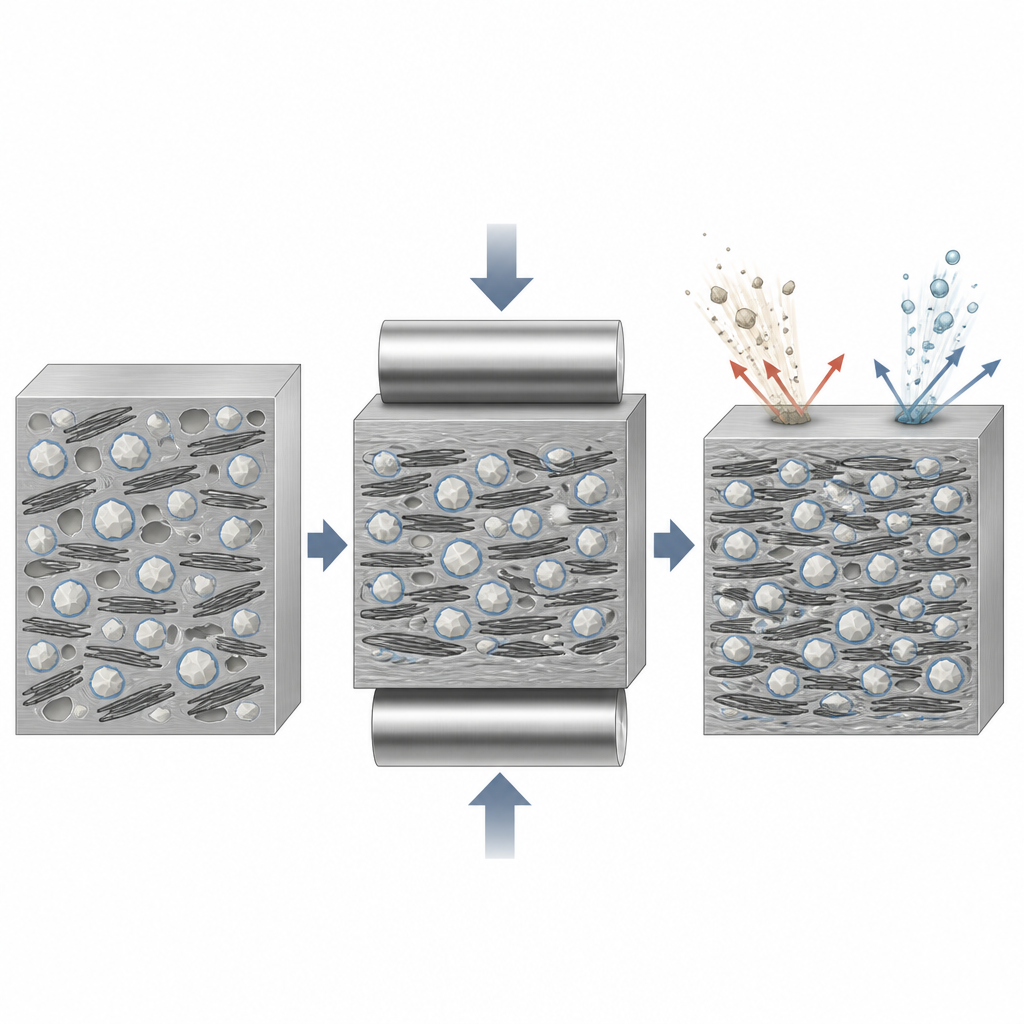
Microscopy and spectroscopy showed that the silver coated hybrid particles were well attached to each other and to the aluminum. In the as cast state, some clumping still appeared at higher particle contents, but hot rolling broke up many of these clusters and improved contact between metal and reinforcement. The aluminum grains became finer and denser, with fewer voids where cracks could start. Mapping the elements confirmed that aluminum, oxygen, carbon, and silver were spread throughout the composite rather than segregated into isolated pockets, which is important for consistent properties across the whole part.
Gains in Strength, Wear, and Corrosion
These internal changes translated into large jumps in performance. Hardness more than doubled when 15 percent hybrid particles were added and the material was hot rolled, rising from about 72 to nearly 169 on the Vickers scale. The ultimate tensile strength also climbed, from around 56 megapascals for plain recycled aluminum to about 140 megapascals in the most heavily reinforced, rolled samples. The material resisted sliding wear much better, especially after rolling, thanks to the hard alumina particles carrying load and the graphene flakes acting as solid lubricants. In a salt water solution mimicking seawater, the as cast composite with reinforcement corroded at only a small fraction of the rate of pure aluminum, indicating a far more protective surface behavior.
Balancing Strength and Rust Resistance
One interesting trade off appeared when the rolled composite was tested in salt solution. While rolling improved strength and wear resistance, it also slightly increased the corrosion rate compared with the as cast composite, likely because the heavy deformation introduced extra defects where corrosion can start. Even so, both reinforced versions outperformed plain recycled aluminum by a wide margin. By blending hard ceramic particles, slippery carbon sheets, and a thin silver layer into recycled aluminum scrap, and then carefully controlling stirring and rolling, the researchers showed that waste metal can be transformed into a high strength, wear resistant material suitable for demanding structural and marine uses.
Citation: Nouh, F., AbdelAziz, E.A., Ahmed, M.M.Z. et al. Impact of Alumina-Graphene nanoplatelets on the microstructure, corrosion behaviour, & mechanical properties of cast aluminium nanocomposite by Vortex technique. Sci Rep 16, 15080 (2026). https://doi.org/10.1038/s41598-026-44474-9
Keywords: recycled aluminum, nanocomposite, graphene, corrosion resistance, mechanical properties