Clear Sky Science · en
Shielding of the total electric field above building platforms near UHVDC transmission lines by grounded metal mesh
Why this matters for everyday life
As ultra‑high‑voltage power lines expand to bring electricity from distant regions into cities, they are increasingly passing close to homes and apartment blocks. Residents who live under these lines sometimes feel odd sensations on balconies and rooftop terraces—like hair standing on end or tiny shocks when touching metal objects. This study looks at a practical way to calm those invisible electric fields around building rooftops, using a simple grounded metal mesh that can be added to existing or new buildings.
Invisible fields around tall power lines
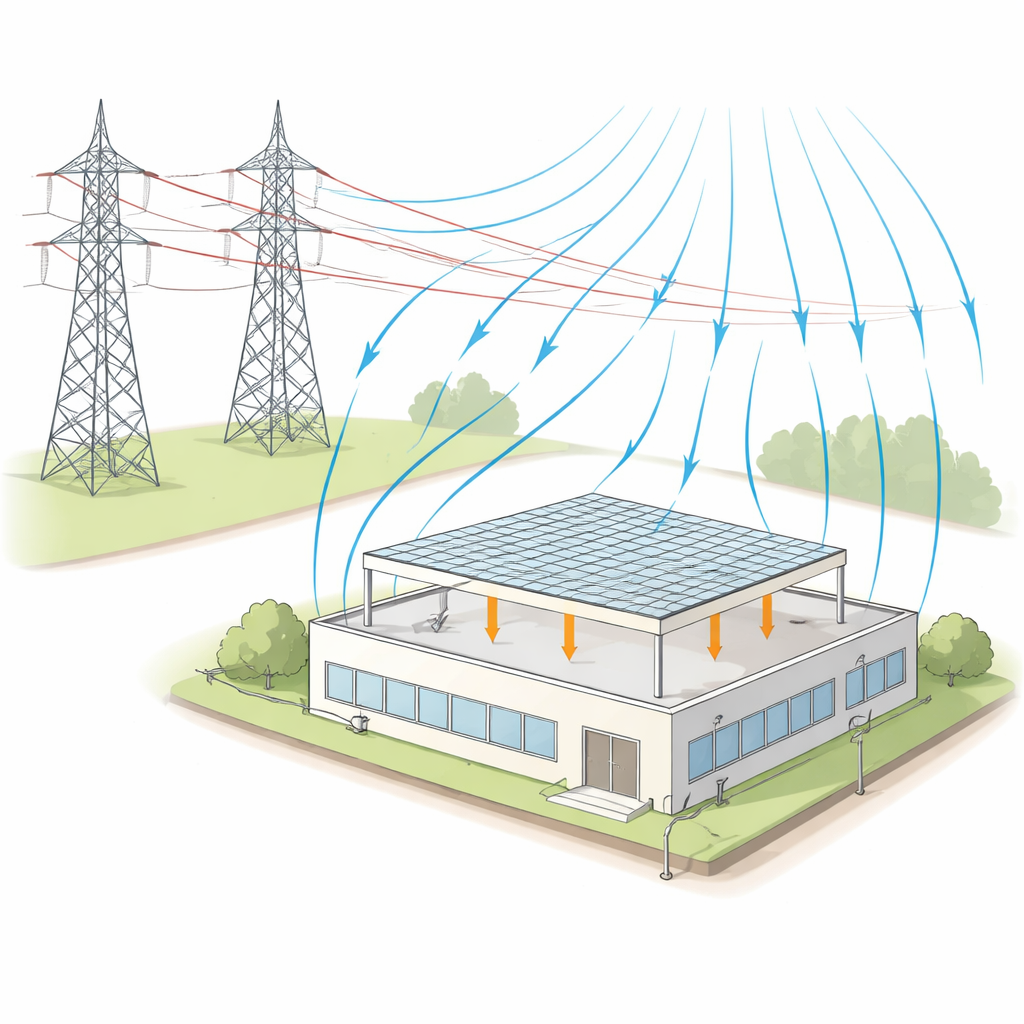
Modern ultra‑high‑voltage direct‑current (UHVDC) transmission lines carry enormous amounts of power over long distances. Around the wires, they create a total electric field made of two parts: the basic static field from the high voltage itself, and a second contribution from charged particles created in the air by tiny corona discharges on the conductors. When these lines pass near multi‑story buildings, the geometry of walls, roofs, and balconies can concentrate the field at specific spots where people stand or touch metal railings. Earlier safety checks mainly evaluated the field at ground level, meaning that rooftop platforms and balconies could experience stronger fields even when regulations were met on the ground below.
A simple shield made of metal mesh
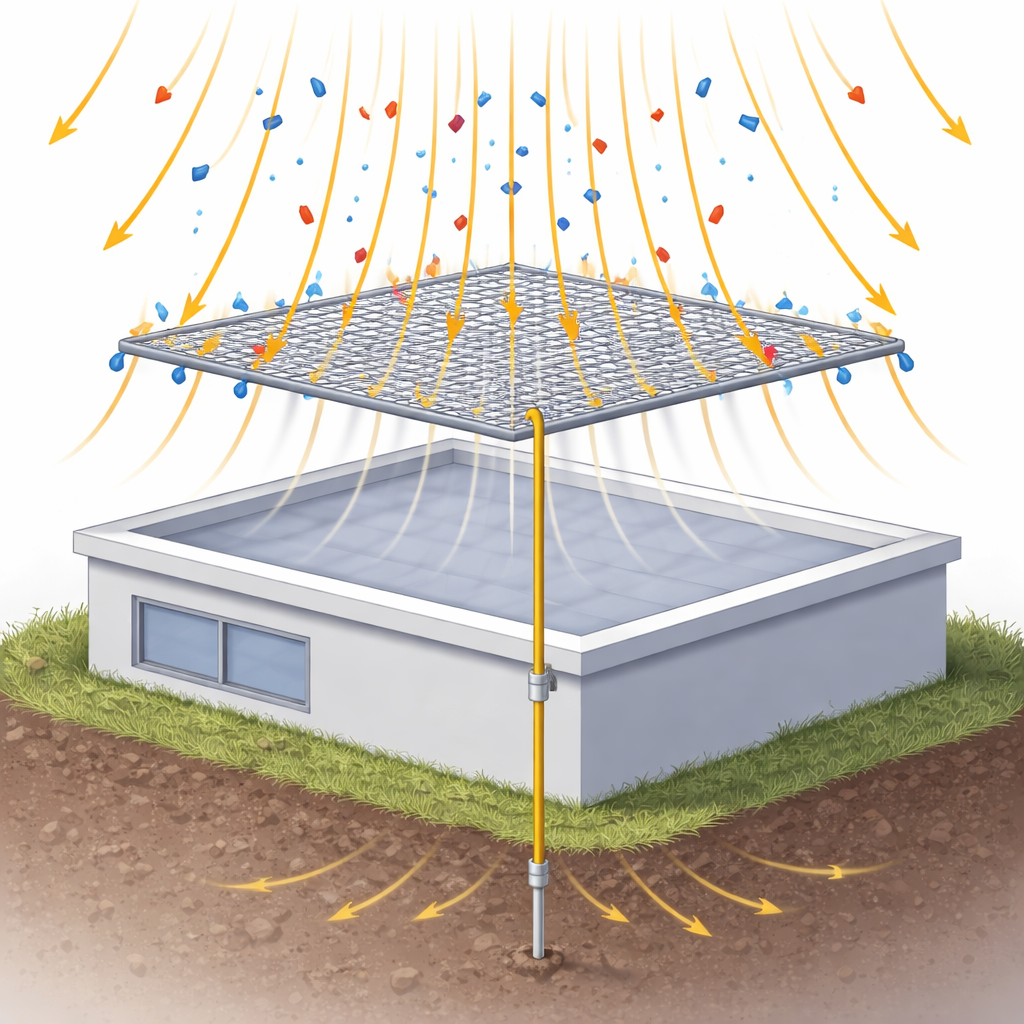
The authors propose a straightforward protection measure: placing a grounded metal mesh just above the flat rooftop platform of a nearby building. The mesh is essentially a grid of thin metal wires, well connected to the building’s grounding system. Because metals allow electric charges to move freely, the mesh tends to sit at a single uniform potential. Incoming field lines from the transmission line terminate on this surface instead of penetrating to the space where people stand. At the same time, the mesh attracts and drains away charged particles drifting down from the line, sending them harmlessly into the ground through a low‑resistance path.
How the team tested and optimized the design
To understand how well this shield works, the researchers built a detailed three‑dimensional computer model that included the transmission line, the building, the grounded mesh, and the surrounding air. They used a combination of finite‑element simulations and numerical calculations to track both the electric potential and the motions of charged particles in the wind. The model let them vary the mesh spacing, wire thickness, height above the roof, and installation angle. They examined two main layouts: a horizontal mesh panel over the platform ("parallel" installation) and a vertical mesh screen mounted along the roof edge facing the line.
What makes the shield most effective
The simulations showed that the size of the grid openings is the key design factor. A coarse mesh with two‑meter squares already reduced the rooftop field by more than 60 percent, while a much denser mesh with quarter‑meter squares lowered it even further. In contrast, making the wires thicker had only a minor effect on shielding, though it helped with strength and durability. Placing the mesh close to the platform gave better protection than mounting it higher up, because a larger gap allowed more charged particles to leak in from the sides. For the horizontal mesh, tilting it slightly like a lean‑to roof, up to about 30 degrees, improved shielding on the side closest to the line by steering field lines and charges away from the platform.
Real‑world checks beside a live power line
The researchers then tested their designs along a real ±800 kilovolt UHVDC line in Xinyang, China. Stainless‑steel meshes were installed over and beside a flat‑roofed building, and sensitive field meters recorded the total electric field at rooftop height before and after installation. With a horizontal mesh placed above the roof, the stronger end of the measured field values dropped to about one sixth of the unprotected level. A vertical mesh along the roof edge also provided a major reduction, though not quite as strong as the overhead configuration. In both cases, the remaining field was well below Chinese and international safety limits.
What this means for people living near power lines
For residents who worry about tingling sensations or small shocks on rooftop platforms under high‑voltage lines, this work points to a practical engineering fix. A properly grounded metal mesh, designed with reasonably small openings and placed close to the areas where people move, can keep the rooftop electric field comfortably within safety standards. The study also shows that this approach outperforms common alternatives such as extra shielding wires or relying on tall trees. Because the materials are standard and installation is simple, grounded metal meshes offer a realistic way to ease grid‑neighborhood tensions while allowing modern power networks to expand.
Citation: Liao, Z., Zhang, J., Zhang, Y. et al. Shielding of the total electric field above building platforms near UHVDC transmission lines by grounded metal mesh. Sci Rep 16, 14522 (2026). https://doi.org/10.1038/s41598-026-44471-y
Keywords: UHVDC transmission lines, rooftop electric fields, grounded metal mesh shielding, building platform safety, corona discharge