Clear Sky Science · en
Biarticular energy transfer mechanisms of the gastrocnemii muscles are associated with managing body energy during hole negotiation gait
Why stepping into a hole is a big deal for your body
Everyday walking may feel effortless, but your body is constantly juggling energy to keep you upright, especially on uneven ground. One common challenge is accidentally or deliberately stepping into a hole or down onto a lower surface. This study explores how certain calf muscles in the back of the lower leg help manage the body’s overall movement and energy in these tricky moments, and why that matters for preventing falls, designing better rehab programs, and building smarter prosthetic limbs and exoskeletons.
Muscles that act across two joints
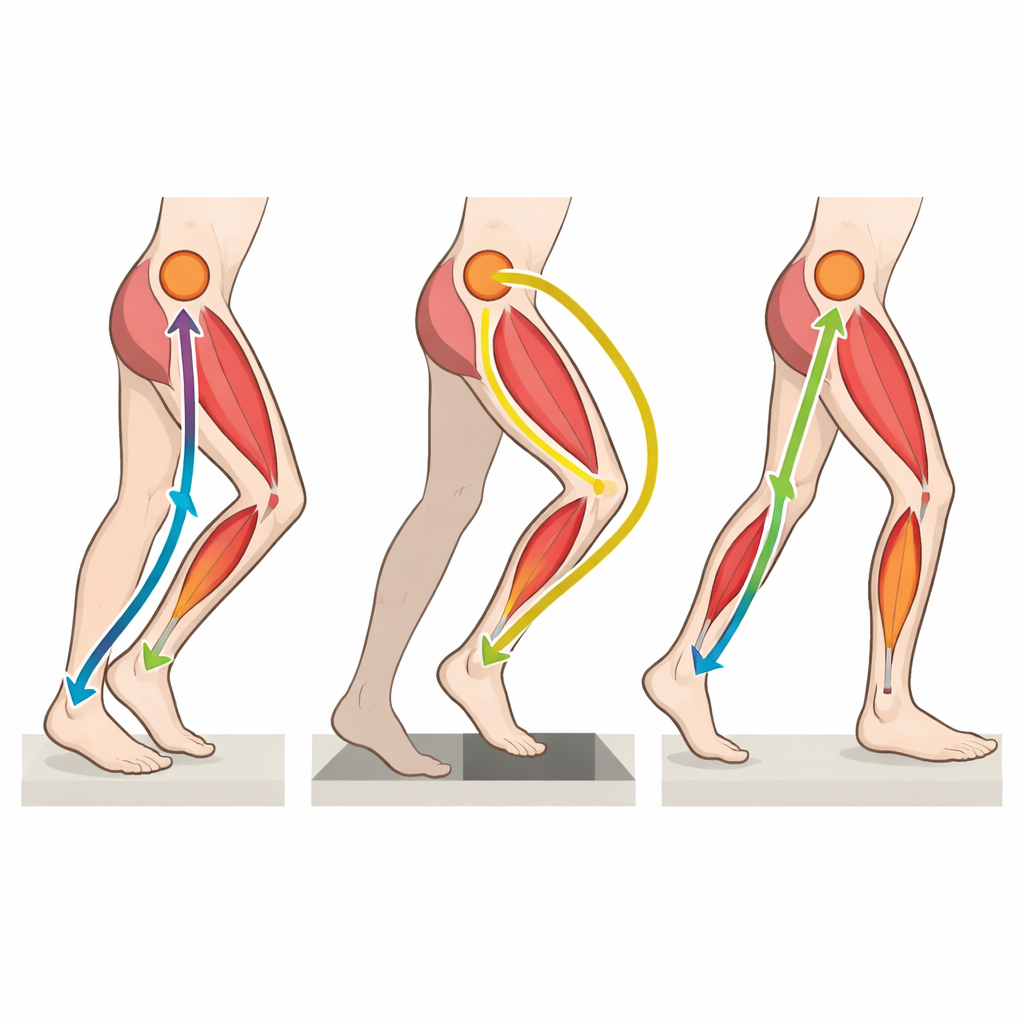
Most people think of muscles as acting on a single joint, like the biceps bending the elbow. But some leg muscles span two joints at once. The gastrocnemius muscles, part of the calf, cross both the knee and the ankle. Because they can pull on both joints together, they are able to shuttle mechanical energy back and forth between them. Earlier work showed that this “biarticular” setup is important in powerful movements like jumping and sprinting. Here, the researchers wanted to know whether the same energy-sharing system is also recruited for a much more everyday, but risky, task: negotiating a hole while walking.
Watching people walk over a hidden drop
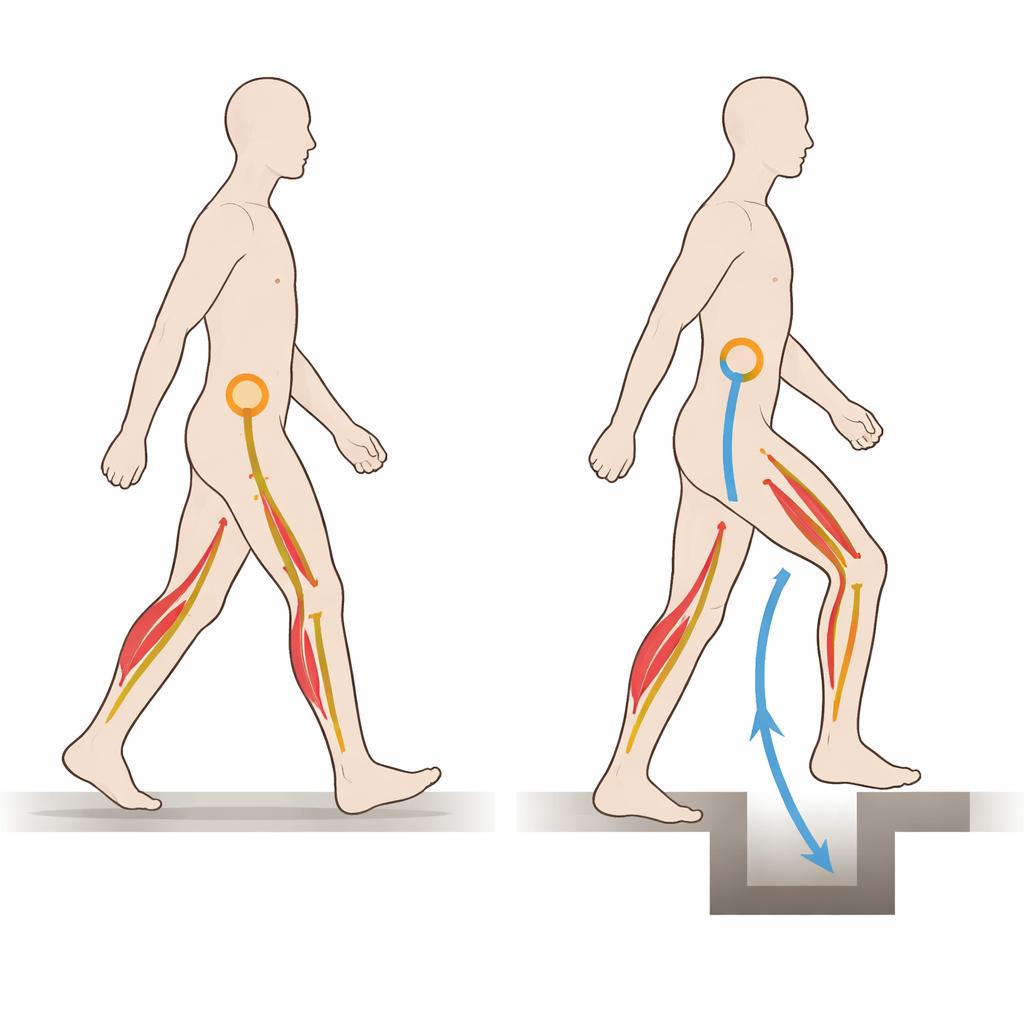
Eighteen young adults walked along a long walkway at their preferred speed. Sometimes the surface was flat; other times they had to step with their right leg into a shallow rectangular hole before stepping out again. Motion capture markers tracked how their ankles, knees, and whole body moved, while small sensors measured electrical activity in key thigh muscles (the vasti) and the two gastrocnemius muscles. By looking at how ankle and knee angles changed together, the team could identify phases when the calf muscles were mechanically positioned to transfer energy from ankle to knee or from knee to ankle. They also computed the total energy of the body’s center of mass (a combination of how high it is and how fast it is moving) to see how much energy was being absorbed or produced during each step.
More energy to manage, more help from the calf
Stepping into the hole made the body’s center of mass rise and fall more than during level walking, meaning the system had to handle larger swings in energy. The researchers found that, during hole negotiation, the potential for energy transfer between ankle and knee increased markedly in all three key steps: the step before the hole, the step into it, and the step after. During the preparation and hole steps, energy tended to move from the ankle up toward the knee at times when the body needed to absorb energy and reduce overall movement. Later, during the hole and recovery steps, energy tended to flow from the knee back down to the ankle in phases when the body needed to push off and raise its center of mass again. Importantly, in these transfer phases, both the gastrocnemius and the thigh muscles were actively contracting, not just passively stretched, indicating real, active energy exchange rather than simple damping.
Linking muscle behavior to whole-body motion
The team did more than simply observe these patterns; they tested how strongly they were related. They found that when conditions were favorable for energy to pass from ankle to knee in the step before the hole, the total energy of the body’s center of mass dropped more, helping to lower the body safely before the unexpected drop. Similarly, when conditions favored energy transfer from knee to ankle in the step into and out of the hole, the body’s total energy increased more, aiding the push-off needed to climb out and regain stable, level walking. In one particularly telling result, higher activation of the calf muscles during a specific ankle-to-knee transfer phase was directly linked to a greater reduction in whole-body energy, underscoring the active role these muscles play in stabilizing gait.
What this means for safer movement
In plain terms, this work shows that the calf muscles that cross both the knee and ankle act as energy managers when we step into a hole: they help soak up extra energy when we need to lower the body and then help return energy when we need to climb back out and move on. Because this mechanism becomes especially important when the ground is uneven and walking is more challenging, training that teaches people to better use these joint movements, and devices that mimic this energy transfer in prostheses, exoskeletons, or robots, could improve balance and reduce fall risk in everyday life.
Citation: Theodorakis, C., Bohm, S., Nikolaidou, ME. et al. Biarticular energy transfer mechanisms of the gastrocnemii muscles are associated with managing body energy during hole negotiation gait. Sci Rep 16, 10996 (2026). https://doi.org/10.1038/s41598-026-44470-z
Keywords: walking balance, uneven terrain, calf muscles, fall prevention, prosthetics and exoskeletons