Clear Sky Science · en
Gas-bearing characteristics and its main controlling factors in low-rank coal seams of the Wujianfang Basin, North China
Hidden energy in everyday coal
Deep beneath northern China, thick layers of soft, low-rank coal quietly hold a surprising resource: natural gas, mainly methane. This gas can both fuel power plants and, if leaked, heat the planet far more strongly than carbon dioxide. The study behind this article asks a practical question with big climate stakes: how much gas do these coals actually hold, what keeps it there, and where are the best places to tap it safely and efficiently?
A basin shaped for coal and gas
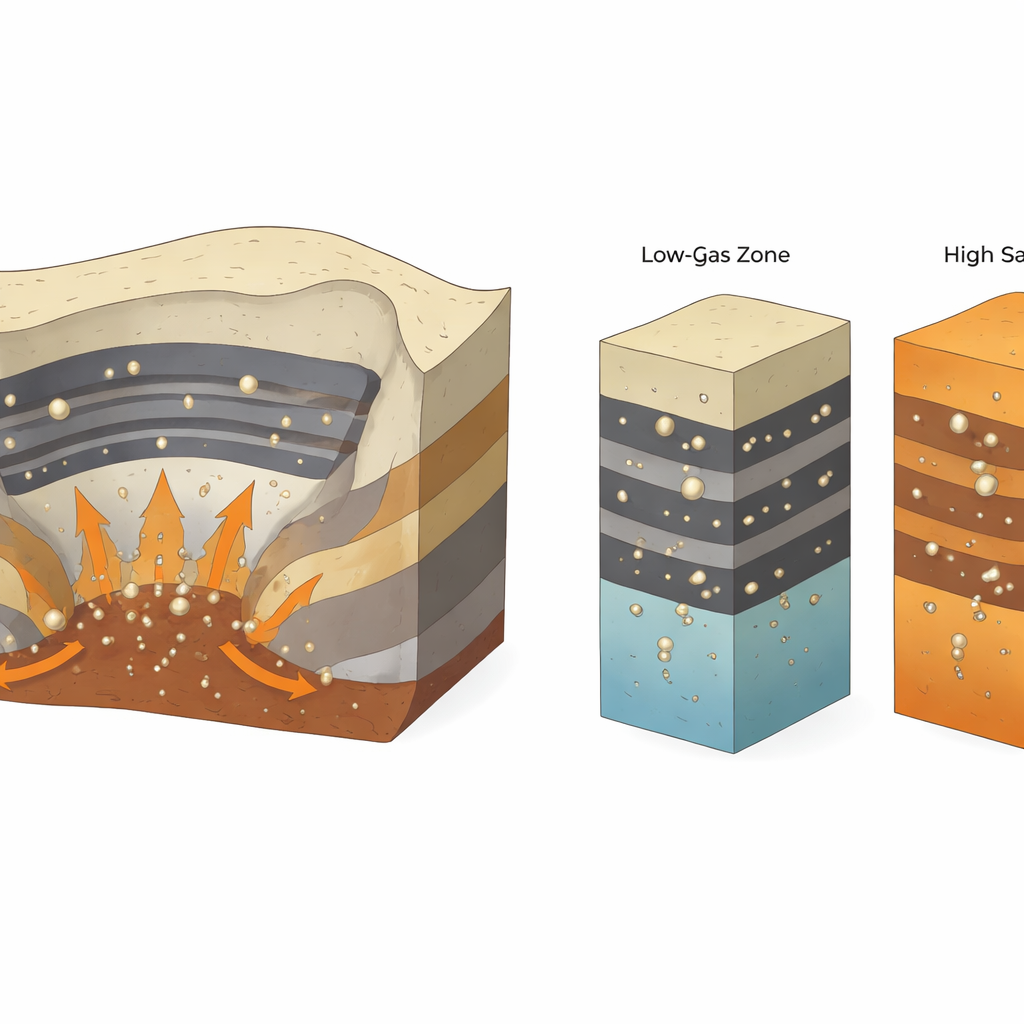
The work focuses on the Wujianfang Basin, part of the larger Erlian Basin in Inner Mongolia, a region singled out as a strategic frontier for low-rank coalbed methane. Here, six main coal seams lie roughly 600 to 1,000 meters underground, formed in a broad ancient river–lake system where plant-rich swamps were repeatedly buried. One seam in particular, known in industry as the 3–3 seam, is thicker and more continuous than the others, making it a natural focal point for gas exploration. Overall, coal layers in this basin can reach tens of meters in total thickness, suggesting ample space for gas storage even though the coals themselves are relatively young and less “cooked” by Earth’s heat.
What the coal looks like up close
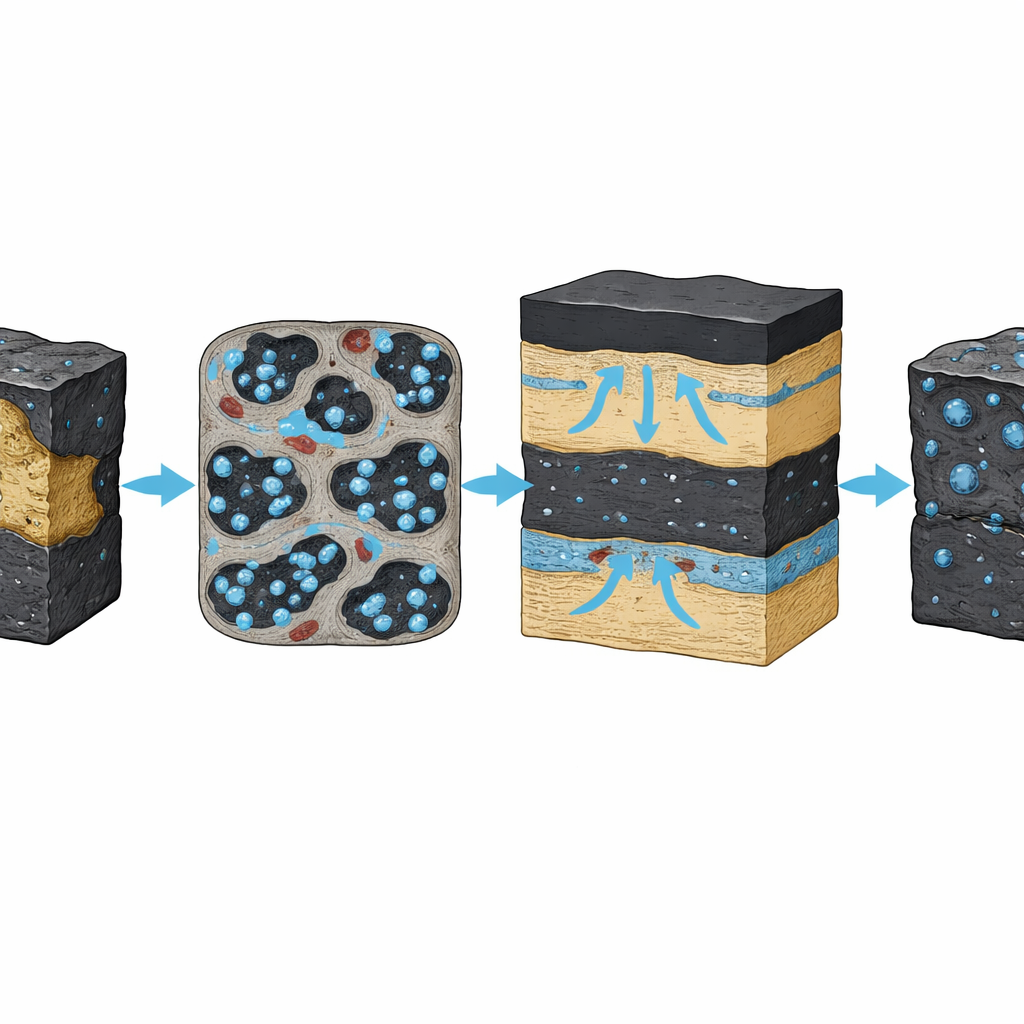
To understand how this rock stores gas, the researchers collected more than a hundred samples from two key wells and put them through a battery of tests. The coals are low-rank types such as lignite and long-flame coal, rich in organic matter but still moist and relatively soft. Under the microscope, they show abundant tiny pores and fractures. Laboratory measurements reveal that most of the pore volume is in small to medium pores, while the majority of the inner surface area—the surfaces where gas can stick—is in ultra-fine pores less than ten billionths of a meter across. At the same time, the pathways that let gas flow are tight: porosity is moderate but permeability is low, meaning gas has trouble moving without stimulation such as hydraulic fracturing.
How much gas is there and where did it come from?
On-site desorption tests show that the coal seams contain modest but variable amounts of gas, from about 0.45 to 1.85 cubic meters of gas per ton of coal, with methane making up roughly half to more than four-fifths of the total. Nitrogen is the main non-hydrocarbon gas, with only small amounts of carbon dioxide and traces of heavier hydrocarbons. By using stable isotope measurements—the subtle fingerprints in the atoms that make up methane—the team determined that most of the gas was generated by microbes in lake-like conditions, rather than by deep heating of organic matter. These microbes mainly followed a pathway akin to fermenting simple organic acids, with a smaller role for reducing carbon dioxide, a pattern consistent with other low-rank coal areas in the Erlian Basin.
Why gas content varies from place to place
Gas is not spread evenly through the basin. Using both field measurements and a machine-learning model that blends depth, coal thickness, rock properties, and well logs, the authors mapped gas content across all six seams. They found a clear patchwork: higher gas zones cluster first in the basin center and, as the basin evolved, shifted toward the northeast, while parts of the northwest have thin or gas-poor coal. To explain this, the team examined many potential controls: coal chemistry, pore space, burial depth, seam thickness, and the tightness of the surrounding rocks. A statistical method called partial least squares regression let them weigh these factors together rather than one at a time. Three stood out as most important: the amount of volatile matter (a marker of coal rank), the overall porosity, and the fixed carbon content. Ash (mineral) content also mattered, while depth, thickness, and the sealing strength of the overlying rock played helpful but secondary roles.
Implications for cleaner, smarter gas use
Putting the pieces together, the study paints a picture of coalbed methane as a product of coupled processes: microbes generate methane; the coal’s fine pores and carbon-rich surfaces store it; larger pores and fractures allow it to move; and thick, strong mudstone layers above and below help keep it from leaking away. In Wujianfang, the most promising development block combines multiple thick seams, favorable structure for trapping gas, and good sealing faults, while other areas lack enough gas-generating coal to be attractive. By clarifying which rock traits matter most, this work helps shift exploration from simply finding where coal is thick to identifying “sweet spots” where that coal can actually deliver gas. That knowledge supports more efficient, targeted production and better control of methane—a crucial step for aligning coal-related energy use with China’s longer-term climate and “dual-carbon” goals.
Citation: Hu, Y., Cai, Y., Chen, J. et al. Gas-bearing characteristics and its main controlling factors in low-rank coal seams of the Wujianfang Basin, North China. Sci Rep 16, 13355 (2026). https://doi.org/10.1038/s41598-026-44456-x
Keywords: coalbed methane, low-rank coal, Wujianfang Basin, gas-bearing properties, reservoir geology