Clear Sky Science · en
Determination of design requirements and characteristic analysis of powertrain configurations for electric tractors based on actual agricultural workload
Why cleaner farm machines matter
Modern farms depend on tractors for almost every job, from plowing soil to hauling loads and powering rotary tillers. Most of these workhorses still burn diesel, which wastes energy and produces exhaust. As climate rules tighten and fuel prices fluctuate, there is growing pressure to replace diesel with cleaner electric power. This study asks a deceptively simple question: if we build an electric tractor to do real farm work, what exactly does it need to be able to do, and what is the smartest way to arrange its motors and gears?
Measuring what tractors really do in the field
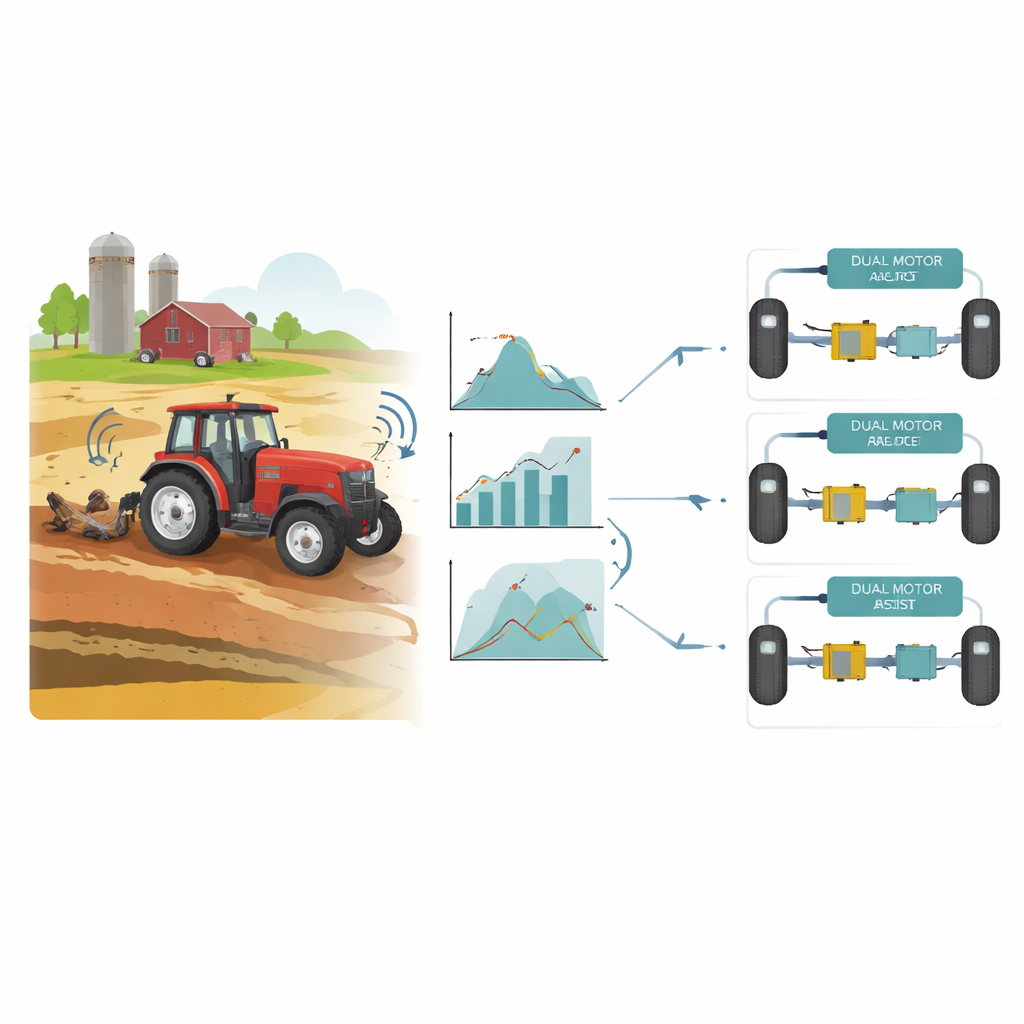
Instead of guessing from catalog ratings, the researchers took a conventional mid-sized diesel tractor into real fields and measured how hard it actually had to work. They equipped all four wheels and the rear power take-off shaft with torque and speed sensors, turning the tractor into a rolling test bench. Then they ran typical operations: pulling a plow through soil, driving a rotary tiller, and traveling on a road at high speed. By combining the forces at the wheels and the twisting load on the rear shaft with travel speed, they could calculate how much useful power each task really demanded over time.
Separating pulling power from spinning power
Tractors do two main kinds of work. One is pulling heavy tools through the soil, which calls for strong tractive force at low speeds. The other is spinning tools such as rotary tillers through the power take-off, which needs steady rotation and torque. From the field data, the team built “power envelopes,” curves that show the combinations of speed and force, or speed and torque, that cover all observed workloads with a safety margin. For pulling tasks, they found that the tractor needed to deliver up to about 32 kilonewtons of drawbar pull at a few kilometers per hour, and reach road speeds of about 33 kilometers per hour, corresponding to roughly 40 kilowatts of traction power. For spinning tasks, the power take-off needed nearly 40 kilowatts at typical rotational speeds, with much of the total demand during rotary tillage coming from the spinning tool rather than from pulling.
Translating workloads into electric design targets
Armed with these envelopes, the authors could specify what an electric tractor of the same class must be able to provide, without blindly copying the diesel engine rating. They argued that existing tractors are often overdesigned because their engines must also run hydraulics continuously and push power through multi-stage gearboxes that waste energy. By designing from measured workload instead, an electric tractor can match real needs while avoiding oversized motors and unnecessarily complex transmissions. The study therefore set separate requirements for traction and power take-off, each with its own maximum force, speed, and power, and treated hydraulic functions as handled by a small dedicated electric motor.
Three ways to arrange an electric tractor’s muscles
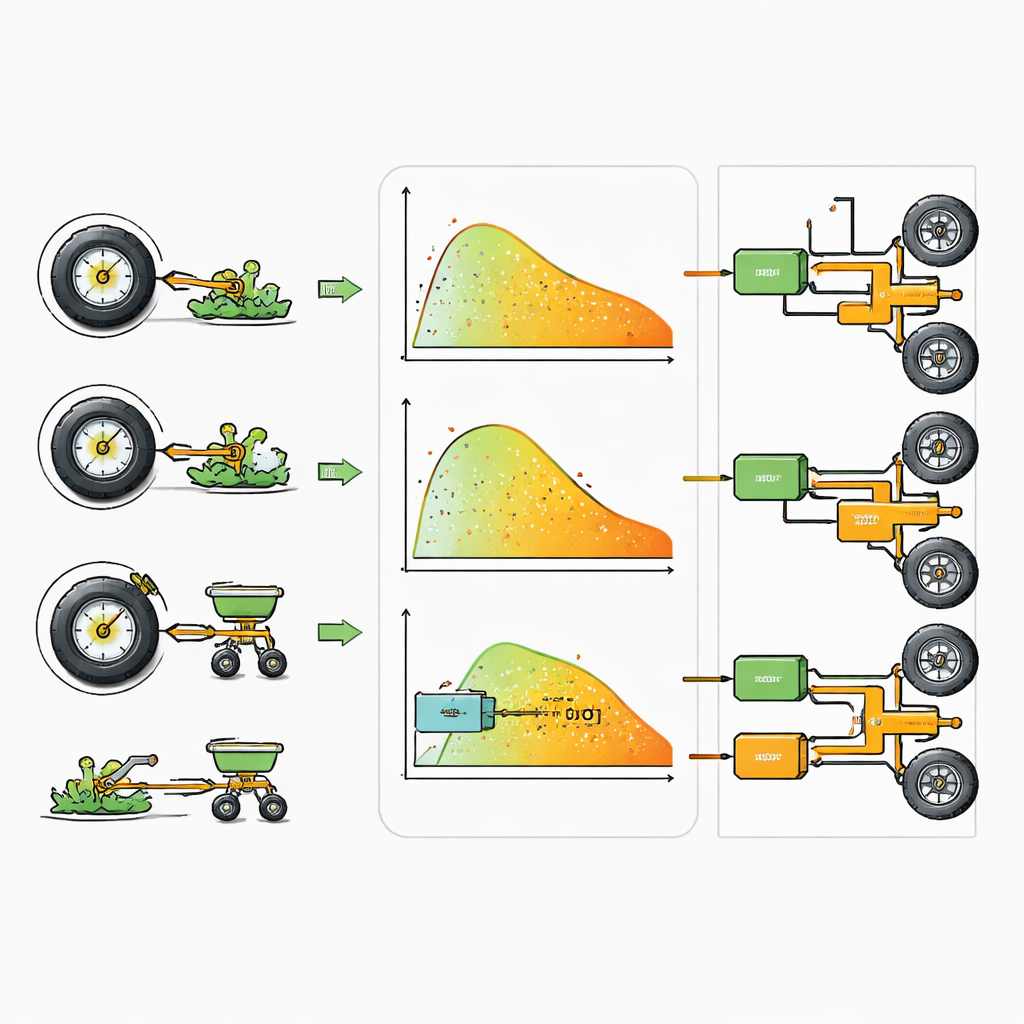
Using these requirements, the team compared three different powertrain layouts. In the single-motor design, one large motor supplies both pulling and spinning power through a gearbox, much like a diesel engine does today. This keeps control simple but demands a complicated transmission and leads to higher mechanical losses. In the dual-motor “power-separated” layout, one motor drives the wheels and another drives the power take-off, each through simpler gearing. This improves efficiency and lets ground speed and tool speed be adjusted independently, but the combined motor capacity is large. A third option, the dual-motor “power-assist” layout, uses a main motor plus a smaller helper motor. Depending on the task, they can work together for traction, or the main motor can focus on the spinning tool while the helper looks after pulling. This can closely match the measured power needs, but requires more intricate clutches and more sophisticated control.
What this means for future farm machines
For non-specialists, the key message is that successful electric tractors cannot simply swap a diesel engine for a battery and motor of the same headline power. They need to be designed from the ground up around what actually happens in real fields: how hard the wheels pull, how fast the tools spin, and how long each job lasts. By turning detailed workload measurements into clear power envelopes and then testing alternative motor layouts against them, this study offers a blueprint for building electric tractors that are powerful enough, efficient, and not overbuilt. The same methodology could guide battery sizing, cooling design, and control strategies, helping farmers adopt cleaner machines without sacrificing performance.
Citation: Ahn, DV., Kim, JT., Kim, K. et al. Determination of design requirements and characteristic analysis of powertrain configurations for electric tractors based on actual agricultural workload. Sci Rep 16, 14381 (2026). https://doi.org/10.1038/s41598-026-44453-0
Keywords: electric tractors, agricultural machinery, powertrain design, farm electrification, tractor workload