Clear Sky Science · en
Constitutive behaviour and microstructural evolution in thermally deformed Al–Zn–Mg alloy
Why this metal story matters
From airplanes to cars, many critical parts are made from aluminum alloys that must survive high temperatures and heavy loads. This study looks at a particular aluminum–zinc–magnesium alloy made by powder metallurgy and asks a practical question: how does it really behave when squeezed while hot, and can we predict that behavior well enough to design safer parts and better forming processes?
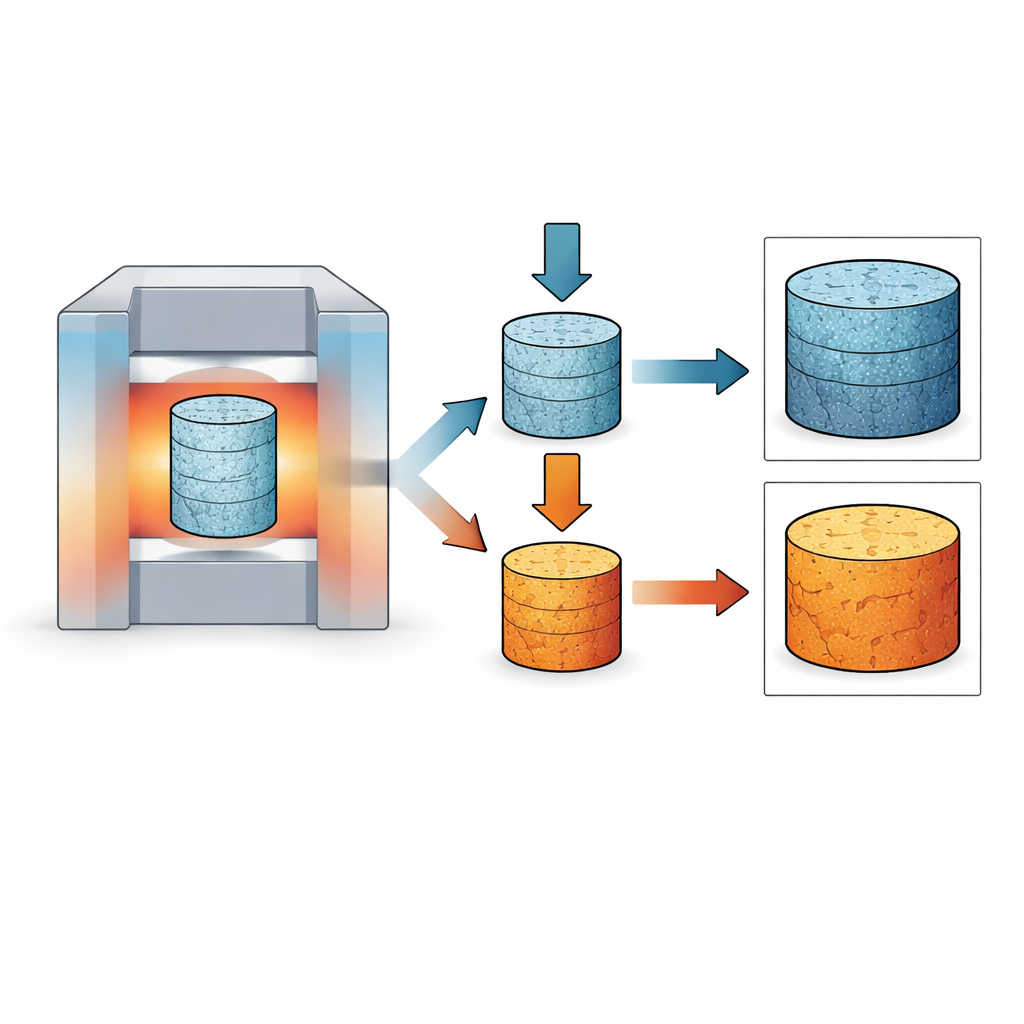
Shaping metal while it is hot
The researchers focused on a process called hot compression, where short cylindrical samples are heated and then squashed between two platens. By changing the temperature and the speed of compression, they created conditions ranging from relatively cold and fast to very hot and slow. At each setting they recorded how much stress was needed to keep deforming the alloy and then rapidly quenched the samples in water so the internal structure would “freeze” in place for later examination.
Looking inside the metal’s grainy landscape
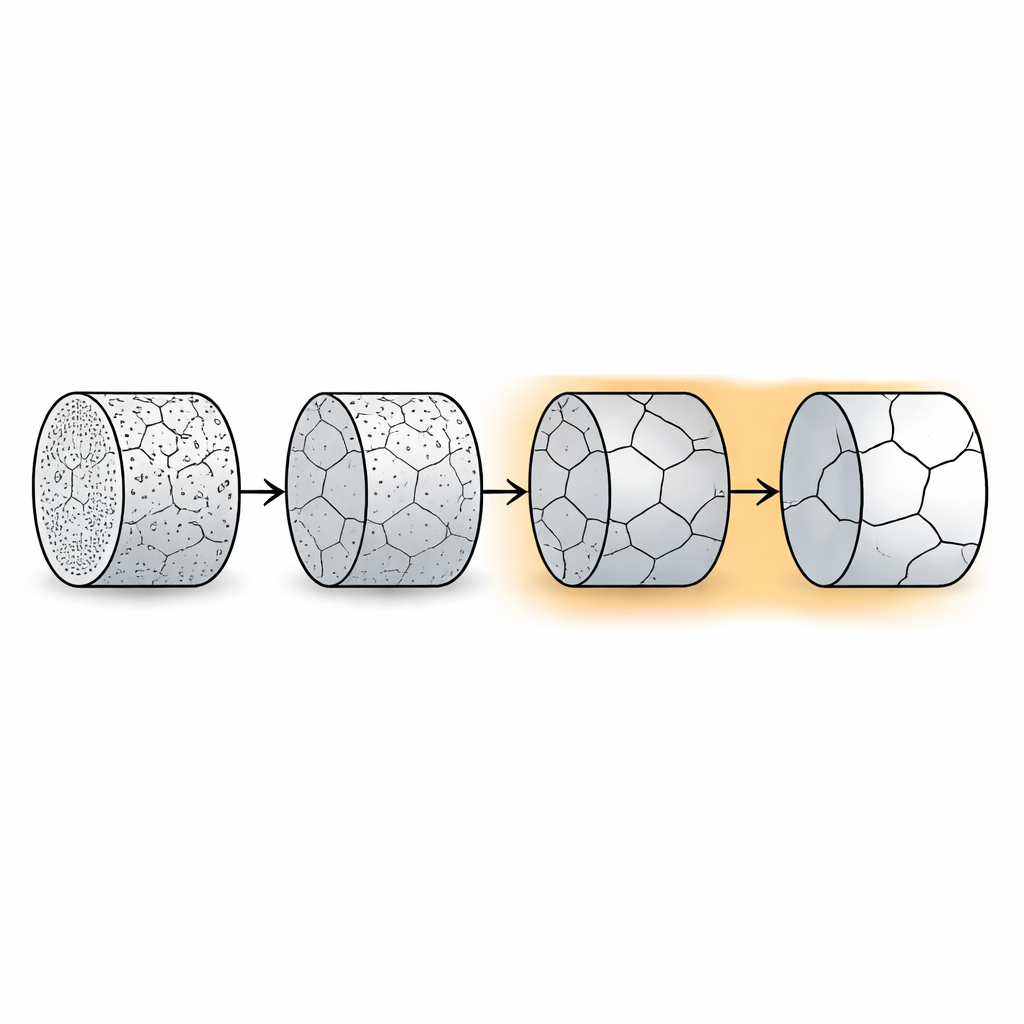
To see what was happening on the microscopic scale, the team used Electron Backscatter Diffraction (EBSD), a technique that maps the orientation and size of tiny crystals, or grains, inside the metal. They measured features such as average grain size, the proportion of low-angle and high-angle grain boundaries, and the local misorientation known as Kernel Average Misorientation (KAM), which serves as a fingerprint of how crowded the metal is with dislocations—defects that carry plastic deformation. These maps revealed how different hot-working conditions rearranged the internal grain structure and dislocation networks.
Hard or soft: how temperature and speed set the tone
The mechanical tests showed a clear pattern. When the alloy was compressed at the lower test temperature (around 300 °C) and at a fast rate, it became strong and hard. Under these conditions the flow stress and microhardness were high, the grains stayed relatively small, and the structure was dominated by low-angle boundaries and high KAM values, all signs of a heavily strain-hardened material packed with dislocations. At the opposite extreme—very hot (around 500 °C) and very slow compression—the alloy softened dramatically. The stress and hardness dropped, grains grew larger, high-angle boundaries became more common, and KAM values fell, indicating that dynamic recrystallization had wiped out many of the stored defects.
Teaching computers how this alloy behaves
Because industry relies on computer simulations to design forming processes, the authors built mathematical recipes, or constitutive models, that let software predict how the alloy will flow under different conditions. They compared the widely used Johnson–Cook (JC) model with a Modified Johnson–Cook (MJC) version that adds a quadratic dependence on strain and allows temperature effects to change with strain rate. Using hundreds of data points from their experiments, they tuned both models and then checked how well the predictions matched real measurements. The MJC model clearly did better, with much smaller prediction errors and smoother stress–strain curves that captured both hardening and softening more realistically.
Linking invisible structure to real-world performance
Beyond simply fitting curves, the team tied their findings together with the Zener–Hollomon parameter, a single quantity that combines temperature and strain rate, and with the activation energy needed for atoms to rearrange during deformation. High values of this parameter and activation energy lined up with fine grains, many low-angle boundaries, high KAM, and high hardness and strength. Low values matched coarse grains, more high-angle boundaries from recrystallization, low dislocation densities, and a much softer response. This unified view shows that simple hardness tests, combined with these parameters, can serve as practical indicators of what the grain structure is doing inside.
What it means for future metal parts
For non-specialists, the key message is that the way we heat and deform this aluminum–zinc–magnesium alloy can be tuned to produce either a tough, hard state or a softer, more easily formed one, and that these states can be predicted with a relatively simple but accurate model. The improved MJC model, anchored by detailed microstructural measurements, gives engineers a more trustworthy tool for virtual tryouts of forging and forming operations. That, in turn, can speed up the design of lightweight components that are strong enough to withstand service at elevated temperatures while making better use of advanced powder-based aluminum materials.
Citation: Harikrishna, K., Nithin, A., Manohar, G. et al. Constitutive behaviour and microstructural evolution in thermally deformed Al–Zn–Mg alloy. Sci Rep 16, 10674 (2026). https://doi.org/10.1038/s41598-026-44449-w
Keywords: aluminum alloy, hot deformation, powder metallurgy, microstructure, constitutive modeling