Clear Sky Science · en
Seeds accelerate germination at beneficial planting depths by sensing the sound of rain
The Quiet Power of a Storm
When we picture seeds sprouting after a storm, we usually credit the water, light, and warmth. This study adds a surprising new player: the sound of rain itself. The research shows that rice seeds can actually sense the vibrations made by raindrops hitting soil or puddles above them, and that this sound helps them decide when and how fast to germinate—especially at planting depths that give young seedlings the best chance to survive.
How Rain Talks to Buried Seeds
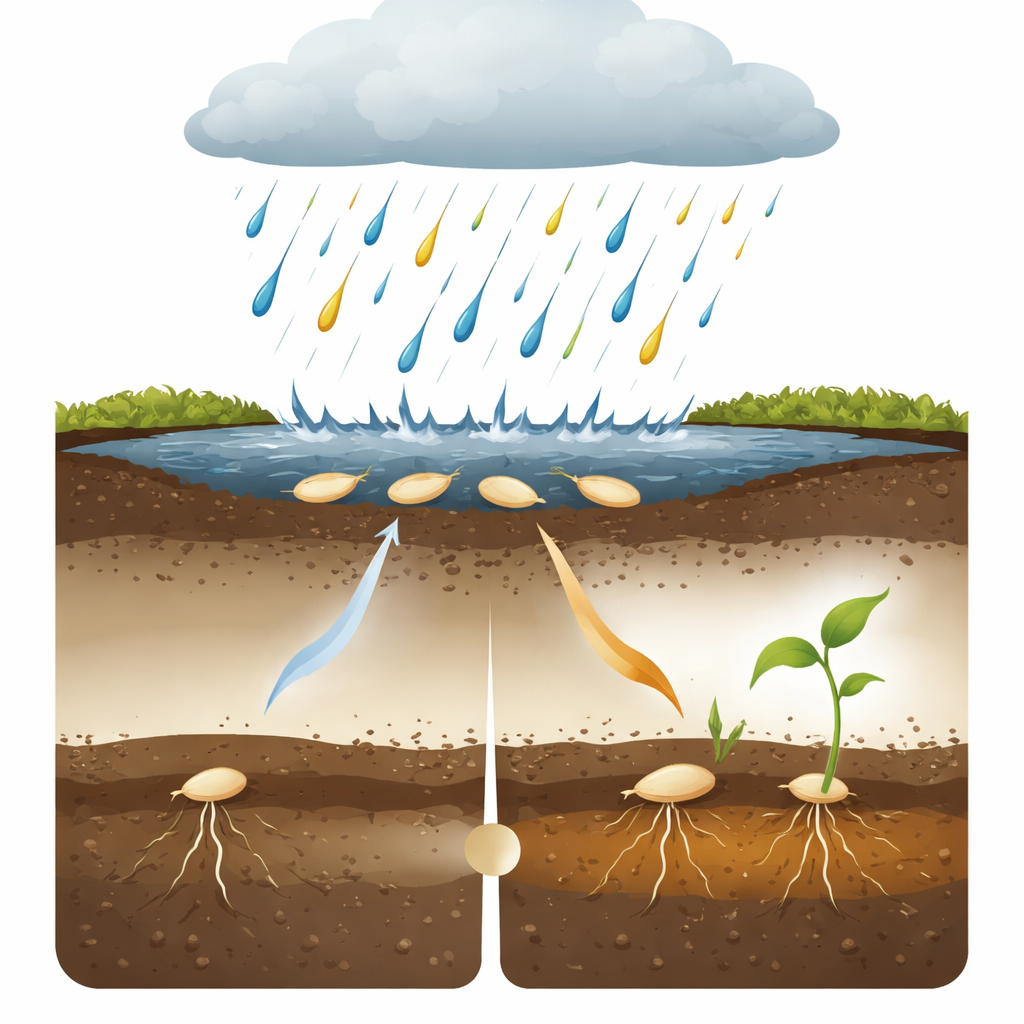
Raindrops hitting a puddle or patch of soil create brief but powerful pressure waves that travel through water and earth. The authors first measured these natural sounds in a simple field puddle and in moist soil. They found that everyday rain can generate underwater sound pressures hundreds of times stronger than those in a normal human conversation, particularly at low tones near the bottom of the human hearing range. These pulses shake the surrounding water or soil, and that motion is passed directly into any seeds lying just beneath the surface.
The Tiny Stones That Feel the Shaking
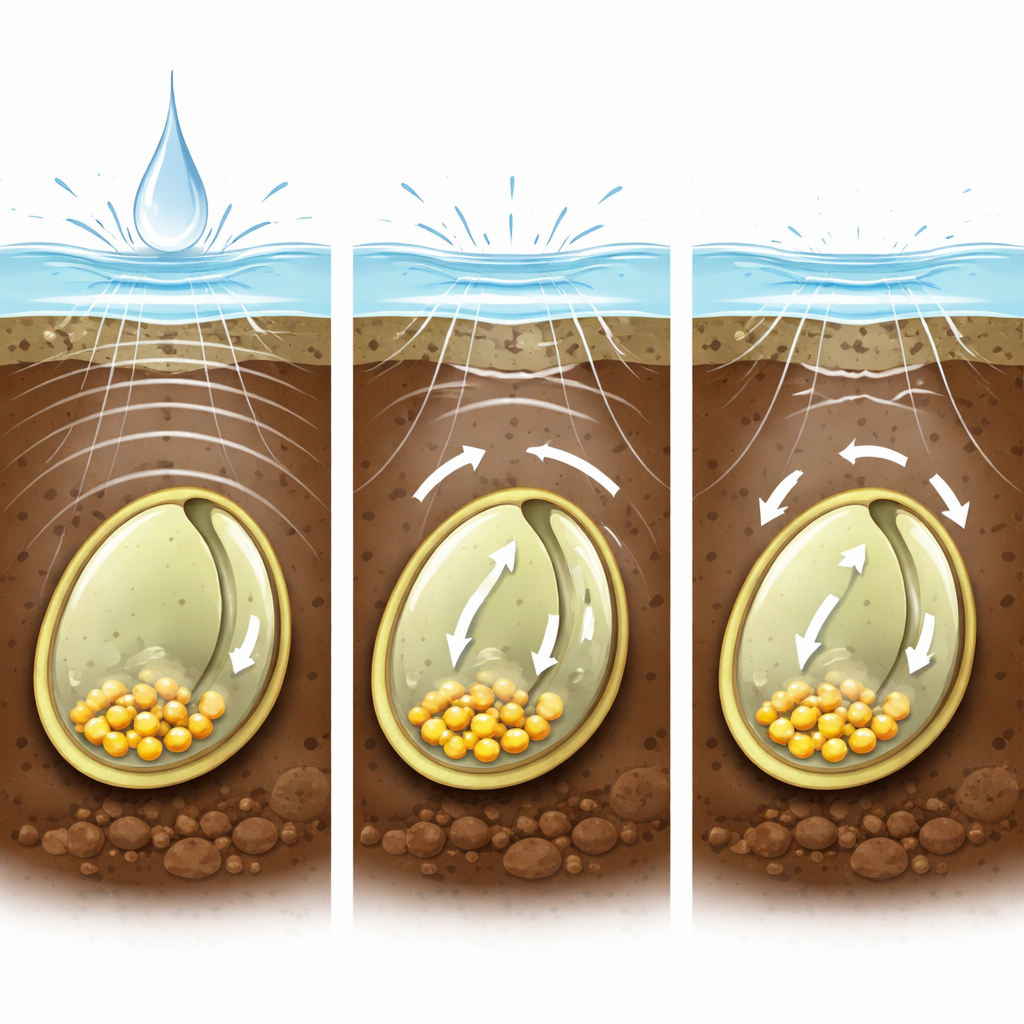
Inside plant “gravity-sensing” cells are tiny, dense grains called statoliths. In calm conditions, these grains settle to the bottom of a cell, helping the plant sense which way is down and guiding roots and shoots as they grow. Recent work has shown that what really matters is where these grains touch the cell’s inner wall, not how hard they press. In this study, the researchers used measurements of rain sound and detailed mechanical modeling to estimate how much rain-driven shaking would move these grains inside rice seeds. They found that realistic rain can jostle statoliths by tens to hundreds of nanometers—enough to briefly pull them away from their resting spots and make fresh contact with new regions of the cell surface.
Experiments in Artificial Rain
To test whether this shaking changes how seeds behave, the team ran controlled “rain” experiments with rice seeds submerged at the bottom of shallow water basins, mimicking natural puddles. Over six days, steady streams of single water drops fell on the surface above one group of seeds, while a nearby control group stayed in the same water under the same light and temperature, but without impacts. By varying the drop height and the distance between seeds and impact point, they created different levels of sound and shaking. Across thousands of seeds, those exposed to stronger rain sound germinated noticeably earlier and at higher rates than their quiet neighbors, with the biggest boosts—up to about one-third higher germination—occurring when estimated internal grain movements were in the 200–600 nanometer range.
Depth Limits and a Built-In Safety Margin
The effect was not limitless. When the shaking of the internal grains was extremely small—on the order of a nanometer or less—germination rates were indistinguishable from the controls. By combining their sound measurements and models, the authors estimated how deep seeds could be buried and still feel enough rain-driven motion to speed germination. The answer was only a few centimeters: roughly 0–5 cm in both water and soil. Strikingly, this matches the planting depths already known to be best for successful emergence in rice and related crops. Deeper seeds would not feel strong enough sound-induced shaking to gain this early start, which may prevent them from wasting energy trying to sprout from depths where survival is unlikely.
Why This Matters for Fields and Wild Plants
Beyond the clear message that rain sound can accelerate germination at helpful planting depths, the study hints at broader possibilities. The same shaking that moves statoliths may also stir fluids inside cells, slightly boosting the spread of growth-related molecules and helping plants fine-tune their sense of up and down. Because rain puddles form and vanish quickly, the sound traveling through them could signal a brief window of ideal moisture that seeds are primed to exploit. The findings suggest that many seeds with similar internal structures may listen, in their own way, to storms overhead—using the rumble and patter of raindrops as a cue to wake up and grow when conditions are safest for new life.
Citation: Makris, N.C., Navarro, C. Seeds accelerate germination at beneficial planting depths by sensing the sound of rain. Sci Rep 16, 11248 (2026). https://doi.org/10.1038/s41598-026-44444-1
Keywords: rain sound, seed germination, plant sensing, rice agriculture, gravitropism