Clear Sky Science · en
Entropy-regularized dual-stream attention fusion for multi-disease lung classification
Why Smarter Lung Scans Matter
Lung diseases like pneumonia and COVID-19 can look surprisingly similar on chest X-rays, even to experienced doctors. Subtle hazy patches, scattered spots, and overall cloudiness may overlap from one illness to another, and image quality can vary from hospital to hospital. This study introduces a new artificial intelligence (AI) approach that aims to read these images more reliably, sort different lung problems correctly, and stay accurate even when the pictures are noisy or come from unfamiliar scanners.
Seeing Both the Small Spots and the Big Picture
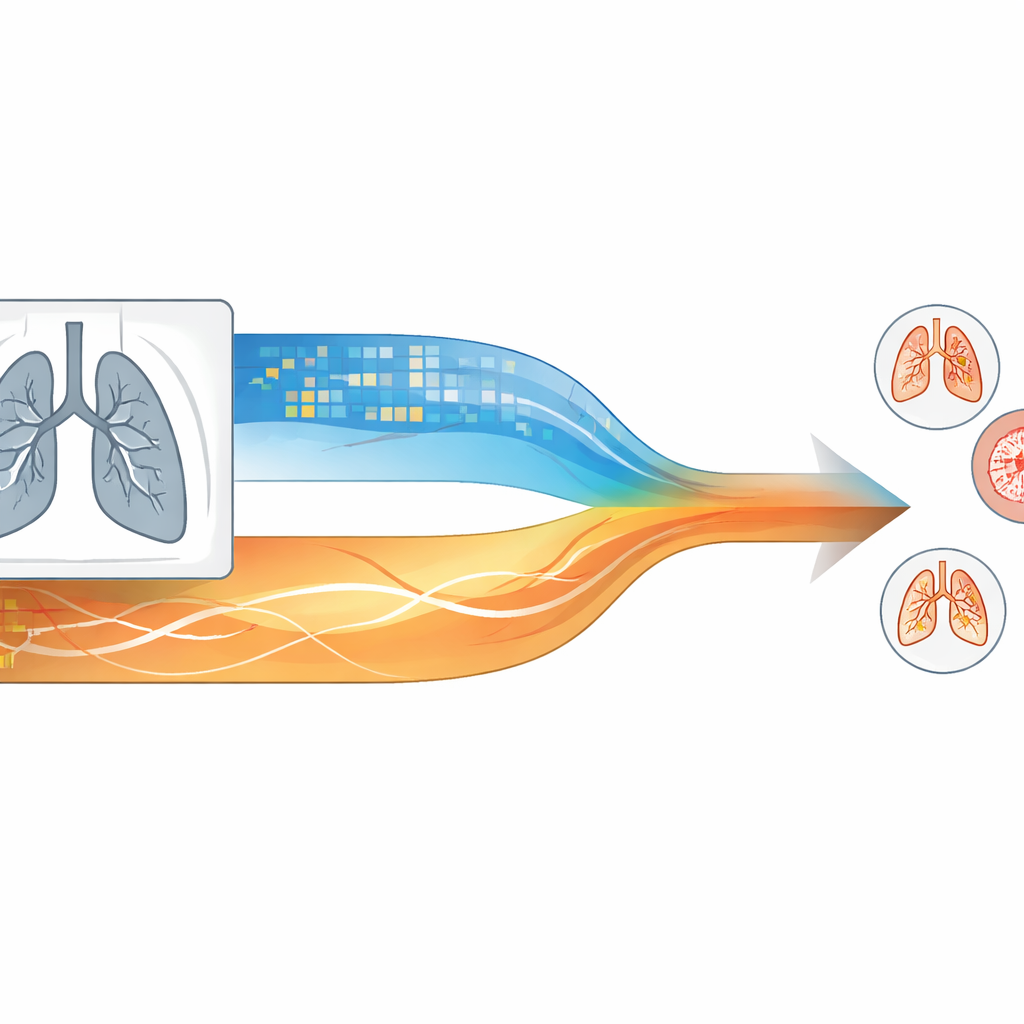
Most existing AI systems for lung images rely on one of two strategies. One type, called convolutional networks, is good at spotting fine details such as tiny bright or dark specks that may signal an early infection or a nodule. The other type, based on newer “attention” ideas, is better at judging the overall pattern across the lungs, which matters for widespread problems like advanced pneumonia or COVID-19. On their own, each style of system misses something: detail-focused systems can overlook long-range patterns, while big-picture systems can gloss over subtle textures.
A Two-Pathway Model That Adapts Per Patient
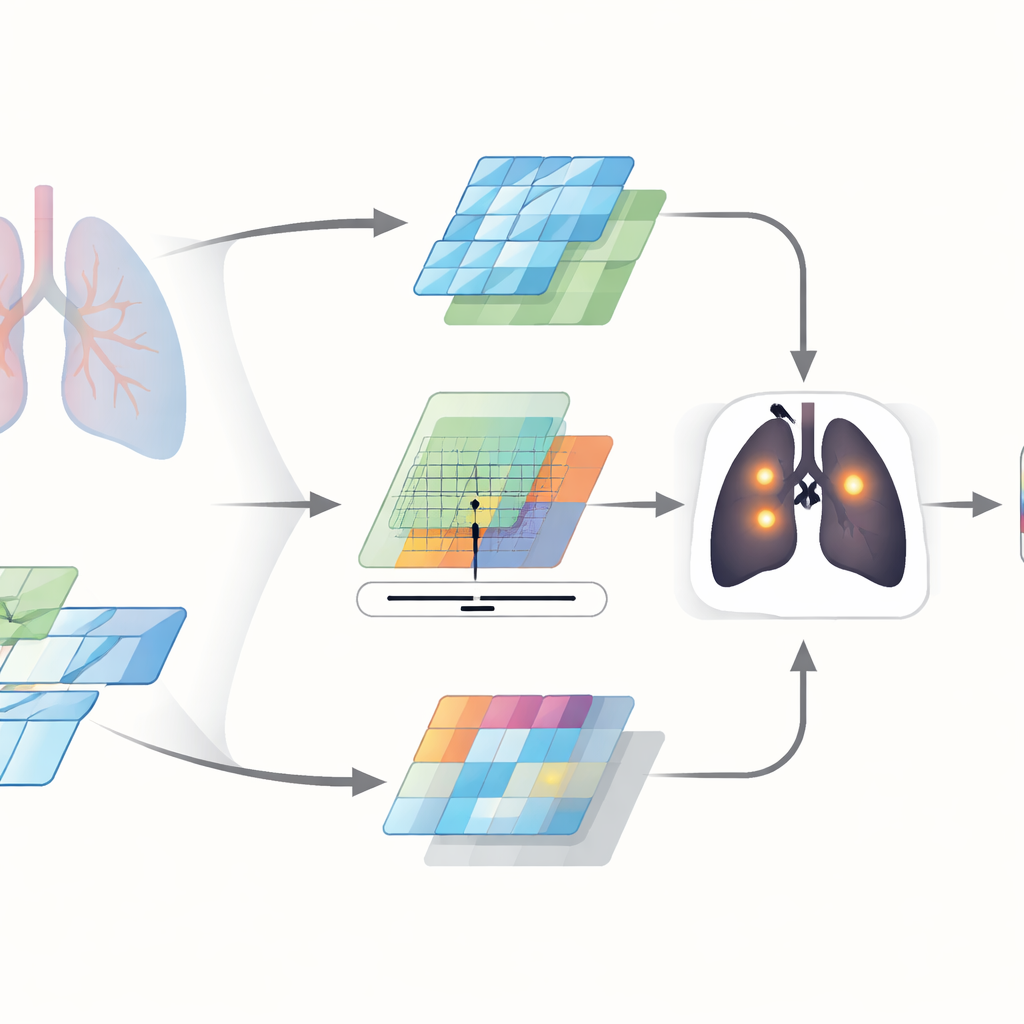
The authors propose a dual-pathway AI framework called Adaptive Dual-Stream Attention Fusion (ADSAF). The same chest X-ray is sent down two parallel paths: a detail-focused path that zooms in on small textures and edges, and a context-focused path that captures how disease patterns spread across the entire lung area. Instead of simply averaging the two outputs, ADSAF learns how much weight to give each path for every individual image. For a scan dominated by small, localized changes, it leans more on the detail path; for a scan with diffuse fogginess, it relies more heavily on the global pattern path.
Letting the Model Decide Confidently
A key twist in this work is how the two information streams are blended. Many earlier “hybrid” systems mix features from different paths in a fixed or mildly flexible way, which can lead to indecisive combinations that blur important clues. ADSAF uses a special training rule that discourages this kind of half-and-half mixing. Mathematically, it penalizes uncertain fusion and nudges the system toward clearer choices about which path should dominate for a given image. On top of that, an extra attention module acts like a spotlight, brightening regions most likely linked to disease while dimming background structures such as ribs or the heart shadow. This not only improves accuracy but also makes the model’s focus easier to interpret visually.
Performance Under Real-World Challenges
To test their approach, the researchers trained and evaluated ADSAF on widely used chest X-ray collections for pneumonia and COVID-19. They compared it against many strong competitors, including deep convolutional networks, transformer-based models, and ensembles that combine several systems. ADSAF matched or exceeded all of them, reaching classification accuracies above 98 percent. When the team deliberately added noise to simulate poor imaging conditions, other models lost much more accuracy than ADSAF. The new system also held up better when it was trained on one dataset and tested on another, mimicking the shift from one hospital’s equipment and patient mix to another’s. Visual explanations using heatmaps showed that ADSAF concentrated on lung regions that radiologists would also flag, suggesting its decisions are grounded in meaningful image cues.
What This Means for Future Lung Care
In plain terms, this study shows that an AI model that can flexibly decide when to trust fine details and when to trust global patterns can classify lung diseases from X-rays more accurately and more reliably than existing methods. By emphasizing the most informative view for each patient and filtering out distracting background features, ADSAF offers a more stable “second pair of eyes” for clinicians. While it still needs clinical trials and real-time testing, the framework points toward decision-support tools that could help catch serious lung problems earlier, reduce misclassification between similar diseases, and perform consistently across varied hospitals and imaging conditions.
Citation: Thakare, V., Aote, S.S., Gangrade, J. et al. Entropy-regularized dual-stream attention fusion for multi-disease lung classification. Sci Rep 16, 14141 (2026). https://doi.org/10.1038/s41598-026-44441-4
Keywords: lung imaging, medical AI, chest X-ray analysis, pneumonia detection, COVID-19 diagnosis