Clear Sky Science · en
Reproducible magnetophosphene thresholds induced by transcranial alternating magnetic stimulation in humans: a replication study
Seeing Flickers from Invisible Fields
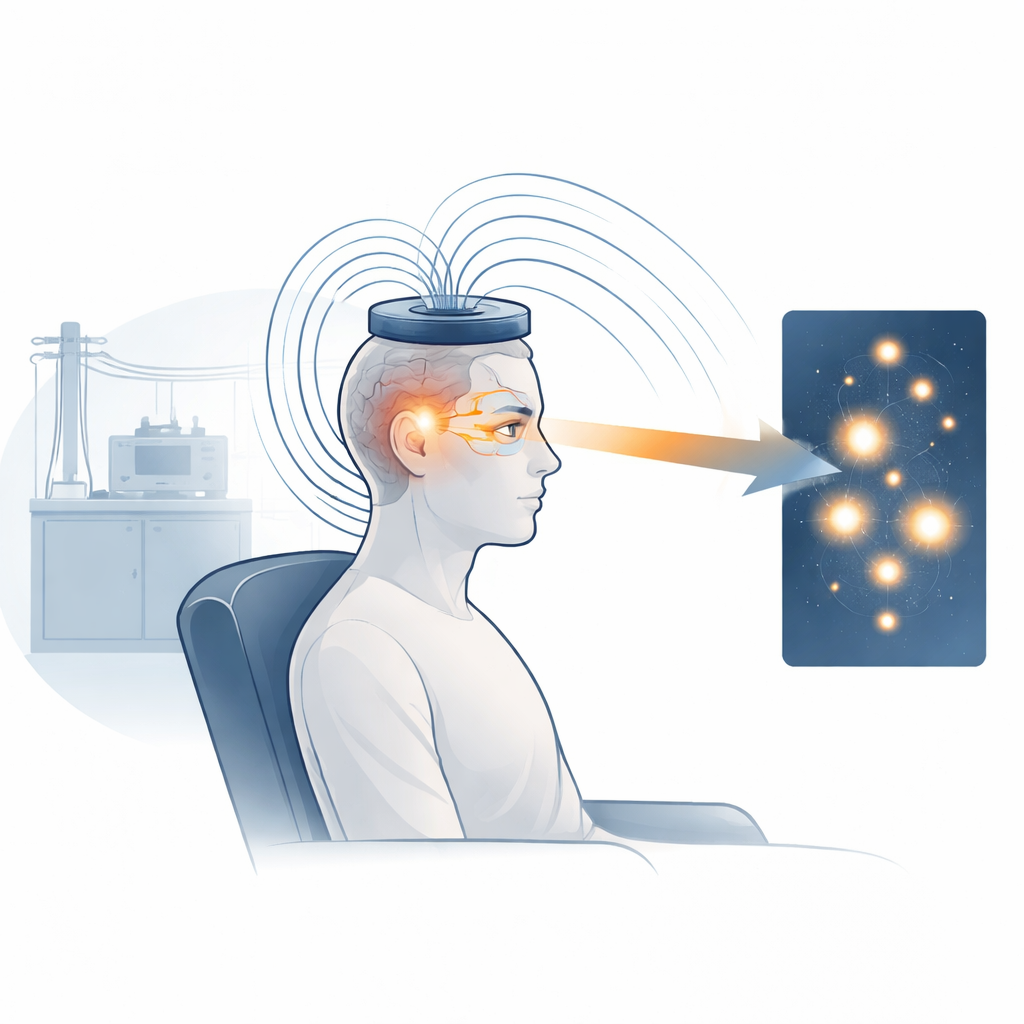
Imagine sitting in total darkness with your eyes closed and suddenly noticing a faint flicker of light, as if tiny stars were dancing behind your eyelids. No screen, no lamp, no laser—just a changing magnetic field outside your head. These ghostly flashes, called phosphenes, are more than a curiosity: they are one of the most sensitive ways scientists can tell how weak electric fields affect the human nervous system. This study tests a new, comfortable kind of magnetic brain stimulation and asks a simple but crucial question: do these flickers appear in a reliable, repeatable way, and where in the visual system do they really come from?
A New Way to Nudge the Brain
Traditional magnetic brain stimulation uses short, powerful pulses to jolt brain cells directly. The technique examined here, called transcranial alternating magnetic stimulation, instead uses gentle, rhythmic magnetic fields. These fields induce tiny electric currents in the head without touching the skin and without the tingling or itching often caused by methods that send current through scalp electrodes. Because international safety rules for power lines and other low‑frequency sources already rely on when people start to see phosphenes, this new approach offers a cleaner way to study those limits and to explore whether such fields might one day be used as a precise tool to probe or modulate brain function.
How the Experiment Was Done
The researchers recruited 62 healthy volunteers and placed them in complete darkness, with eyes closed and ears plugged. Each person was exposed to smoothly oscillating magnetic fields at three frequencies—20, 50, or 60 cycles per second—while the intensity was gradually stepped from zero up to levels strong enough to reliably cause phosphenes in earlier work. To pinpoint where in the head these flickers begin, the team used three coil setups: one aimed mainly at the eyes (retinal), one that surrounded the whole head (global), and one centered over the back of the head, where the visual cortex lies (occipital). For each brief stimulation, participants simply pressed a button to say whether they had seen a flicker or not, allowing the team to build up a detailed picture of how the chance of seeing phosphenes rose with field strength.
What the Flickers Revealed
The key finding is that the patterns of phosphene perception in this new experiment closely matched those from an earlier study using the same technique. When the eyes or whole head were targeted, the chance of seeing flickers rose steeply as the magnetic field changed more rapidly over time, while stimulation over the back of the head produced only weak and inconsistent effects. The lowest thresholds—meaning the greatest sensitivity—occurred at 20 Hz, which aligns with how the eye’s rod cells, tuned for dim light, respond over time. In some cases, a few volunteers reported colored glows, but most described the classic grayish, flickering patches. Statistical comparisons showed that the slopes and thresholds in this replication lined up remarkably well with the original results, even though the data were collected by five different experimenters.
Why the Retina Takes Center Stage
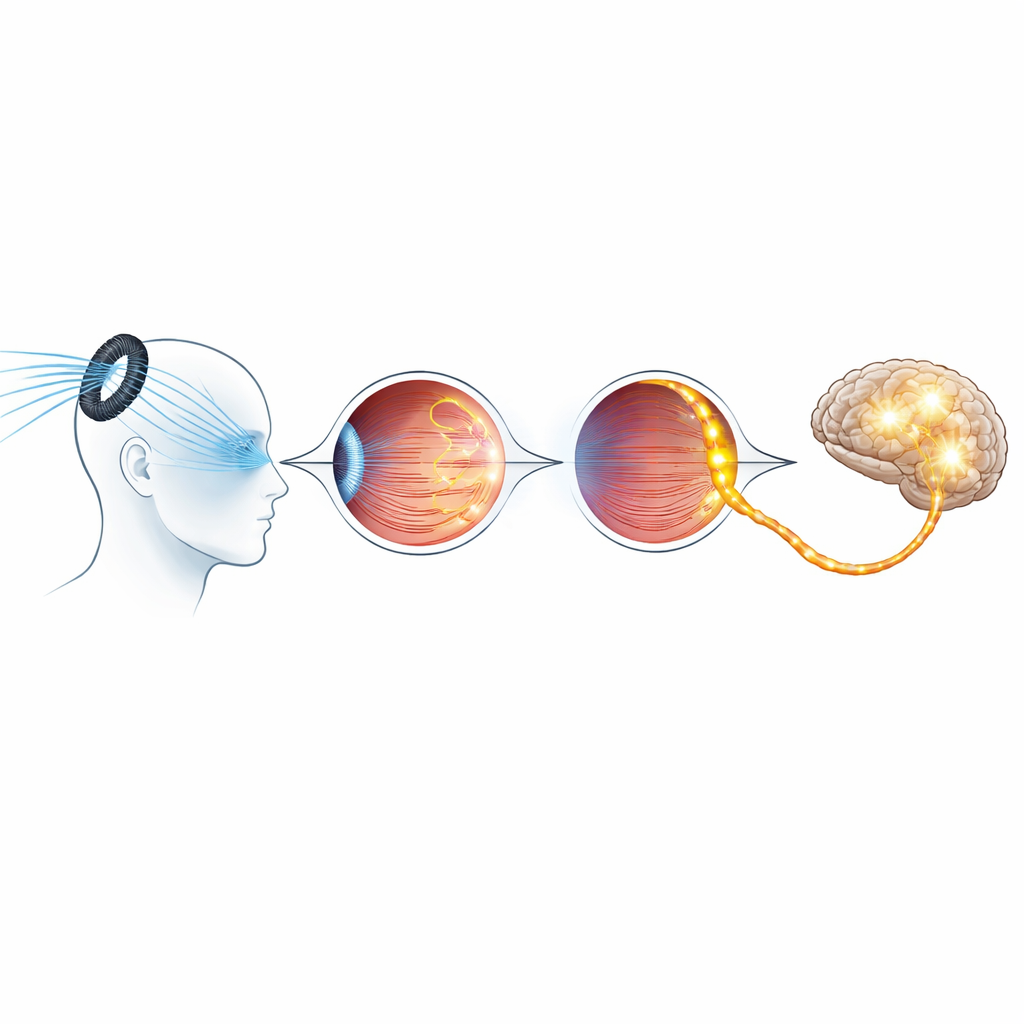
Because the same magnetic fields that barely produced effects when aimed at the visual cortex caused robust flickers when aimed at the eyes, the results strongly support a retinal origin for these magnetically induced phosphenes. Detailed computer models from earlier work suggest that the rods in the outer layer of the retina are especially sensitive to the tiny electric fields created there when the external magnetic field oscillates. Importantly, the retina is itself part of the central nervous system, built from the same kind of nerve cells and circuits as the brain. That makes it a convenient natural “sensor” for weak fields, yet the findings also caution that seeing phosphenes alone does not prove that deeper brain areas are being effectively controlled.
What This Means for Safety and Future Tools
By repeating earlier work with more volunteers and multiple operators, this study shows that the level of low‑frequency magnetic exposure needed to make people see phosphenes is highly reproducible. That stability strengthens the use of these thresholds as a cornerstone for international safety standards that aim to keep everyday exposures—near power lines, transformers, or new stimulation devices—well below levels that noticeably influence the nervous system. At the same time, the work highlights transcranial alternating magnetic stimulation as a promising, comfortable, and confound‑free way to probe how our visual system and, eventually, other parts of the brain respond to weak electric forces. Future studies combining this method with brain recordings and behavior tests will be needed to determine whether it can move from a sensitive sensor of neural responsiveness to a practical clinical tool.
Citation: Fresnel, E., Penault, M., Moulin, M. et al. Reproducible magnetophosphene thresholds induced by transcranial alternating magnetic stimulation in humans: a replication study. Sci Rep 16, 14368 (2026). https://doi.org/10.1038/s41598-026-44440-5
Keywords: magnetophosphenes, retinal stimulation, low-frequency magnetic fields, non-invasive brain stimulation, tAMS