Clear Sky Science · en
Precipitation-aware sensor ecosystem modelling for performance-driven autonomous vehicle navigation
Why safer self-driving in bad weather matters
Most current self-driving systems work best on clear, dry days. Yet real roads are often soaked in rain, coated with snow, or hammered by hail. In these moments, the very sensors that help a car "see" its surroundings can struggle, raising the risk of missed hazards or false alarms. This paper introduces a new way for autonomous vehicles to stay reliable when the weather turns ugly, by teaching the car to anticipate incoming rain or snow and to reshuffle how it trusts its different sensors in real time.
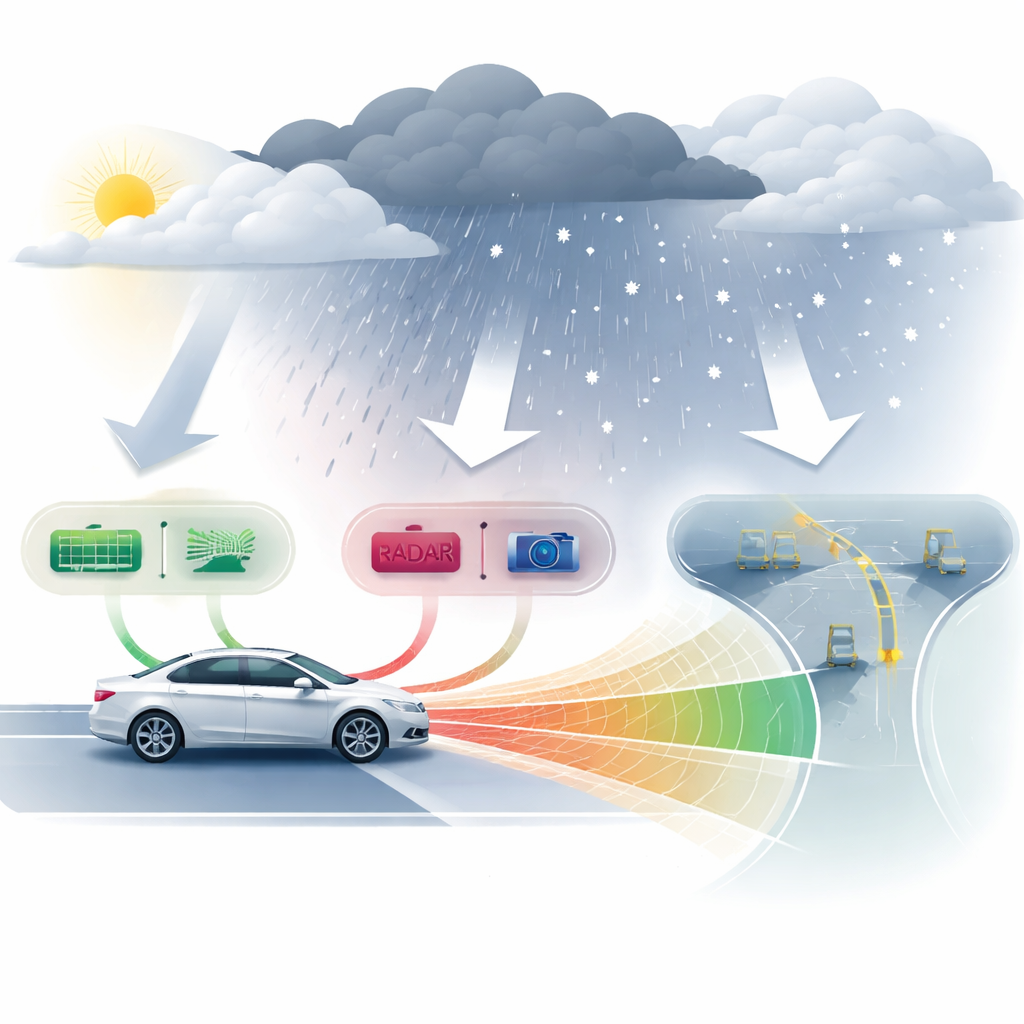
How driverless cars sense the world
Autonomous vehicles typically rely on three main sensing technologies. Laser scanners map the world in 3D, radar gauges distance and speed using radio waves, and cameras capture rich visual detail. Together they build a picture of pedestrians, cyclists, cars, and obstacles around the vehicle. However, each of these tools has weaknesses when the sky opens up. Raindrops and snowflakes can scatter laser beams, water on lenses can blur camera images, and heavy precipitation can add clutter to radar. Many current systems still combine these sensors with fixed, unchanging rules, as if every day were dry and sunny. That means the car may lean too heavily on a sensor that is temporarily half-blind.
Letting the car look ahead to the weather
The authors propose a framework that does something closer to what a cautious human driver might do: check the weather ahead and prepare. They use weather-radar data—similar to what powers many weather apps—to predict how much rain or snow will fall in the next half hour along the vehicle’s path. A machine-learning model turns these radar images into short-term rainfall forecasts on a fine grid around the car. From these predictions, the system creates a simple scale of how severe the precipitation will be, normalized between "no rain" and "very heavy rain." This severity score becomes a compact weather signal the vehicle can use continuously while it drives.
Teaching the car which sensors to trust
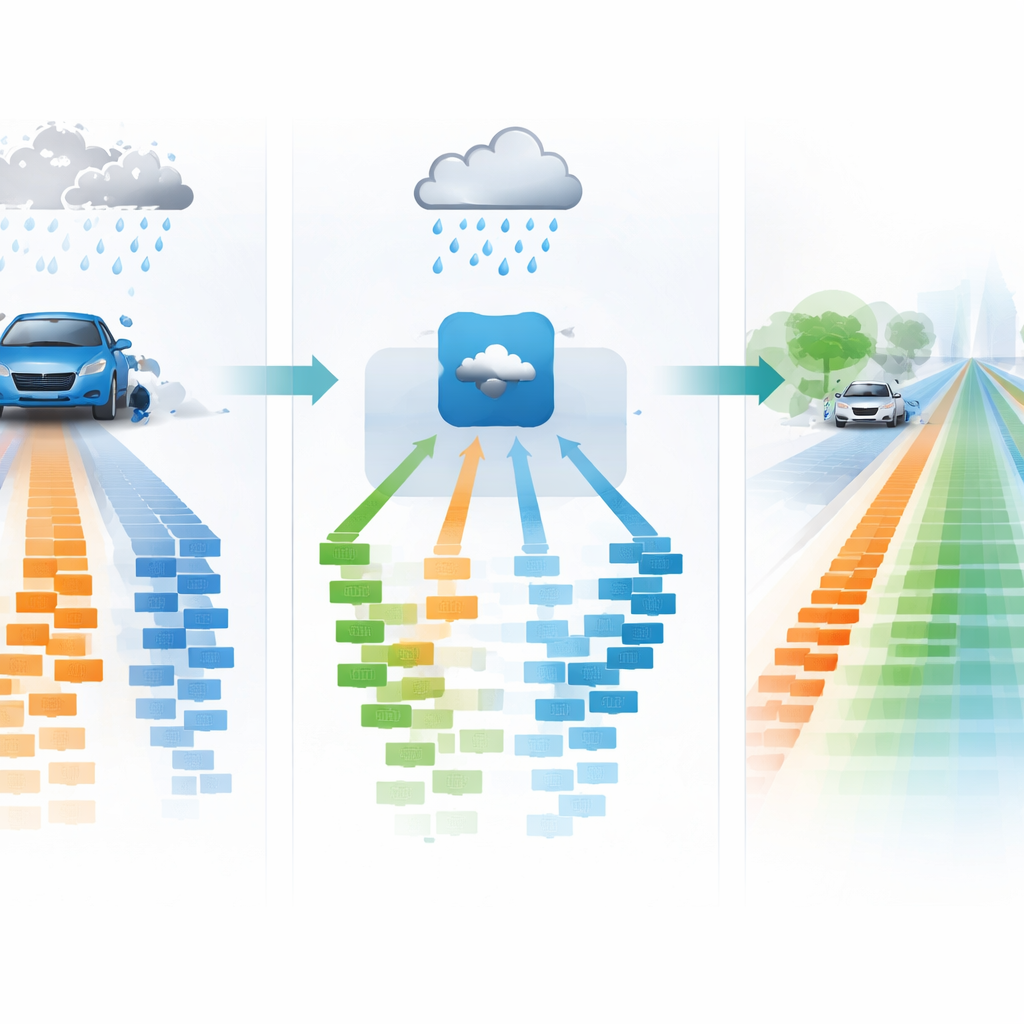
Knowing that a downpour is coming is only part of the story. The framework also learns how rain, snow, and hail actually degrade each type of sensor in practice. Using more than 4.5 terabytes of data collected over 320 hours of driving in different storms, the researchers measure how laser scans thin out, how camera images lose contrast, and how radar returns become noisier. A deep learning model converts these patterns into a reliability score for each sensor stream at every moment. A probabilistic decision module then turns these scores into weights that decide how much each sensor should influence the final picture of the scene. Crucially, these weights are updated continuously, smoothed over time to avoid sudden jumps, and always add up to a full picture.
From smarter fusion to safer behavior
To test their idea, the authors compare their adaptive system against a strong baseline that treats all three sensors equally regardless of weather. Both versions use the same underlying detection network and the same computing hardware, isolating the impact of the new strategy. Across city streets, suburbs, and highways, and under light rain, heavy rain, wet snow, and hail, the adaptive framework makes far fewer mistakes. Overall detection precision rises by more than 30 percentage points, false alarms drop by nearly 28 percent, and the time needed to perceive the scene falls from about 51 milliseconds to 43 milliseconds. Vulnerable road users such as pedestrians and cyclists see some of the largest gains, and the system maintains steadier performance in heavy rain than the fixed-weight alternative.
What this means for everyday travel
For a non-specialist, the key idea is straightforward: instead of assuming its electronic "eyes" always work equally well, a self-driving car can learn to predict when some of them will be compromised by rain or snow and adjust on the fly. By looking ahead at the weather, estimating how each sensor will hold up, and then blending their signals accordingly, the proposed system gives autonomous vehicles a more resilient sense of their surroundings. While it still faces challenges in the most extreme storms and depends on good weather-radar coverage, this approach brings fully autonomous driving a step closer to handling the messy, wet, and unpredictable conditions of real-world roads.
Citation: Kalra, S., Beniwal, R., Beniwal, N.S. et al. Precipitation-aware sensor ecosystem modelling for performance-driven autonomous vehicle navigation. Sci Rep 16, 14224 (2026). https://doi.org/10.1038/s41598-026-44435-2
Keywords: autonomous vehicles, sensor fusion, adverse weather, precipitation nowcasting, LiDAR radar cameras