Clear Sky Science · en
The deformation characteristics and the prefabricated crack pressure relief stability control of a small coal pillar roadway under stress superposition
Why underground coal roadways matter
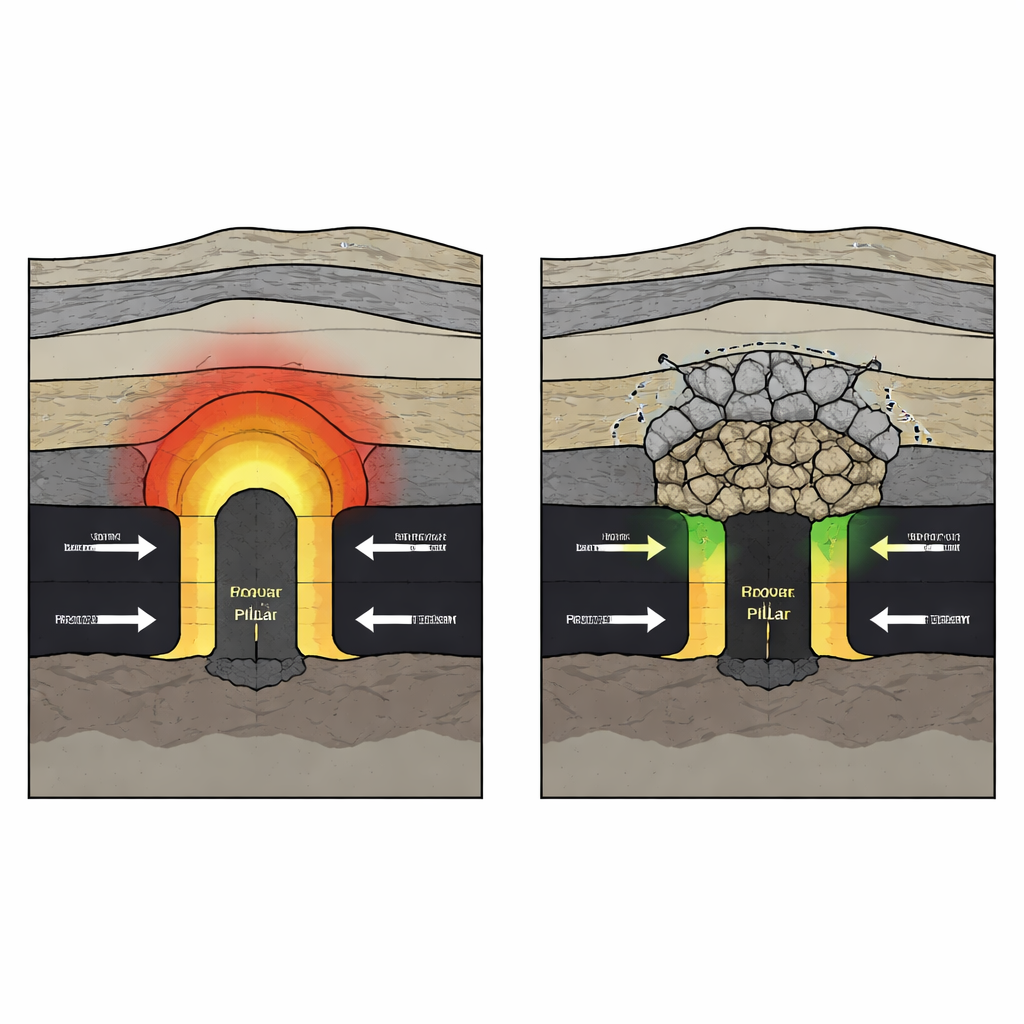
Much of the world’s coal is mined using long tunnels driven deep underground. Between these tunnels, thin "pillars" of coal are deliberately left in place to hold up the rock above. As operations intensify and engineers try to leave smaller pillars to recover more coal, these remaining blocks can become dangerously overstressed, causing the tunnel to squeeze, crack, or even fail. This paper explores how and why such small coal pillars become overloaded, and introduces a way to deliberately crack the rock roof above them so that stresses are safely relieved before serious damage occurs.
Hidden forces building up underground
The authors focus on a roadway – the main access tunnel – that runs beside a small coal pillar sandwiched between two mining panels. As each panel is excavated and the mining front moves, the rock around the pillar does not simply feel one push, but a series of repeated stress waves. Using computer models, the team simulated four key stages: cutting the first roadway, cutting the opposite roadway, retreating (mining back) the first panel, and then retreating the second. At each step the vertical load on the pillar climbed, eventually reaching more than three times the original rock stress and approaching or exceeding the measured strength of the coal. Under these compounded loads, the pillar and the roadway beside it are prone to crushing and serious deformation.
Energy stored like a compressed spring
To understand failure in a more physical way, the study tracks not only stress but also the elastic energy stored in the coal – the "spring energy" that builds up as the pillar is squeezed. Numerical simulations show that with each excavation step, this energy accumulates at the center of the small pillar. During panel retreat, the energy density more than doubles compared with the roadway-excavation stage, eventually surpassing the level at which lab-tested coal samples fail. By the time the second panel advances, the energy stored in the pillar is high enough to approach conditions associated with violent rock bursts. In other words, the pillar is not just over-stressed; it is primed to release energy suddenly, threatening both roadway stability and miner safety.
Making the roof break where and when we want
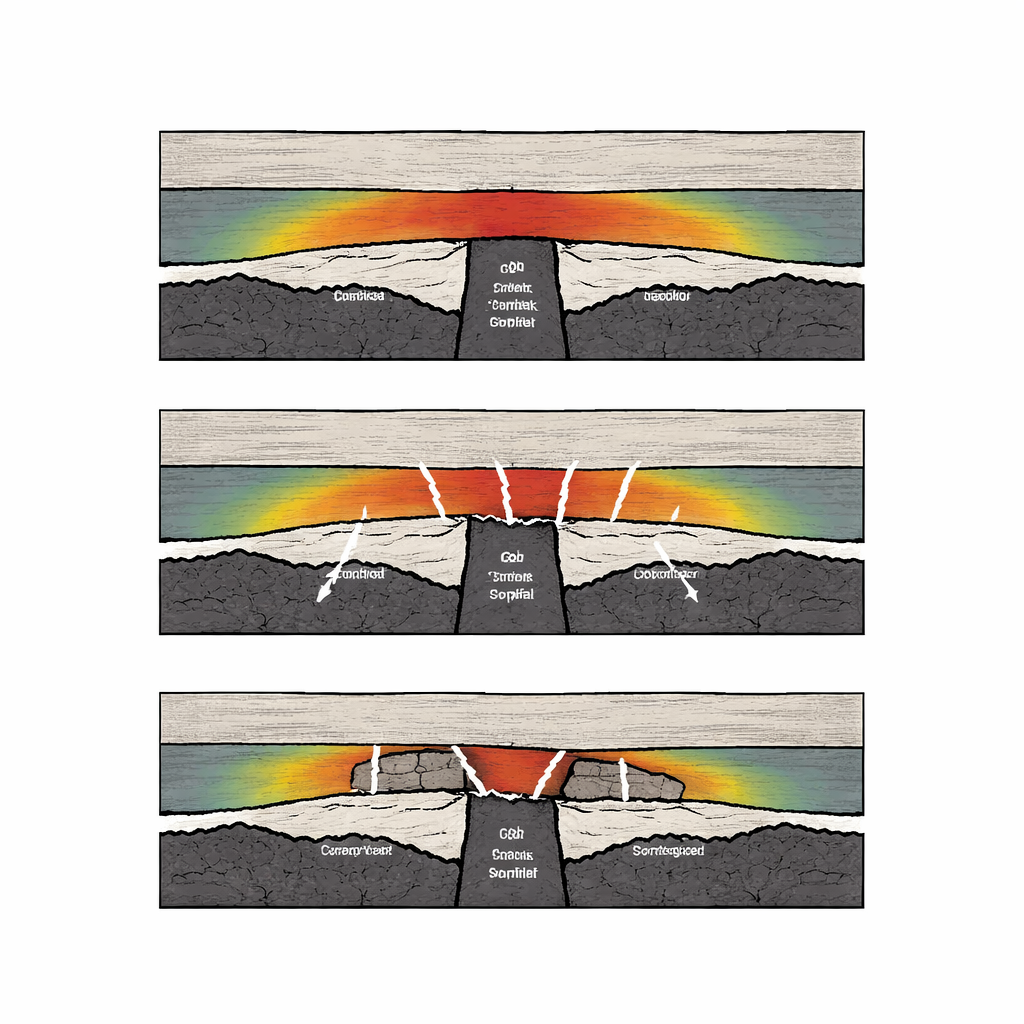
Instead of simply adding more supports in the roadway – which quickly becomes crowded and still may not be enough – the authors test a different idea: deliberately weakening the roof a short distance above the small pillar so that it caves in a controlled way. Through scaled physical models, they compare two cases: one with a strong, unbroken roof and one where a narrow vertical zone of prefabricated cracks is introduced above the roadway using a technique similar to directional blasting. In the intact case, a long, stiff roof beam hangs over the mined-out void, forming a long cantilever that transfers large loads back into the pillar. In the cracked case, the main roof breaks earlier along the prefabricated fractures, the caving angle becomes steeper, and the overhanging beam shortens by nearly half. Broken rock falls and packs tightly into the void, helping to support the remaining roof and lowering the load transmitted to the small pillar.
Watching the rock layers move
The team uses careful photography and displacement measurements in their models to track how rock layers move as mining progresses. They find that prefabricated cracks cause greater, earlier settlement in the upper layers directly above the crack zone, which speeds up the compaction of the broken rock in the mined-out area. At the same time, movement in the lower layers and in the adjacent panel’s gob changes only slightly, meaning the disturbance is largely confined to where it is intended. Stress sensors embedded in the model roof show that within a few crack-heights above the coal seam, vertical stress drops by more than 10 percent compared with an intact roof. Beyond that height, the rock "forgets" about the crack and stress levels even out, indicating a well-bounded influence zone.
Proof from a working coal mine
To verify the method, the authors apply deep-hole directional pre-splitting in the roof of a real roadway at the Wangzhuang Coal Mine in China. Long boreholes are drilled from the roadway into the roof, then loaded with shaped explosive charges to cut a vertical fracture zone above the small pillar. As the mining panel retreats, stress gauges installed in boreholes inside the pillar record the changing loads. In the section without roof cracking, stress increases by about 5.5 megapascals at 3 meters depth. In the cracked section, the increase is less than half that value, around 2.5 megapascals. Similar reductions are observed deeper in the pillar, demonstrating that the engineered fractures substantially ease the pressure on the roadway and the pillar.
What this means for safer, cleaner coal extraction
For non-specialists, the key idea is that small coal pillars can become dangerously overloaded as nearby panels are mined, not just once but repeatedly. By intentionally introducing cracks in the rock roof above these pillars, engineers can make the roof break in a more favorable pattern: it caves sooner, at a steeper angle, and over a shorter span, allowing broken rock to act as a natural cushion and support. The study’s simulations, laboratory-scale models, and full-scale field tests all point to the same conclusion: this controlled-cracking approach reduces stress concentration and deformation around small coal pillar roadways, helping to keep tunnels more stable while still allowing a high recovery of coal.
Citation: Cheng, S., Ma, Z., Li, Y. et al. The deformation characteristics and the prefabricated crack pressure relief stability control of a small coal pillar roadway under stress superposition. Sci Rep 16, 10850 (2026). https://doi.org/10.1038/s41598-026-44430-7
Keywords: coal pillar stability, underground roadway support, roof cracking, rock burst control, longwall mining