Clear Sky Science · en
scRNA-seq reveals different cell clusters in the testes of Mongolian cattle and EGR1/FOS/JUN regulation in Sertoli cells
How hardy cattle keep their fertility
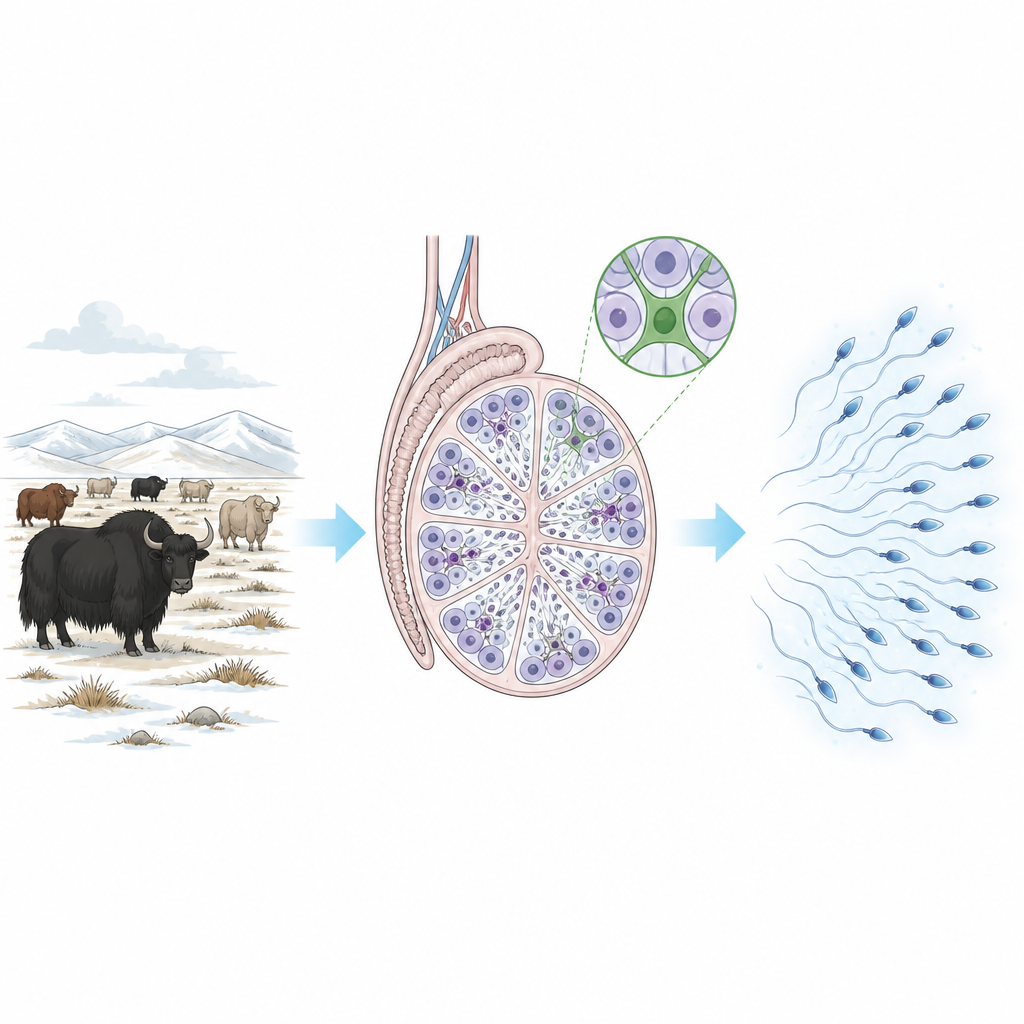
Mongolian cattle are famous for thriving on frozen grasslands where winters are long, food is scarce, and conditions are harsh. Yet their bulls still produce enough healthy sperm to sustain herds of meat and dairy animals. This study asks a basic question behind that success: what is happening inside their testes at the level of individual cells that helps safeguard fertility in such a tough environment?
The many cell types inside a testis
The researchers began by taking small samples of testes from young and adult Mongolian cattle and reading out the genes switched on in more than forty thousand single cells. Using this single cell map, they could sort the cells into familiar groups such as sperm precursors, hormone producing cells, immune cells and blood vessel cells. They found that adult animals had more total testis cells, while the younger animals had a larger share of a crucial support cell type that lines the tubes where sperm develop. This suggested that changes in these support cells over time might be central to how the testis matures and maintains sperm production.
Four stages of a key support cell
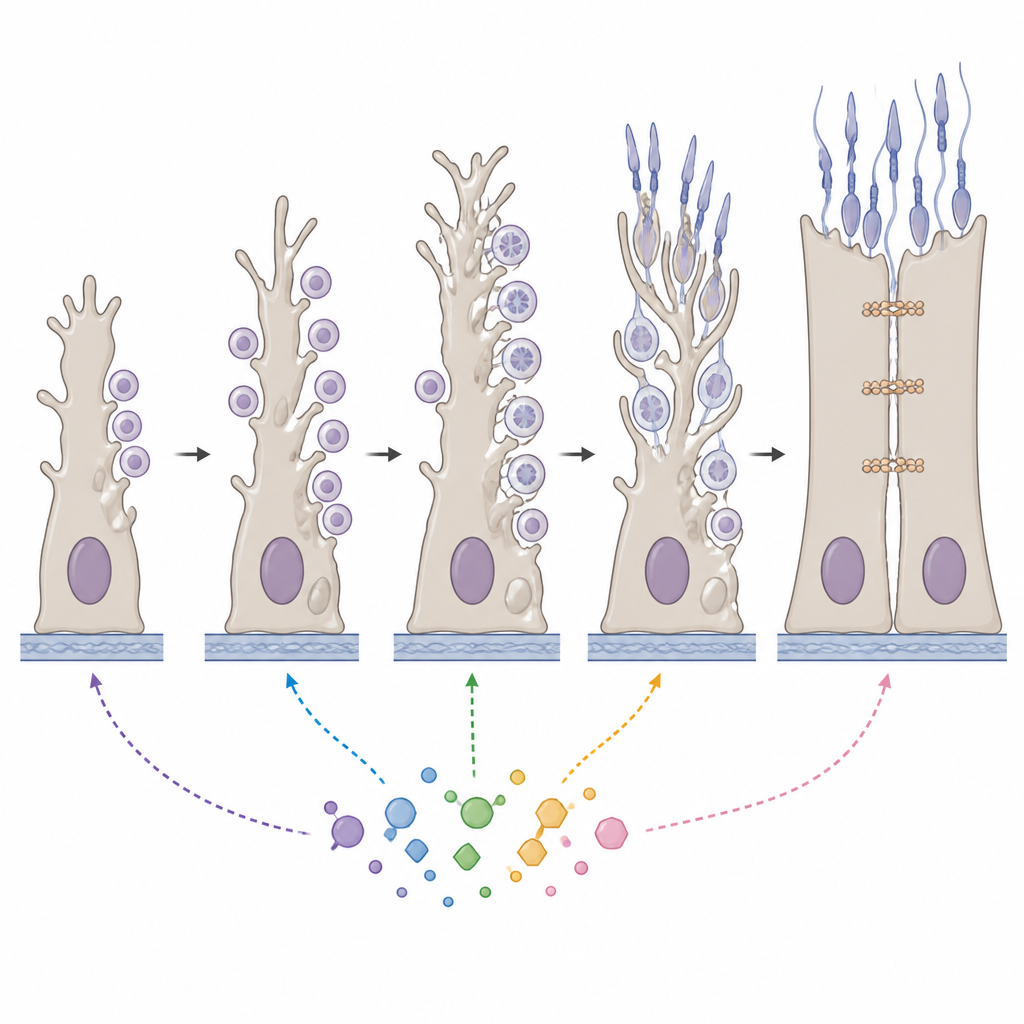
Focusing on these support cells, called Sertoli cells, the team discovered that they were not all the same. Instead they fell into four distinct clusters that formed a smooth path from immature to fully mature cells. In calves, all four stages were present in similar numbers, but in adults the final, mature stage dominated. Gene activity shifted along this path: early stage cells were very active and expressed many genes linked to cell regulation and stress responses, while late stage cells emphasized genes tied to sperm handling and testis structure. Two middle stages appeared specialized for making large amounts of protein to support this transition.
A control switch for cell maturation
Among the early stage genes, one stood out as an apparent control switch: a regulator called EGR1. Its activity dropped sharply as Sertoli cells matured, hinting that it might help launch the developmental program. By comparing Mongolian cattle with Holstein cattle and water buffalo, the authors showed that this early Sertoli cell state and its gene signature, including EGR1, appeared across species, although with different strengths. This suggested that the same basic machinery for starting and guiding Sertoli cell maturation is shared among these animals, even if local breeds like Mongolian cattle may tune it differently.
Signals that help build a secure barrier
To test what EGR1 actually does, the scientists isolated Sertoli cells and altered the amount of this regulator. When they reduced EGR1, levels of two partner proteins, FOS and JUN, dropped; when they boosted EGR1, FOS and JUN rose. Further experiments showed that EGR1 can physically bind near the genes for FOS and JUN, switching them on directly. Together FOS and JUN form a known control unit that in turn activates Nectin 2, a molecule that helps glue Sertoli cells together at the blood testis barrier. This barrier separates developing sperm from the immune system and harmful substances, and is vital for normal sperm development.
What this means for cattle fertility
In simple terms, the study reveals a chain of signals inside testis support cells that helps them grow up and lock together to form a protective wall around developing sperm. EGR1 sits near the top of this chain, turning on FOS and JUN, which then promote Nectin 2 and strong cell junctions. By charting this pathway cell by cell in Mongolian cattle, the work offers a cellular explanation for how their testes stay functional under challenging conditions, and provides a framework for comparing fertility traits and testis health across different cattle breeds.
Citation: Gao, S., Zhang, S., Ren, H. et al. scRNA-seq reveals different cell clusters in the testes of Mongolian cattle and EGR1/FOS/JUN regulation in Sertoli cells. Sci Rep 16, 15371 (2026). https://doi.org/10.1038/s41598-026-44429-0
Keywords: Mongolian cattle, Sertoli cells, single cell RNA sequencing, testis development, spermatogenesis