Clear Sky Science · en
High precision measurements of the hyperfine structure of Vanadium ions in the ultraviolet range
Why tiny shifts in metal atoms matter
Stars, planets, and even meteorites carry a detailed chemical fingerprint written in the light they emit. To read that fingerprint correctly, scientists need very precise reference data from the laboratory. This study focuses on vanadium, a metal common in industry and visible in stellar spectra, and measures its internal atomic “fine print” in unprecedented detail using ultraviolet laser light. The results help astronomers extract more accurate stories about how stars evolve and how elements were forged in the cosmos.
A closer look at a stubborn metal
Vanadium belongs to a family of tough, high‑melting metals that resist vaporization, making them particularly important in astrophysics and cosmochemistry. In the Sun and many stars, vanadium leaves a dense forest of spectral lines—thin colored stripes when starlight is spread out by a prism or spectrograph. However, these lines are not single, simple features. Because of the interaction between the nucleus and its surrounding electrons, each line is split into many closely spaced components, known collectively as hyperfine structure. If this intricate structure is ignored, astronomers can misjudge how much vanadium is present in a star, and thus misinterpret its chemical history.
Probing ions with overlapping beams
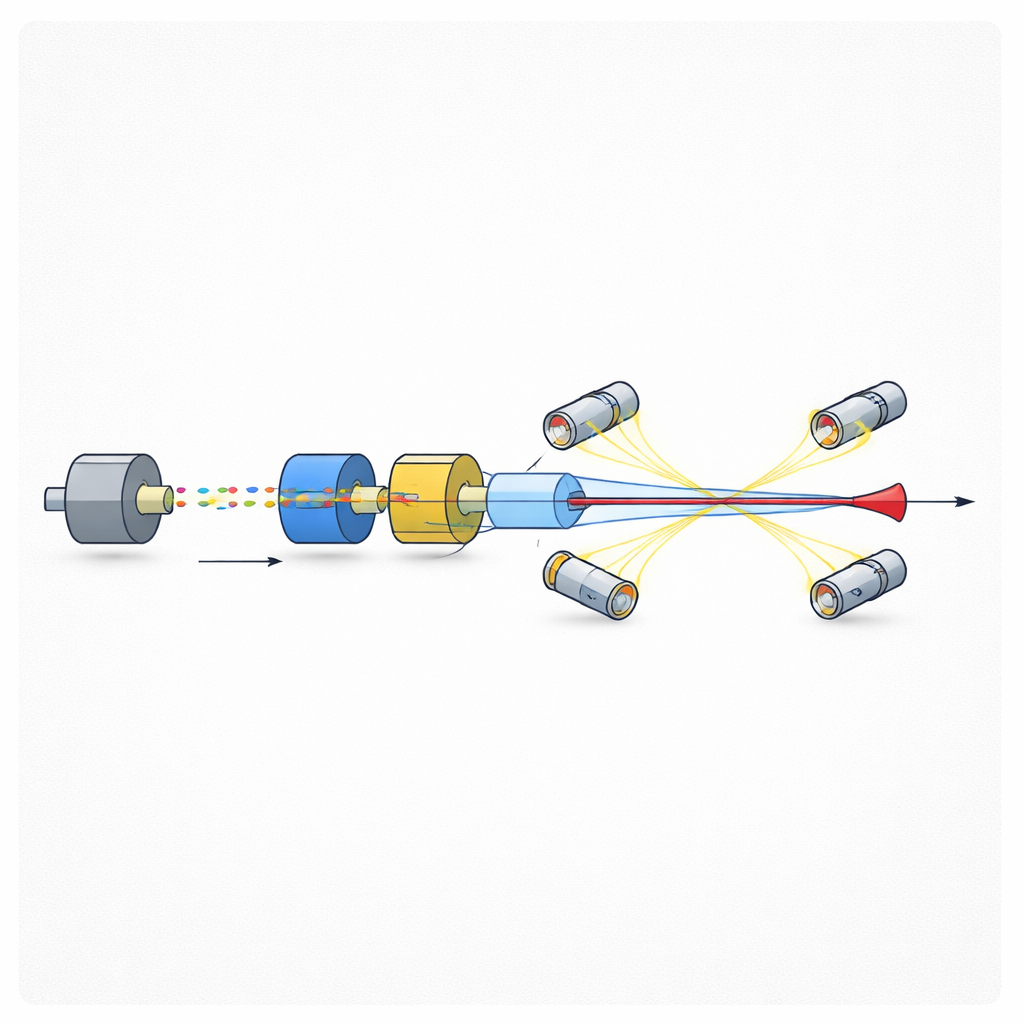
The researchers studied singly charged vanadium ions, where one electron has been removed, because this form appears frequently in hot stellar atmospheres. At the IGISOL facility in Finland, they produced beams of vanadium ions, accelerated them to high speed, cooled and bunched them, and then sent them through a long vacuum tube. There, a narrow, continuous laser beam in the ultraviolet range was aimed directly against the ion beam, so that ions and light met head‑on. By slightly adjusting the electrical voltage on the beamline, the scientists used the Doppler effect to tune the ions into resonance with the laser, causing them to fluoresce—emit tiny flashes of light that were collected by sensitive detectors.
Unraveling the hidden patterns
In total, the team explored eleven different ultraviolet transitions between specific energy levels in the vanadium ion. Each measured spectrum showed a cluster of peaks corresponding to separate hyperfine components. Sophisticated computer models were used to fit these peaks, taking into account how nuclear magnetism and electric charge distribution disturb the energy levels. From these fits, the scientists extracted two key sets of numbers that describe the interaction between the nucleus and its electrons: the magnetic dipole and electric quadrupole constants. Compared with earlier measurements made with lower‑resolution techniques, the new values are up to about one hundred times more precise, and several of the electric quadrupole parameters were determined experimentally for the first time in this ion.
Weighing the difference between isotopes
Vanadium naturally occurs in two isotopes, which have the same number of protons but slightly different numbers of neutrons in the nucleus. These subtle differences affect the exact color of the light they absorb and emit, shifting each spectral line by a tiny amount. For five especially strong transitions, the team measured the shift between the two isotopes with high accuracy. Because the isotopes were recorded under nearly identical conditions and compared directly, many sources of experimental error canceled out. These isotope shifts provide an essential link between what is measured in the lab and the size and shape of the atomic nucleus, helping nuclear physicists track how nuclear charge radii change across a range of vanadium isotopes.

What this means for stars and nuclei
By pinning down the hyperfine structure and isotope shifts of vanadium ions with such precision, this work delivers a new, reliable reference set for both atomic and nuclear physics. Astronomers can now model vanadium’s spectral fingerprints in stellar atmospheres more faithfully, leading to better estimates of stellar metallicities and a clearer picture of how elements are produced and recycled in the Galaxy. At the same time, the identified high‑quality transitions pave the way for future experiments on short‑lived vanadium isotopes, which will shed light on how nuclear shapes and sizes evolve in this important region of the nuclear chart.
Citation: Karadimas, A., Bettaney, D., Campbell, P. et al. High precision measurements of the hyperfine structure of Vanadium ions in the ultraviolet range. Sci Rep 16, 13670 (2026). https://doi.org/10.1038/s41598-026-44426-3
Keywords: vanadium ions, hyperfine structure, laser spectroscopy, isotope shifts, stellar spectra