Clear Sky Science · en
Optimization of hospital resource scheduling efficiency based on dynamic weighted distance anomaly detection algorithm
Why smarter hospitals matter
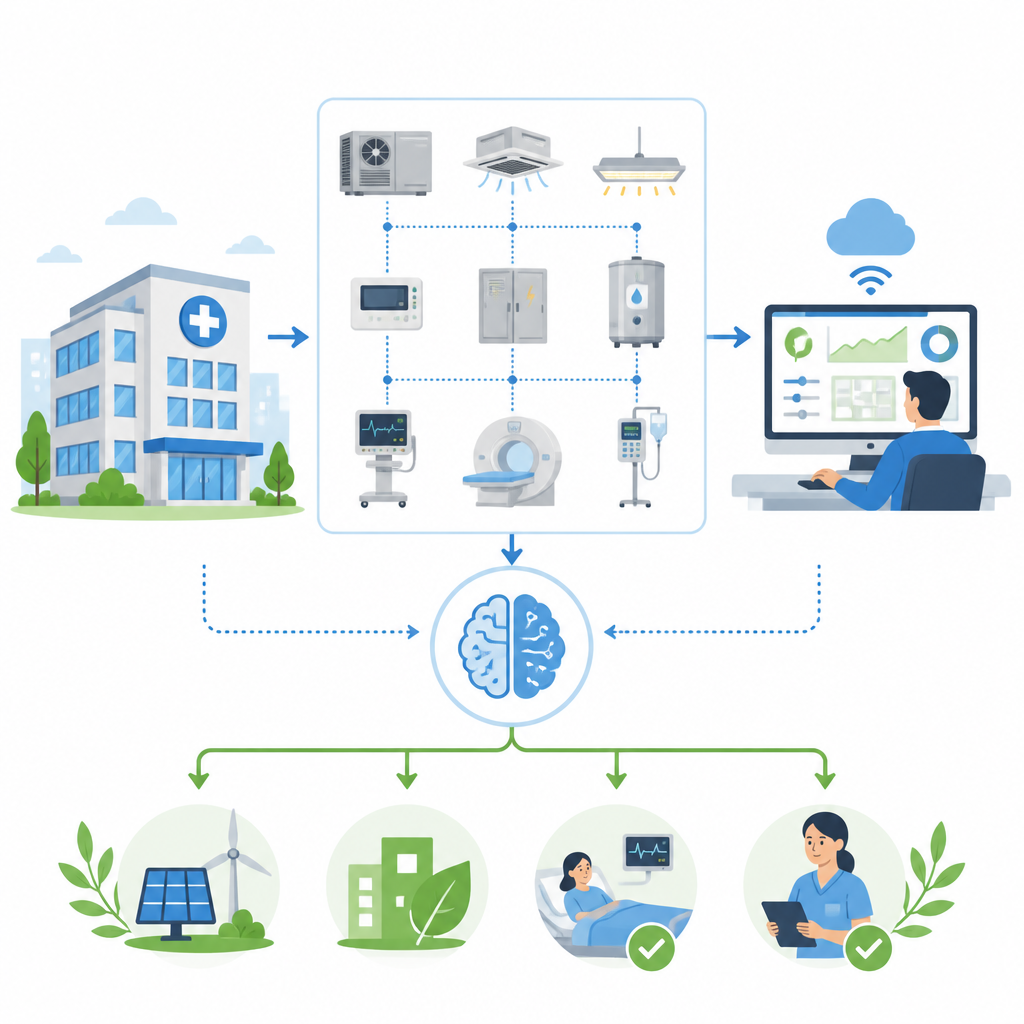
Modern hospitals run around the clock, drawing huge amounts of power to keep scanners humming, air clean, and patients safe. Yet much of this energy is scheduled and monitored with blunt tools that react slowly when something goes wrong, wasting money and adding risk. This study explores how an intelligent digital control system can watch hospital equipment in real time, spot unusual behavior quickly, and reshuffle computing and energy resources so care stays fast while power use becomes far more efficient.
The hidden heartbeat of hospital machines
Behind every ward and operating room lies a web of devices: heavy power users such as MRI scanners and ventilation systems, everyday lighting, and countless sensors. Today, many hospitals struggle with overloaded equipment in one area while others sit underused, and abnormal power use can go unnoticed for hours. The authors show that large facilities can consume tens of millions of kilowatt-hours a year, with heating, cooling, and clean air taking up to 60 percent of that bill. Traditional rule lists and simple machine learning tools often miss subtle warning signs, especially when the loud "noise" of big machines drowns out the small signals from low-power devices.
Teaching the system to notice what really matters
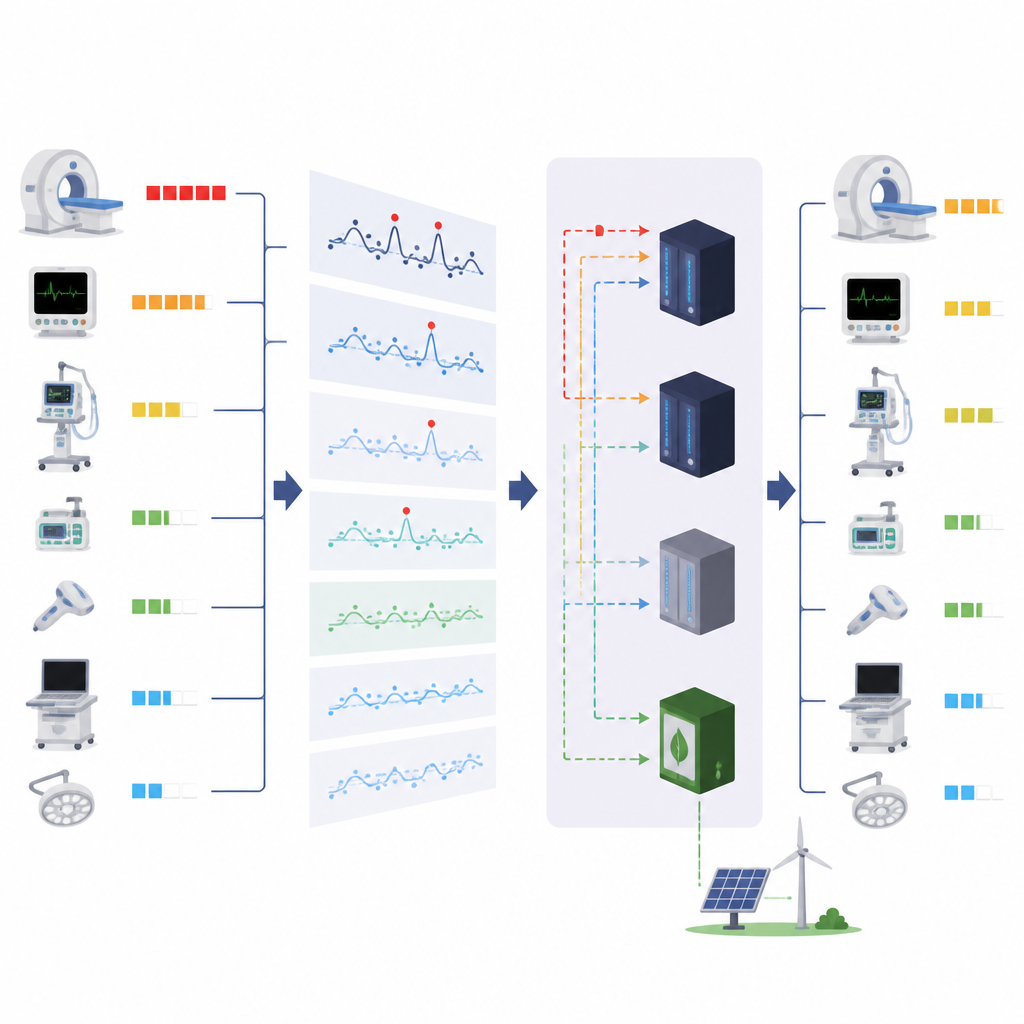
To tackle this, the researchers design a new way for the computer to measure differences in device behavior. Instead of treating every reading the same, their method gives more weight to equipment that is critical for patient care and adjusts for how wildly each device normally swings in energy use. A ventilator or MRI may spike during normal work, while ward lights should stay steady. By sliding through recent data in short time blocks and constantly updating what “normal” looks like, the system can raise an alert when a small but important device starts acting oddly or when a large unit shows a pattern that no longer fits its usual rhythm. In tests on a real hospital’s data, this approach spotted abnormal energy events with over 95 percent accuracy, and did so in just a few thousandths of a second per reading.
Letting computers reshuffle work on the fly
Spotting trouble is only half the story; the next step is acting on it. The team builds a two-stage scheduling framework that first fences off suspicious tasks so they cannot drag down the rest of the system. Using a cloud platform, abnormal energy users are moved into their own virtual “rooms,” while normal tasks continue elsewhere. Then, for the healthy workload, a second layer based on containers and small services searches for ways to place jobs on servers that keep communication fast and power use low. The scheduling engine borrows ideas from evolution and controlled random search to escape bad choices and steadily refine better ones. In practice, this setup improved overall energy efficiency to nearly 90 percent and held the response time for critical tasks, such as patient monitoring alerts, to under five seconds.
Keeping data safe while saving energy
Because hospital systems handle sensitive medical and building data, the authors weave a light but continuous security layer into their design. A scanning engine checks virtual machines and containers for known weaknesses, ranking them by how easily they could be misused and how recent the fixes are. A streamlined encryption scheme protects information in motion and at rest, while access rules adapt to context such as device location and unusual behavior. These protections are tightly connected to the scheduler: when a serious flaw is found, affected tasks can be moved automatically, and encryption keys can be refreshed without slowing the rest of the system too much. In tests, vulnerability checks ran faster and caught more issues than older methods, with a modest cost in extra computing effort.
What this means for future smart hospitals
Overall, the study shows that hospitals can move from reacting late to energy and network problems toward predicting and containing them in near real time. By combining sharper anomaly detection, flexible scheduling, and built-in security, the proposed framework cut waste, kept critical services quick, and reduced the chance that hidden faults or attacks would ripple through the infrastructure. The work was demonstrated at a single large hospital and used partly simulated rare events, so its performance in smaller or very different facilities remains to be tested. Even so, it points toward a future in which hospital buildings quietly tune themselves, supporting reliable care while using less energy and keeping patient data safer.
Citation: Liu, Y., Mai, L., Huang, F. et al. Optimization of hospital resource scheduling efficiency based on dynamic weighted distance anomaly detection algorithm. Sci Rep 16, 16076 (2026). https://doi.org/10.1038/s41598-026-44415-6
Keywords: hospital energy management, anomaly detection, resource scheduling, smart hospital, healthcare IT