Clear Sky Science · en
Photosynthetic pigments in developing seeds of Acer platanoides and Acer pseudoplatanus
Why Green Seeds Matter
Most of us think of seeds as dry, brown specks waiting for the right moment to sprout. But many seeds actually pass through a bright green stage, quietly using sunlight while still inside the fruit. This study looks at two familiar maple trees and asks a deceptively simple question: how do the green pigments inside their developing seeds shape how long those seeds can survive in storage? The answer helps explain why some seeds tolerate drying and long-term storage, while others quickly lose the ability to germinate—an issue that matters for forest regeneration, seed banks, and adapting forests to climate change.
Two Maples, Two Survival Strategies
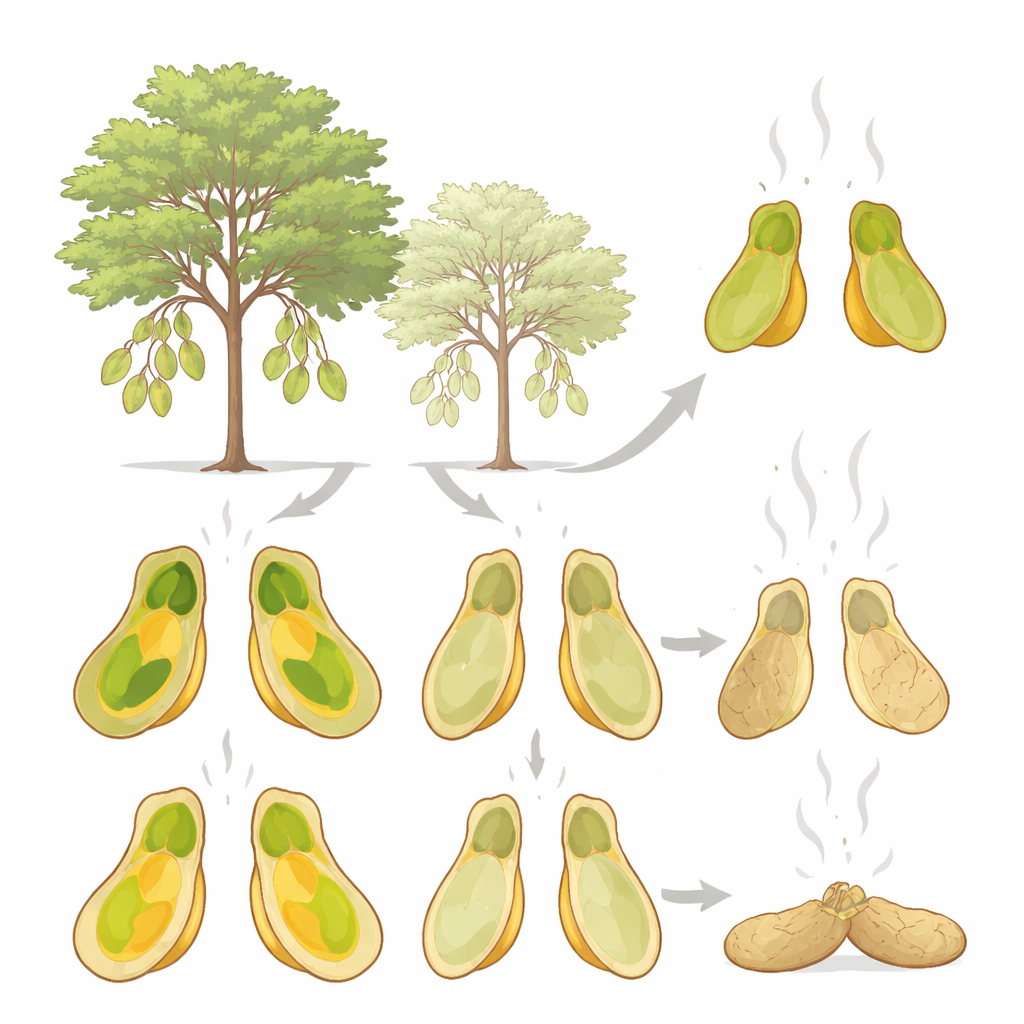
The researchers compared seeds from Norway maple (Acer platanoides) and sycamore maple (Acer pseudoplatanus), close relatives that differ drastically in how well their seeds handle drying. Norway maple seeds are “orthodox”: they can be dried and stored for a long time. Sycamore maple seeds are “recalcitrant”: they are sensitive to drying and rapidly lose viability. The team tracked these seeds from early embryo formation through full maturity and drying, measuring levels of the main green pigments (chlorophyll a and b), protective orange pigments (carotenoids), and the activity of photosystem II—a key component of the light-harvesting machinery. They also used microscopy to visualize where chlorophyll was located inside seed tissues.
Rising and Falling Green Pigments
In both species, chlorophyll levels rose as the embryos formed and seeds took shape, then declined as the seeds matured. Chlorophyll a was always more abundant than chlorophyll b, especially in the seed leaves (cotyledons). However, the magnitude of the decline differed sharply: in Norway maple, chlorophyll dropped by up to eightfold during late development and drying, whereas in sycamore maple it decreased only about threefold. Total chlorophyll peaked during the active “morphogenesis” phase, when seed structures are being built, and then fell as the seeds approached maturity. By the time the seeds were fully dry, both species had similar overall chlorophyll levels, despite having taken very different pigment “paths” to reach that point.
Light Use and Protective Pigments
Measurements of photosystem II fluorescence showed that developing seeds were not just green—they were photosynthetically active. Sycamore maple seeds often showed higher light-harvesting activity than Norway maple, particularly at the very beginning and the very end of development and during partial drying. Carotenoids, which can both assist in light capture and protect cells from excess light and oxidative damage, behaved differently in the two species. Sycamore maple had especially high carotenoid levels early on, suggesting a strong protective role while chlorophyll was building up. The ratio of carotenoids to chlorophyll shifted over time and during drying, hinting at how each species balances energy capture with protection against stress.
Inside the Seed: Changing Structures
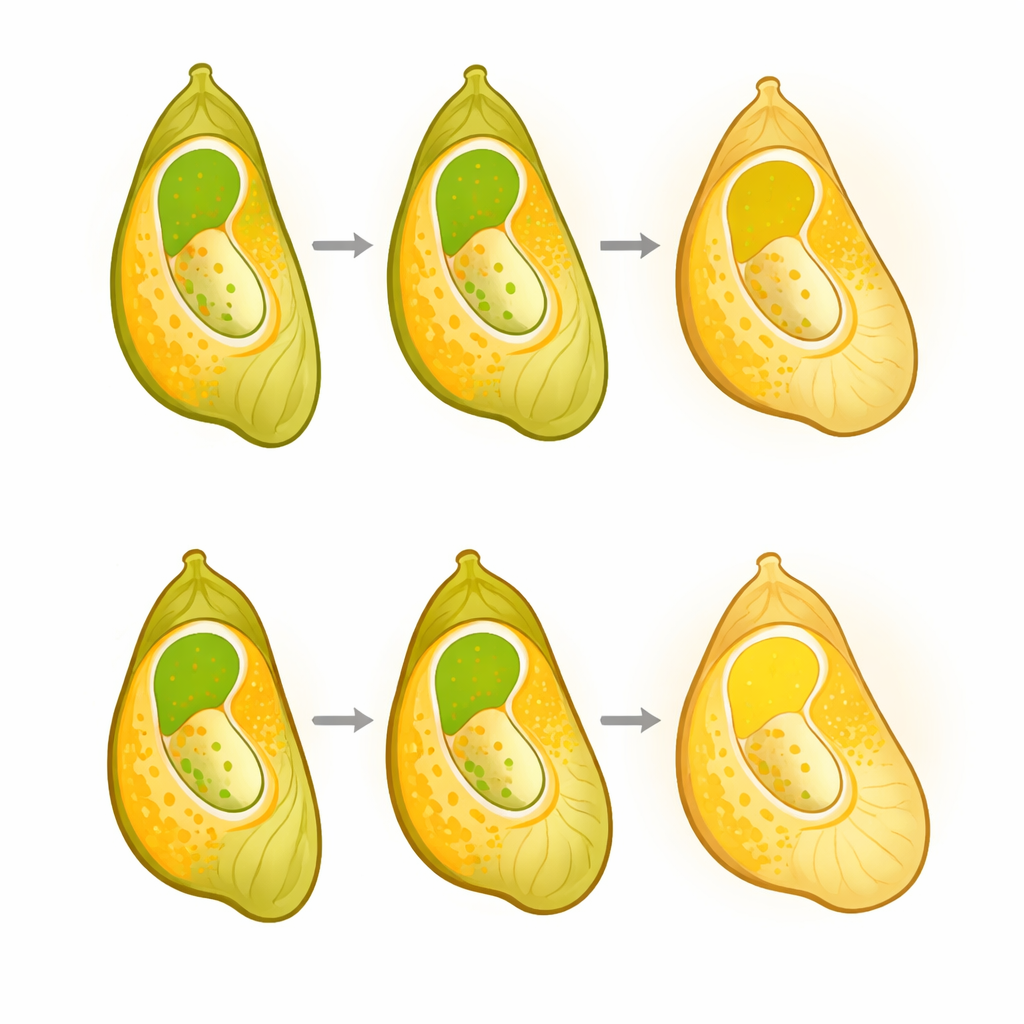
Microscopy offered a window into the inner architecture of the seeds. In both maples, chlorophyll autofluorescence in the embryonic axis—the part that will become the young stem and root—appeared irregular and diffuse. In sycamore maple cotyledons, the pattern was similarly diffuse. Norway maple cotyledons, however, showed a second, striking pattern: compact, spherical fluorescence spots. These suggest that some chloroplasts—the green organelles that perform photosynthesis—may be reorganizing or transforming into non‑photosynthetic forms as the seeds dry. Such structural “dismantling” of chloroplasts has been linked in other species to longer seed life and better tolerance of desiccation.
What This Means for Seed Longevity
Taken together, the findings point to two distinct strategies. Norway maple seeds strongly reduce their chlorophyll and likely reorganize chloroplasts as they mature and dry, changes that are typical of long‑lived, dry‑tolerant seeds. Sycamore maple seeds do degrade some chlorophyll but appear to maintain more active photosynthetic machinery and less evidence of chloroplast reworking. This may help them during development but leaves them poorly prepared for deep drying and long storage. For foresters and seed conservationists, these pigment and structural differences help explain why some species easily supply durable seed stocks, while others demand careful, short‑term handling to ensure that future forests can still grow.
Citation: Mokhtari, A.M., Wojciechowska, N., Kowalski, A. et al. Photosynthetic pigments in developing seeds of Acer platanoides and Acer pseudoplatanus. Sci Rep 16, 14443 (2026). https://doi.org/10.1038/s41598-026-44414-7
Keywords: seed longevity, maple seeds, chlorophyll, photosynthesis, desiccation tolerance