Clear Sky Science · en
Quantum machine learning for predicting anastomotic leak: a clinical study
Why this study matters for patients and doctors
Anastomotic leak is a dangerous complication that can occur after surgeons reconnect a patient’s bowel, and it can lead to infection, more operations, or even death. This study asks a timely question: can new quantum computer inspired tools help doctors spot which patients are most at risk better than today’s standard statistical and machine learning methods, using the same small but carefully collected hospital data?
Understanding a serious surgical complication
When part of the intestine is removed, surgeons join the remaining ends in a connection called an anastomosis. If this join fails to heal, bowel contents can leak into the abdomen, causing inflammation, sepsis, and a long, risky recovery. In the hospital studied, leaks occurred in about 14 percent of patients and were linked to up to 40 percent of surgery related deaths, so even small improvements in prediction could save lives. Earlier research has highlighted risk factors such as diabetes and smoking, and has shown that certain surgical techniques and monitoring tools can lower the chance of a leak.
What the researchers measured in real patients
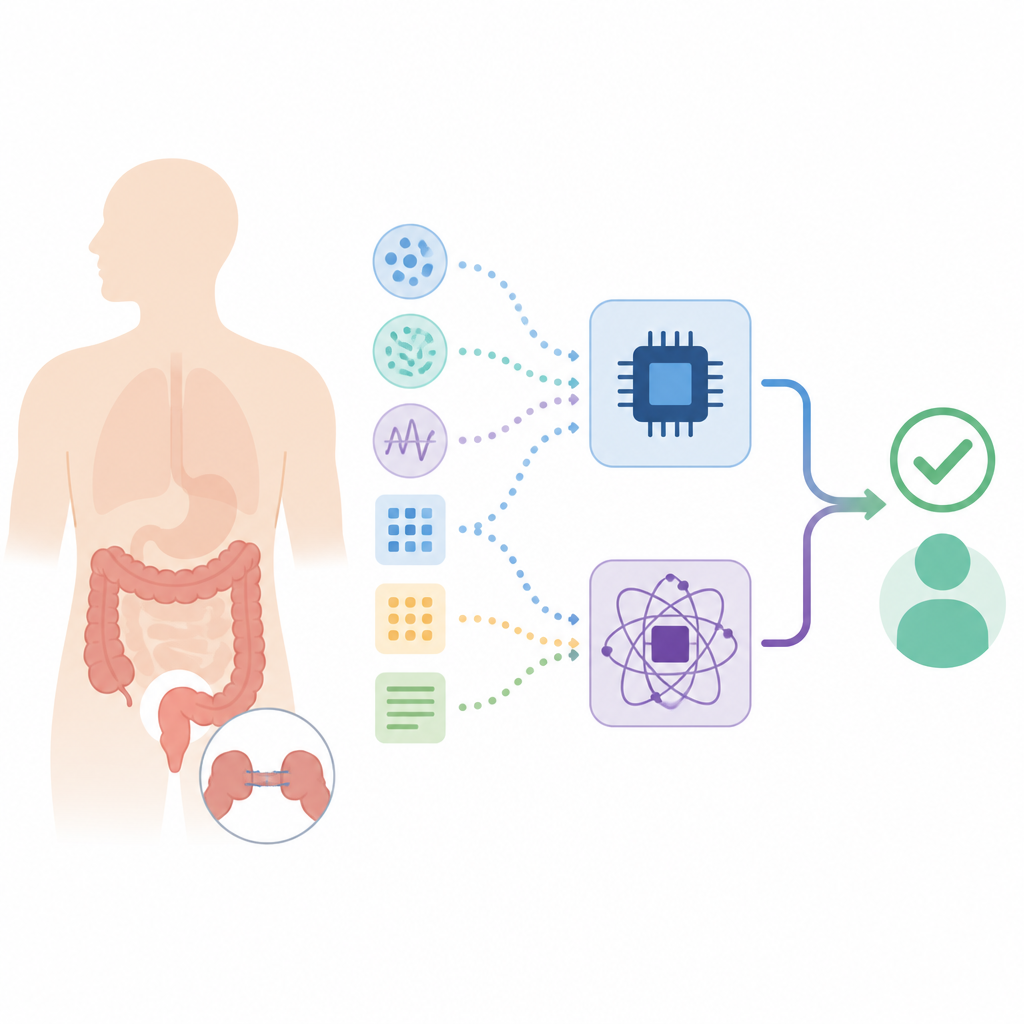
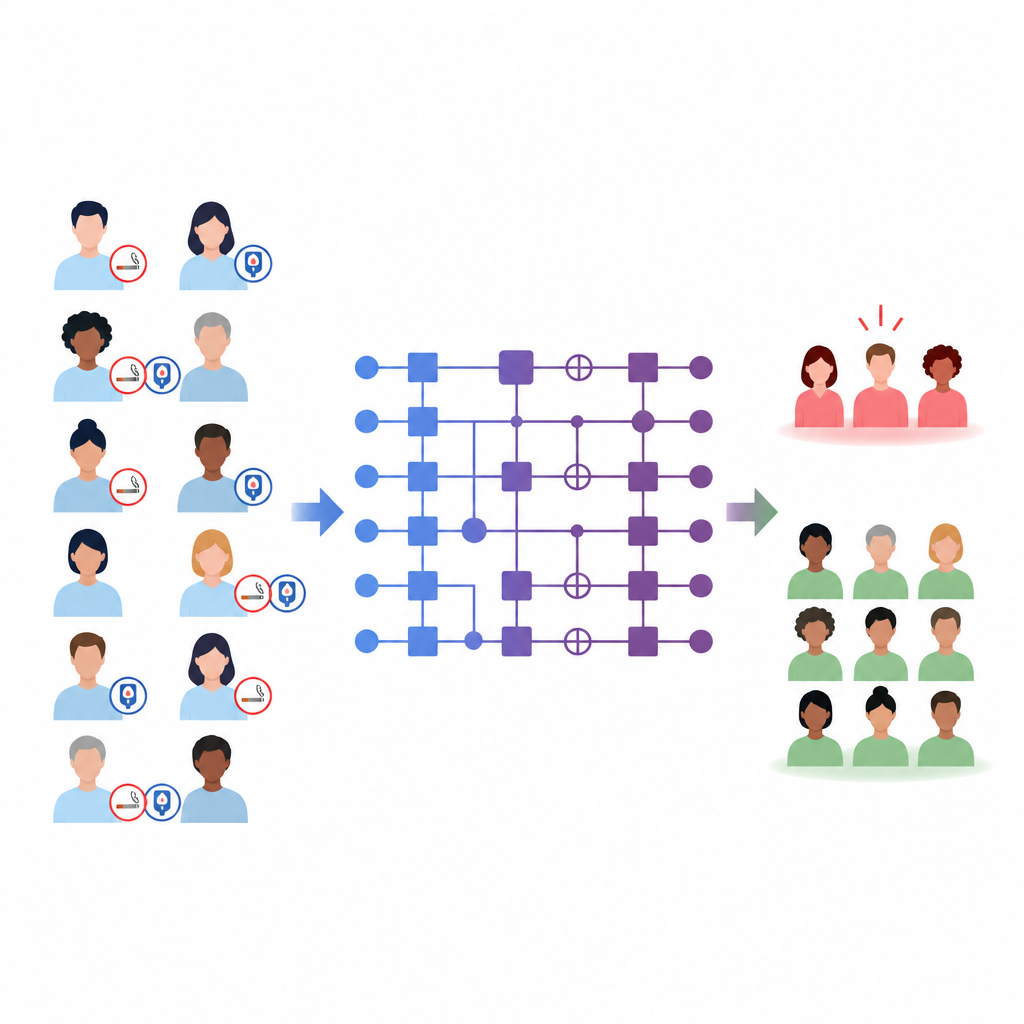
The team analyzed records from 200 patients who underwent colorectal surgery between 2015 and 2016, of whom 28 developed a leak. They started with 76 pieces of information per patient, covering surgical choices and medical history. Through detailed statistical testing and discussions with surgeons, they narrowed this down to a smaller set of clinically meaningful factors. Four stood out: whether a soft rectal tube (NoCoil) was used to relieve pressure, whether a key artery supplying the bowel (ACSP) was preserved, and whether the patient had diabetes (DM) or smoked. Using these factors, they built both traditional predictive models and quantum neural network models on the unchanged, naturally imbalanced dataset, to mimic real hospital conditions.
How quantum inspired models were built and tested
Quantum neural networks are machine learning models that run on quantum circuits rather than purely classical code. In this work they were simulated on a conventional computer, but with realistic quantum hardware noise added, such as random gate errors and limited measurement precision. Patient information was first encoded into quantum states and then passed through trainable layers that mimic a small quantum circuit. The researchers tested two main circuit designs and combined them with several different optimization strategies, some using gradients and others relying on evolutionary style search, to see which combinations learned best from the data under noisy conditions.
Comparing quantum and classical predictions
The key comparison was made at a sensitivity of 83 percent, a level chosen to reflect a clinical priority: avoid missing patients who will develop a leak, even if that means accepting more false alarms. With this sensitivity fixed, some quantum neural network setups, especially those using the EfficientSU2 circuit with a BFGS optimizer or the RealAmplitudes circuit with CMA-ES, reached specificities up to 66 percent and negative predictive values up to 96 percent. Classical models, including logistic regression and a tuned multilayer perceptron, topped out at about 44 percent specificity and 94 percent negative predictive value at the same sensitivity. This means the quantum based models produced fewer false positives while still catching the same proportion of real leaks.
Strengths, limits, and what happens next
While quantum neural networks were better at drawing a clean line between high risk and low risk patients, the classical models were better at probability calibration: their predicted risk percentages matched observed outcomes more faithfully. This makes the classical approaches more suitable for fine grained risk scoring, for example when weighing different treatment plans. The study is also limited by its modest sample size and single center data, which can make any model appear better than it will be on new patients. The authors stress that larger, multi hospital studies and trials on real quantum hardware are needed before such tools can be relied on in routine care.
What this means in plain terms
In everyday language, this study shows that quantum style machine learning can, at least in simulation, help doctors screen for a dangerous bowel surgery complication while raising fewer false alarms than standard methods. However, traditional models still provide more trustworthy risk percentages. For now, quantum neural networks look promising as an extra safety net for early warning, but they must be confirmed in bigger patient groups and combined with clear, well calibrated risk estimates before they can directly guide treatment decisions.
Citation: Novák, V., Zelinka, I., Přibylová, L. et al. Quantum machine learning for predicting anastomotic leak: a clinical study. Sci Rep 16, 15518 (2026). https://doi.org/10.1038/s41598-026-44402-x
Keywords: anastomotic leak, quantum machine learning, colorectal surgery, clinical risk prediction, medical AI