Clear Sky Science · en
Acute and chronic dosing of the GABA A alpha 2,3 selective agonist BAER-101 do not alter behavior but may impact auditory-evoked EEG responses in adults with fragile X syndrome
Why this study matters for families
Many families affected by fragile X syndrome hope that new medicines can ease sensory overload, anxiety, and attention problems. This study tested a drug called BAER-101, designed to gently calm brain activity without causing strong sedation. The researchers looked not only at outward behavior, but also at brain wave patterns, to see whether the drug was changing how the brain responds to sound. Their results offer a careful look at what worked, what did not, and why measuring change in this condition is so challenging. 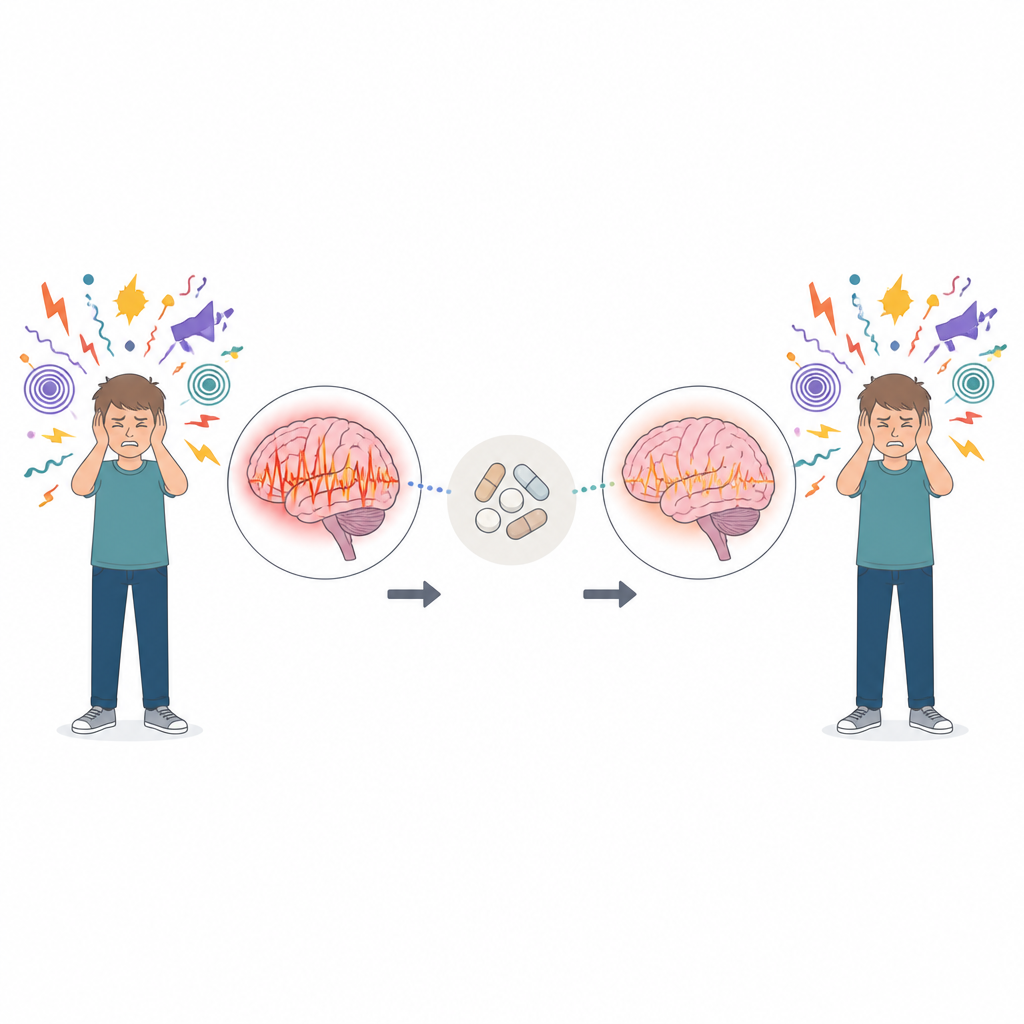
A brain condition tied to sound sensitivity
Fragile X syndrome is the most common inherited cause of intellectual disability and is often linked with autism. Many people with fragile X are extremely sensitive to sights and sounds, feel easily overloaded, and struggle with irritability and anxiety. Earlier work has shown that their brain activity, measured with electroencephalography, or EEG, is unusually strong and noisy, especially when they hear sounds. Animal studies suggest that one reason is a shortage of calming signals in the brain, which depend on a chemical messenger called GABA. Those findings led scientists to ask whether boosting specific GABA pathways might restore balance in the fragile X brain.
A targeted calming drug put to the test
BAER-101 is a pill that attaches to certain GABA receptors thought to reduce anxiety while avoiding the strong drowsiness caused by typical tranquilizers. Thirteen adults with fragile X took part in a carefully controlled trial. Each person went through three two week treatment periods, receiving a low dose of BAER-101, a higher dose, and a placebo in random order, without knowing which was which. On some days the team measured behavior and EEG before and a few hours after a dose, to see quick effects. After each two week period they repeated the same tests, to see whether longer use made a difference. 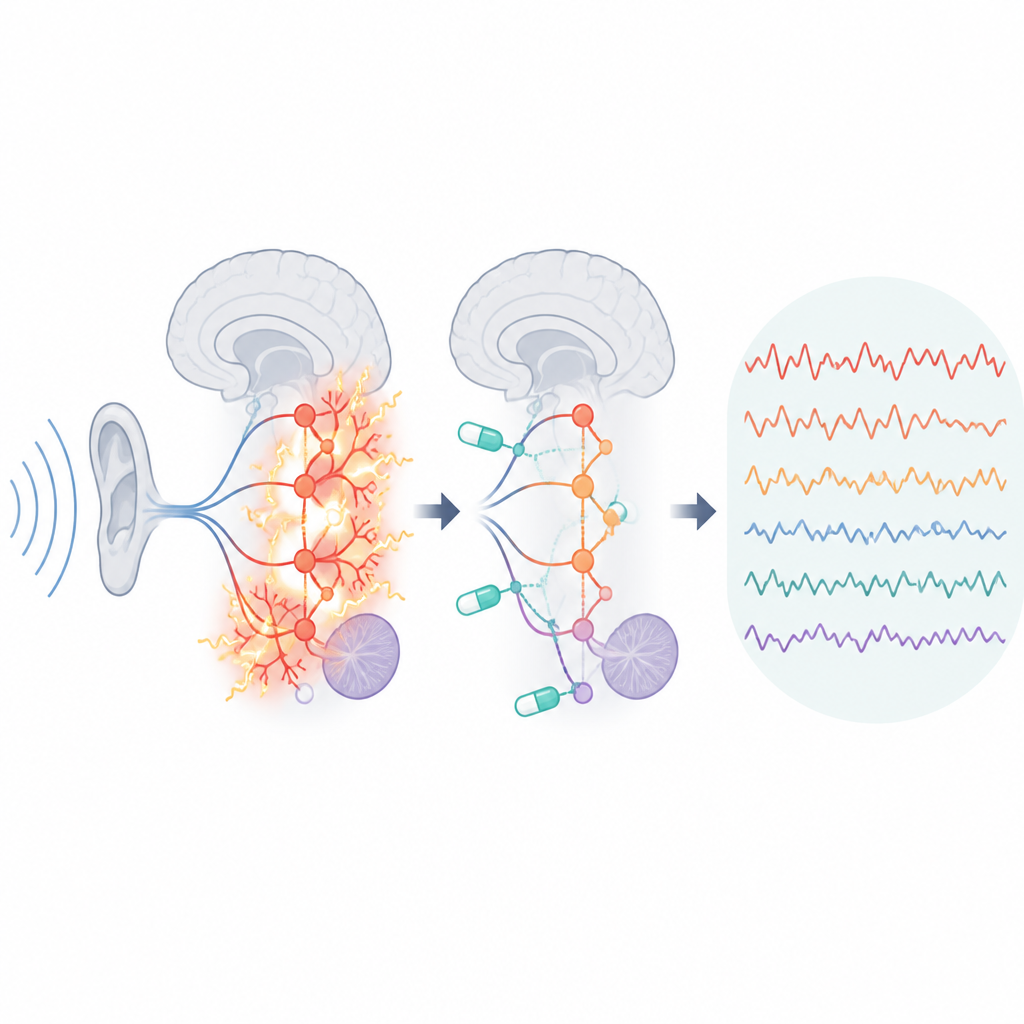
Behavior in daily life changed very little
Doctors rated overall improvement, parents filled out checklists of problem behaviors, and participants completed computer tasks that tested attention, memory, and flexibility. Across these many measures, the patterns were strikingly flat. A few scattered results hinted that one dose or another might slightly help reaction time or word learning, but these did not follow a clear pattern, did not consistently favor the drug over placebo, and often faded when a single extreme score was removed. In plain terms, people did not reliably seem calmer, more focused, or better in daily behavior while taking BAER-101 at the doses and time frame used here.
Brain waves showed hints without a clear signal
The team also recorded brain activity at rest and while participants listened to carefully designed sounds. They looked at overall power in different frequency bands, how consistently the brain responded to repeated sounds, and the size of quick electrical responses at sound onset. Some of the complex statistics suggested that brain waves changed differently over time with drug versus placebo, especially in slower frequencies. However, when the researchers compared brain activity before and after BAER-101 within each dose, the changes were small, did not line up across conditions, and did not grow with higher dose. A few results hinted that the drug might slightly reduce the size of early sound responses, but again the pattern was not strong enough to be confident it reflected a true medication effect rather than random noise.
Why measuring change is so hard
An important lesson from the study was that many of the tools used to track change were not as stable as expected. When the same person took the same tests on different days, scores and EEG measures often varied more than earlier reports had suggested. With only a small group of volunteers and relatively short recordings, this day to day variability can easily hide small genuine drug effects. The authors therefore caution that not finding a clear benefit is not the same as proving the drug never helps. Instead, their work underscores how future fragile X trials will need larger samples, longer dosing, and more reliable behavioral and brain measures to fairly judge whether new treatments are making a difference.
What this means for future treatment hopes
For now, BAER-101 at the doses and short treatment periods tested here did not lead to clear, repeatable improvements in behavior or brain responses in adults with fragile X syndrome. The study does not close the door on this drug or on GABA based approaches, but it highlights just how careful researchers must be in designing trials and choosing measures that can pick up real change. For families, the message is that progress in this field depends not only on new medicines, but also on better ways to see and measure how the fragile X brain responds to treatment over time.
Citation: De Stefano, L.A., Kim, H., Erickson, C.A. et al. Acute and chronic dosing of the GABA A alpha 2,3 selective agonist BAER-101 do not alter behavior but may impact auditory-evoked EEG responses in adults with fragile X syndrome. Sci Rep 16, 15404 (2026). https://doi.org/10.1038/s41598-026-44380-0
Keywords: fragile X syndrome, GABA, EEG, clinical trial, sensory processing