Clear Sky Science · en
Information theory and thermal properties of an extended cosine hyperbolic potential model
Why this study matters
How tightly atoms bind together and how they store heat under different temperatures lie at the heart of chemistry, materials science, and even planetary atmospheres. This study shows how a single mathematical model can describe both the way electrons are arranged in simple molecules and how those same molecules respond to heating, giving researchers a unified tool for connecting the quantum world to everyday thermal behavior.
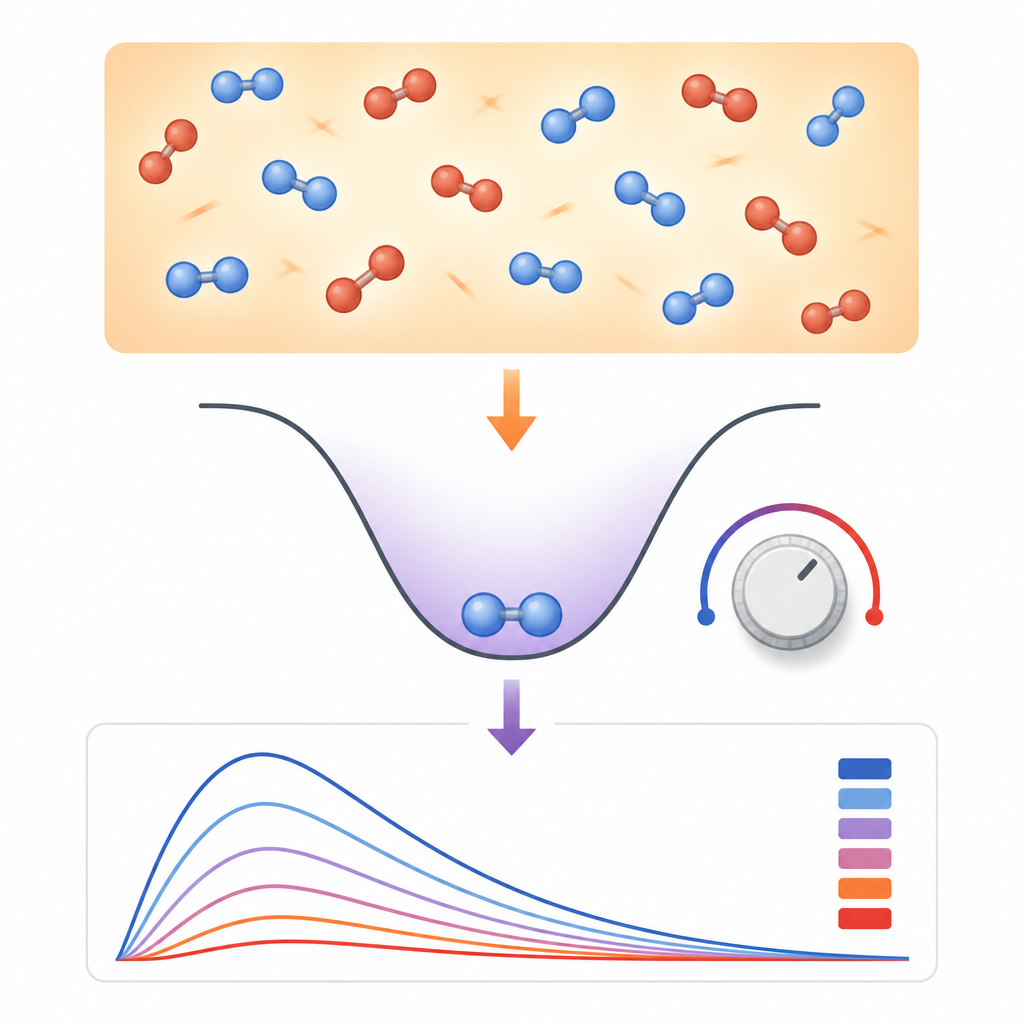
A new way to picture molecular bonds
The authors focus on a specific mathematical form for the energy of two bonded atoms called an extended cosine hyperbolic potential. In less technical terms, this potential is a smooth curve that tells you how the energy of a pair of atoms changes as you stretch or compress the bond between them. By adjusting a few parameters, the curve can mimic different kinds of chemical bonds, from relatively weak to very stiff. This flexibility makes it attractive for describing a range of diatomic molecules using one consistent framework.
Measuring information in quantum clouds
Beyond the shape of the energy curve, the study asks how much “information” is contained in the quantum cloud of electrons that binds the atoms. Two ideas from information theory are used for this: Fisher information, which is sensitive to sharp features and localization, and Shannon entropy, which captures how spread out the electron density is. The team derives exact formulas for both quantities in real space and in momentum space, meaning they can track how precisely the electron cloud is confined around the bond and how this precision trades off with uncertainty in the electrons’ motion. They confirm that their results obey key limits from information theory, such as the Cramér–Rao bound and the BBM entropy inequality, showing that the model behaves consistently with fundamental uncertainty principles.
From quantum levels to heat and energy
Once the energy levels of the potential are known, they can be used to build a partition function, a statistical tool that connects microscopic quantum states to macroscopic properties. The authors work out analytic expressions for how the molecules’ heat capacity, enthalpy, entropy, and Gibbs free energy change with temperature. They include contributions from vibrations, rotations, and the motion of the whole molecule. This allows them to follow how more and more internal motions are activated as the temperature rises, and how these motions store and redistribute thermal energy in the gas.
Testing the model on real molecules
The team applies their formulas to four well known molecules: phosphorus dimer (P₂), potassium dimer (K₂), potassium bromide (KBr), and silicon monoxide (SiO). Across temperatures from absolute zero up to 6000 kelvin, the calculated curves for heat capacity, enthalpy, entropy, and Gibbs free energy closely track high quality experimental data from the NIST database. Small differences do appear, especially at extreme temperatures, but the average deviations are tiny, often only a few hundredths of a percent. The trends also make physical sense: for example, heat capacity in P₂ and SiO rises quickly at low temperature then levels off as available modes saturate, while Gibbs free energy decreases steadily as thermal disorder grows.
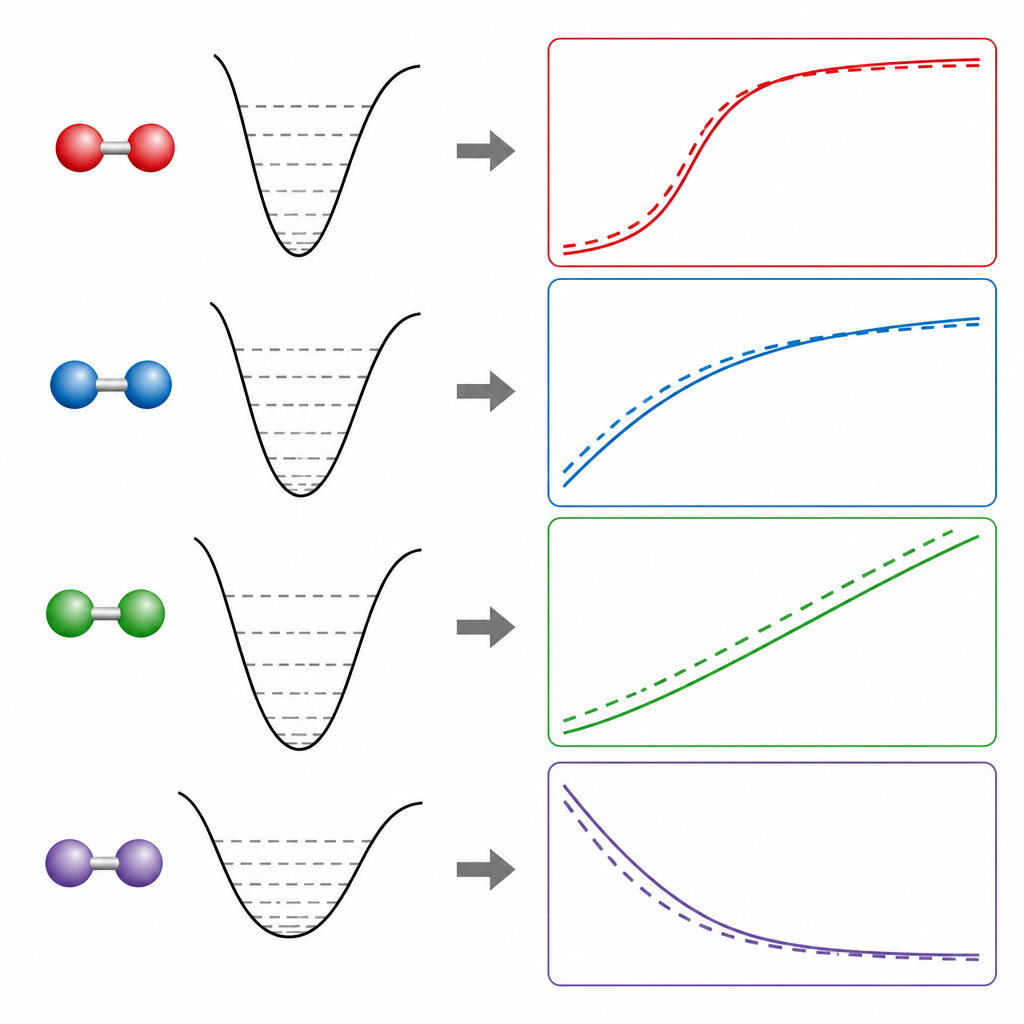
What the results tell us
For the general reader, the key outcome is that a carefully chosen mathematical description of a chemical bond can simultaneously capture how electrons are arranged and how the molecule stores and releases heat. By tying information theory to thermodynamic behavior, the work shows that concepts like uncertainty and localization at the quantum scale have clear fingerprints in bulk properties such as heat capacity and free energy. Because the model matches experimental data very well for several different molecules, it offers a reliable bridge between theory and measurement and a useful tool for predicting thermal behavior in systems where experiments are difficult or incomplete.
Citation: Hsu, CY., Singh, P.K., Yusupov, Y. et al. Information theory and thermal properties of an extended cosine hyperbolic potential model. Sci Rep 16, 14835 (2026). https://doi.org/10.1038/s41598-026-44371-1
Keywords: information theory, diatomic molecules, thermodynamic properties, heat capacity, quantum potential