Clear Sky Science · en
Classification of fallers and non-fallers in older adults using electrical IMU signal for gait analysis and explainable deep learning
Why keeping steady on your feet matters
As people age, a simple misstep can lead to a serious fall, with consequences that range from broken bones to a loss of independence. Doctors know that the way someone walks holds vital clues about their likelihood of falling, but it has been hard to measure those clues accurately and turn them into practical warnings. This study shows how small wearable sensors on the feet, combined with modern artificial intelligence, can not only sort older adults into higher- and lower-risk groups with striking accuracy, but also reveal which parts of the walking cycle are most closely tied to falling.
Reading movement with tiny sensors
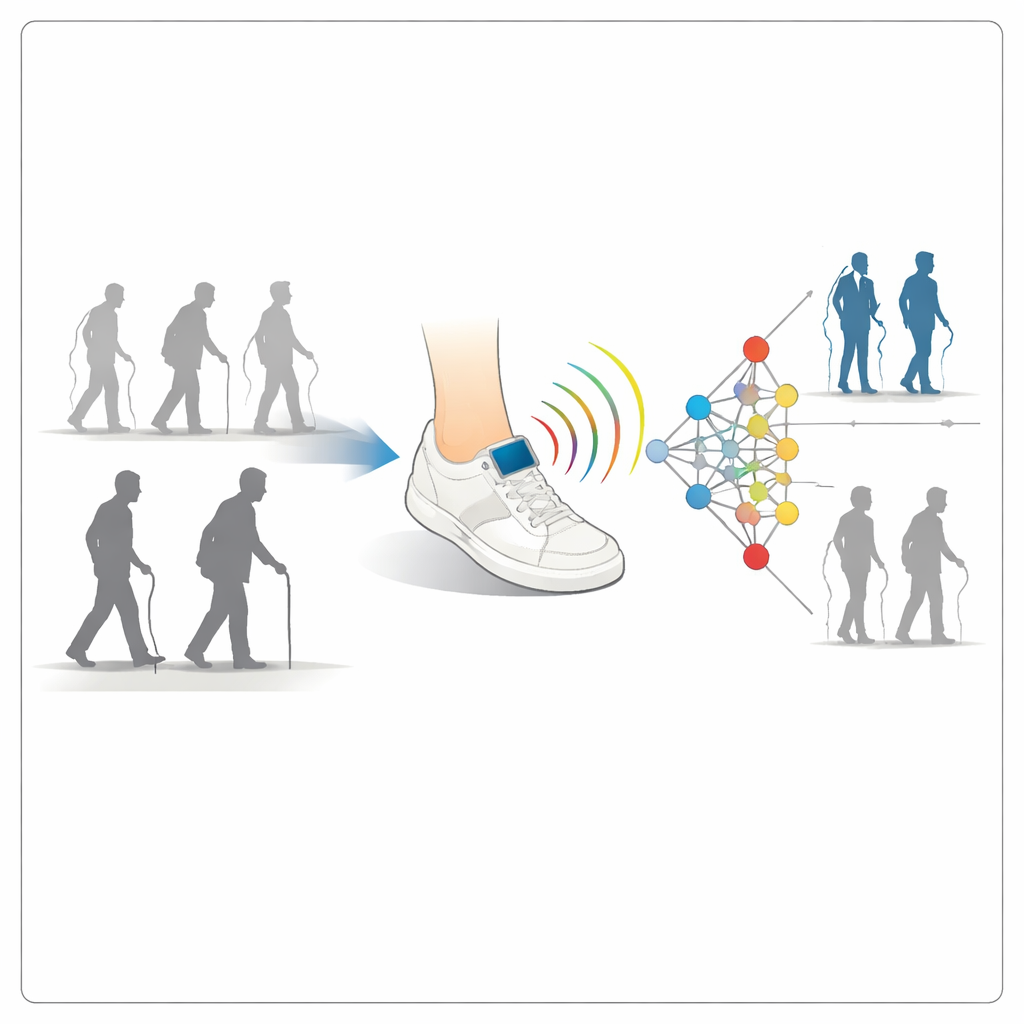
The researchers drew on a public database of 163 adults between 70 and 99 years old. Each volunteer wore a lightweight device called an inertial measurement unit, or IMU, strapped to one foot while walking for about 30 minutes. These sensors record how the foot moves in three dimensions, capturing both acceleration and rotation hundreds of times per second. Participants were labeled based on whether they had fallen in the past year and were also grouped by age decade (70s, 80s, or 90s). From the continuous recordings, the team cut the data into short windows covering several steps, creating thousands of small "snapshots" of walking patterns to feed into their computer models.
Teaching computers to spot risky walking
To turn these motion traces into meaningful risk groups, the researchers compared traditional machine-learning methods with more advanced deep-learning approaches. Classic algorithms, such as decision trees and random forests, were given summary statistics from each walking segment, like average and variability over time. Deep-learning models called convolutional neural networks (CNNs) and long short-term memory networks (LSTMs), by contrast, were allowed to process the raw wave-like sensor signals directly, learning patterns on their own without hand-crafted features. The goal was to see how well each family of methods could distinguish older adults who had fallen from those who had not, and how reliably they could sort people into their age groups based solely on the way they walked.
How well the models performed
When the data from all participants were mixed and split into training and testing portions, the deep-learning models clearly outperformed the traditional ones. The CNN correctly classified fallers and non-fallers about 96% of the time, and the LSTM was close behind at 95%, while the best classic methods reached the high 80s at best. Even under a tougher test, where the models were trained on some individuals and then evaluated on completely different people, the CNN still achieved around 92% accuracy for fall history and nearly 90% for age-group classification. Both deep models could also tell individuals apart surprisingly well, suggesting that each person’s gait is as distinctive as a signature when viewed through these sensors.
Opening the "black box" of AI decisions
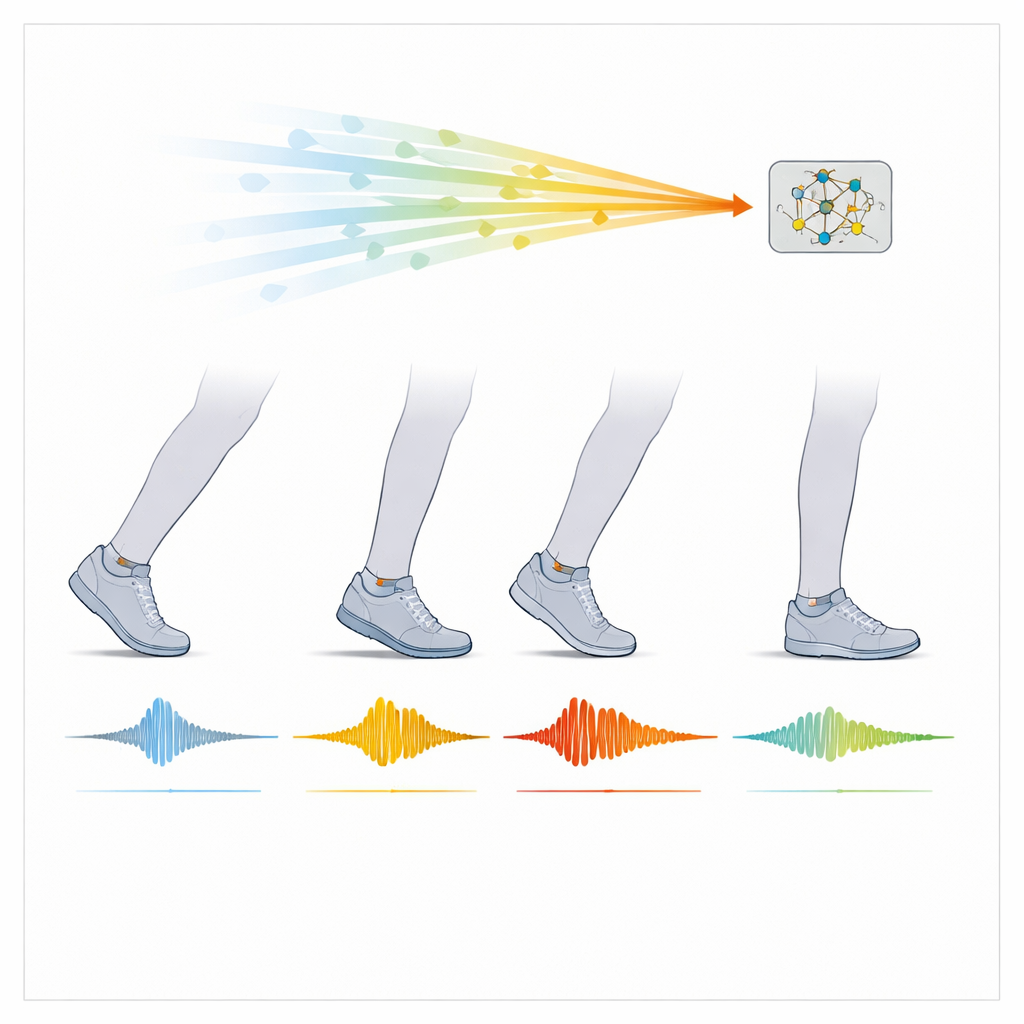
A common criticism of powerful AI methods is that they are often opaque: they may be accurate, but they rarely explain themselves. To tackle this, the authors used an explanation tool called LIME to probe the CNN’s decisions for fall-history classification. Rather than asking which overall features mattered, they examined which moments within each step contributed most to labeling someone as a faller or non-faller. They found that the model focused primarily on the stance phase—the period when the foot is on the ground bearing weight—especially the middle and late portions when the body shifts forward and prepares to push off. In people with a history of falls, irregularities during these phases dominated the model’s reasoning, while non-fallers showed a more balanced contribution from both stance and swing (when the foot is in the air).
What this means for preventing falls
For a layperson, the key message is that small, unobtrusive foot sensors plus smart algorithms can detect subtle instabilities in how someone walks long before a fall happens—and can point to the exact part of the step cycle where trouble arises. The study shows that deep-learning systems can reliably tell past fallers from non-fallers and separate different age patterns of walking, all from a few seconds of sensor data. Just as important, by highlighting problems during weight-bearing phases of the step, the method suggests concrete targets for exercise and rehabilitation, such as improving balance and strength when the foot is on the ground and the body is moving over it. With further testing in broader groups and over time, this approach could evolve into wearable tools that quietly monitor gait in daily life and give clinicians early, understandable warnings when an older adult’s risk of falling begins to rise.
Citation: Alqurashi, A., Alharthi, A., Alammar, M.M. et al. Classification of fallers and non-fallers in older adults using electrical IMU signal for gait analysis and explainable deep learning. Sci Rep 16, 14353 (2026). https://doi.org/10.1038/s41598-026-44368-w
Keywords: fall risk, gait analysis, wearable sensors, deep learning, older adults