Clear Sky Science · en
Smart delivery of herbicide for safe and effective control of Egyptian broomrape parasitizing Indian mustard
Why a hidden weed matters to your cooking oil
Indian mustard is a major source of cooking oil for millions of people, but in many fields an invisible underground thief is stealing its food. The culprit, a parasitic plant called Egyptian broomrape, latches onto mustard roots and can wipe out entire harvests. This study explains how researchers designed a “smart” way to deliver a tiny dose of herbicide directly to the parasite in the soil, protecting the crop while keeping residues in the environment extremely low.

A parasite that lives off mustard roots
Egyptian broomrape doesn’t look like a typical weed. Its seeds lie buried in the soil, sometimes for years, waiting for the chemical signals released by nearby crop roots. When mustard is planted, those signals wake the seeds, which then send out small tubes that pierce the roots and plug into the plant’s plumbing. Acting as a powerful “super sink,” broomrape drains water and nutrients so efficiently that farmers can lose anywhere from a small fraction to all of their yield. Because the parasite is physically fused to the crop below ground, usual weed-control methods like pulling or surface spraying fail.
Designing smarter herbicide delivery
The scientists set out with two goals: find a chemical that reliably kills broomrape, and package it in a way that reaches the parasite early without hurting the mustard itself. They focused on metsulfuron-methyl, a well-known weed killer that acts through the soil but can damage crops if not handled carefully. Working with formulation specialists, they created several “smart” versions: suspension concentrates, suspo-emulsions that combine herbicide with neem oil, nano- and micro-emulsions, and mixtures with another herbicide, pendimethalin. All were designed for pre-emergence use—that is, sprayed on the soil right after sowing, before either crop or parasite emerges.
Field trials in real farmers’ problem plots
Over four growing seasons, the team tested these formulations in hot spots of broomrape infestation in semi-arid regions of Rajasthan, India. Early trials showed that a strong metsulfuron product could completely eliminate broomrape, but at the cost of stressing the mustard plants and reducing yield. The researchers then dialed back the concentration and improved how the herbicide was dispersed in tiny particles within water. A 5% suspension concentrate, applied at a very low rate of 4 milliliters of active ingredient per hectare, consistently cut broomrape numbers by about 90% or more. In many sites it nearly erased infestations while actually boosting mustard seed yields by roughly half compared with weedy, untreated plots.
Targeting the parasite while sparing the crop
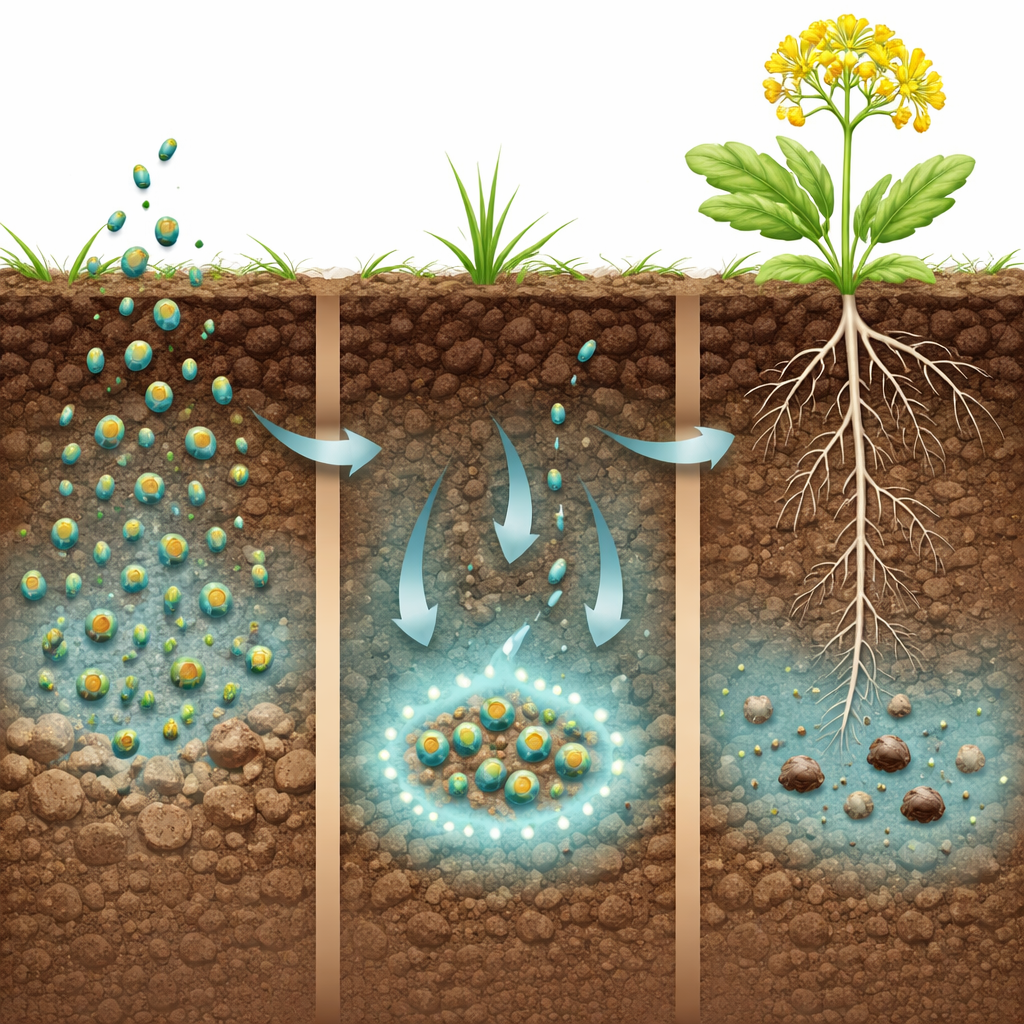
The new formulation works by moving through moist soil to the depth where broomrape seeds germinate and reach for mustard roots. There, the herbicide blocks cell division in the parasite early in its life cycle, preventing it from attaching and forming the draining structures that weaken the crop. Because the smart particles are tiny (around a few micrometers) and optimized for movement in soil, they achieve this at half the dose of the existing commercial product. Other experimental mixtures that combined metsulfuron with neem oil or pendimethalin also reduced the parasite, but the refined 5% suspension concentrate gave the best balance of control, crop safety, and yield.
Checking safety for soil, plants, and consumers
To address concerns about residues, the team analyzed soil samples from different depths and mustard plants themselves using sensitive laboratory instruments (LC-MS/MS). They did not detect metsulfuron-methyl in either the soil or plant material at the end of the season, suggesting that the herbicide broke down quickly or remained below detection limits. Combined with the low application rate and targeted mode of action, this indicates that the smart formulation offers strong control of broomrape with minimal environmental footprint.
What this means for farmers and food supplies
For farmers battling broomrape, the study offers a practical way to protect Indian mustard yields without resorting to heavy, risky doses of chemicals. A carefully engineered, low-dose formulation of metsulfuron-methyl, sprayed once before plants emerge, can almost completely block the underground parasite while leaving the crop unharmed and fields free of detectable residues. More broadly, the work shows how “smart” delivery of herbicides—shaping how they move and act in soil—can turn existing molecules into safer, more precise tools for managing stubborn parasitic weeds and safeguarding vital oilseed crops.
Citation: Jat, R.S., Agrawal, A., Kala, S. et al. Smart delivery of herbicide for safe and effective control of Egyptian broomrape parasitizing Indian mustard. Sci Rep 16, 11739 (2026). https://doi.org/10.1038/s41598-026-44367-x
Keywords: Egyptian broomrape, Indian mustard, parasitic weeds, metsulfuron methyl, smart herbicide formulations