Clear Sky Science · en
Green combustion synthesis of monoclinic Bi₂₆Mo₁₀O₆₉ nanoparticles using simarouba glauca leaves for efficient visible-light-driven photocatalytic degradation of Rose Bengal dye
Cleaning up colored water
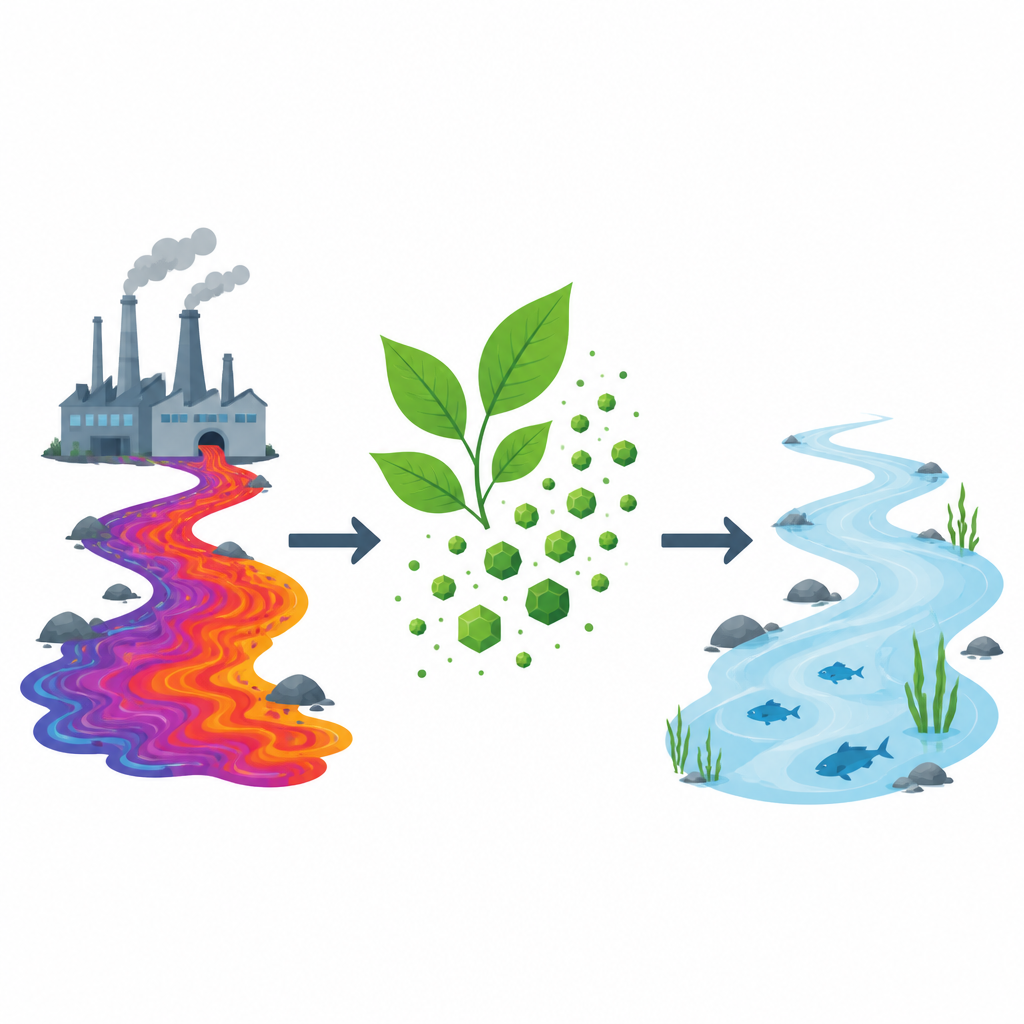
Brightly dyed wastewater from factories is a hidden problem that can linger in rivers and lakes for years. This study explores a new type of tiny material made with plant leaves that can use ordinary visible light to strip stubborn dye molecules from water and even help reveal hidden fingerprints. It offers a glimpse of how chemistry, sunlight, and greenery can work together to tackle pollution and support forensic work.
Why stubborn dyes are hard to remove
Modern industries such as textiles, printing, and leather use complex dyes that do not easily break down in nature. These colorful molecules can be toxic, resist normal treatment methods, and build up in living organisms. Traditional clean-up strategies like filtering or adding chemicals often just move the problem around or create new waste. Scientists therefore look for methods that actually destroy dye molecules, ideally by using sunlight and reusable materials that do not introduce new hazards.
Tiny helpers made with tree leaves
The researchers focused on a bismuth and molybdenum based material, shaped into nanoparticles only a few dozen billionths of a meter across. Instead of relying on harsh chemicals or high energy routes, they used powdered leaves from the tropical tree Simarouba glauca as a natural fuel in a combustion style synthesis. The plant compounds help mix the metal ingredients evenly, provide heat when they burn, and guide the growth of highly ordered crystals. By carefully tuning the ratio between metal precursors and leaf fuel, the team obtained a pure, well crystallized form called Bi₂₆Mo₁₀O₆₉ with a structure rich in tiny defects that are helpful for light driven reactions.
How the light driven clean up works
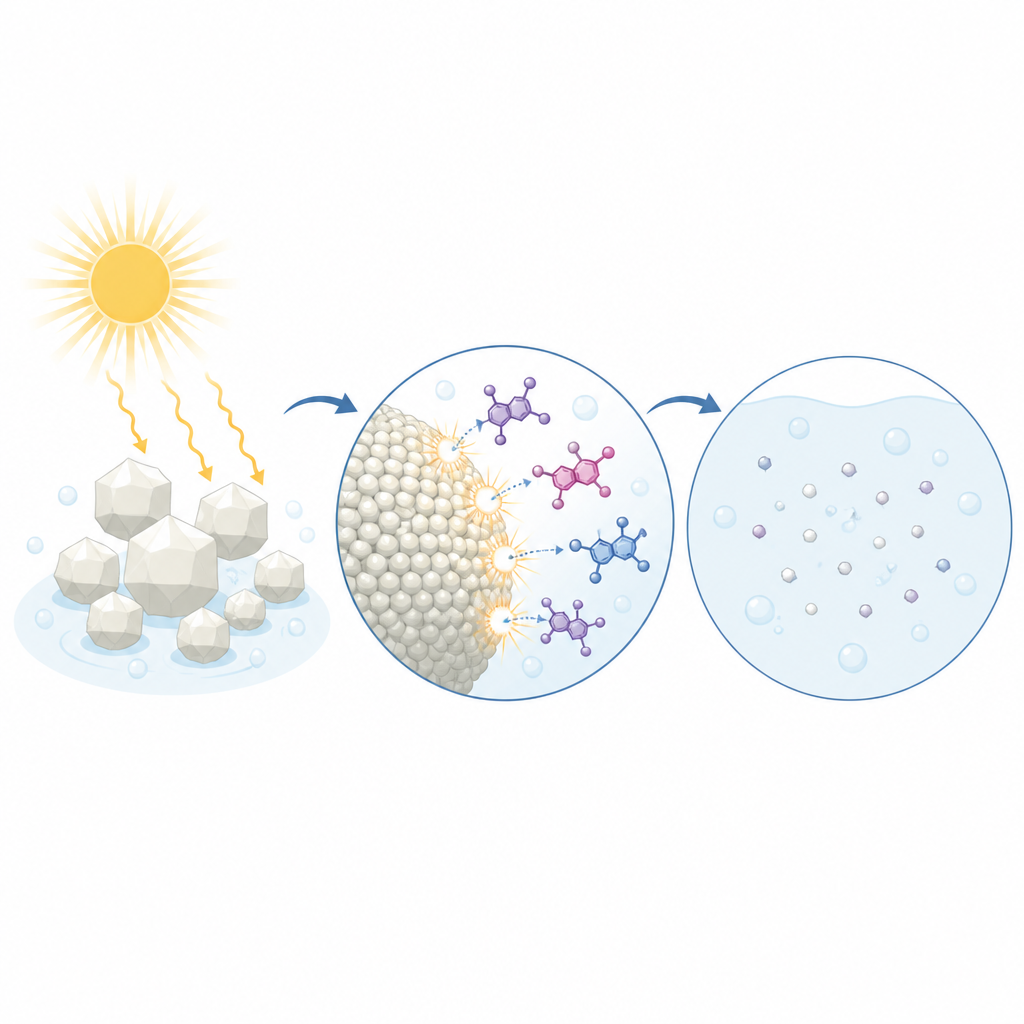
When this material is placed in water containing a pink dye called Rose Bengal and exposed to visible light, it behaves like a small solar powered reactor. Light energy lifts electrons inside the particles, leaving behind positively charged “holes.” These charges migrate to the surface, where they react with oxygen and water to produce highly reactive oxygen based species. These short lived radicals attack the dye molecules, breaking their complex ring structures into smaller, less harmful fragments such as carbon dioxide and water. Tests that deliberately blocked specific reactive species showed that hydroxyl radicals play a key role in the breakdown process.
Finding the sweet spot for best performance
The team examined how different conditions affected dye removal. They found that the sample made with equal parts precursor and leaf fuel had the most favorable optical properties, absorbing visible light up to about the green region and showing relatively low light emission from electron–hole recombination, a sign that charges stay separated long enough to react. Under these conditions, only 10 milligrams of the powder could remove more than 99 percent of a dilute Rose Bengal solution in three hours under visible light, especially in slightly acidic water. Higher particle doses or more concentrated dye led to slower improvement, mainly because of crowding, light blocking, and limited surface sites.
Extra use in fingerprint detection
Beyond water treatment, the same nanoparticles proved useful for revealing latent fingerprints on smooth objects like CDs and phone screens. The particles cling to the faint residues left by fingers and glow with a bluish cyan color under ultraviolet light, highlighting fine ridge patterns and small details. This combination of strong surface sticking, light emission, and stability allowed the researchers to capture clear fingerprint images without damaging the surface, hinting at applications in forensic science.
What this work means
In simple terms, the study shows that a leaf assisted route can create tiny, light sensitive particles that clean dye polluted water efficiently while remaining stable and reusable. The same material can also enhance hidden fingerprints for identification. By joining green synthesis, solar style water treatment, and optical sensing in one system, the work points toward practical tools that can both protect waterways and support investigations without relying on harsh chemicals.
Citation: Puttaswamy, S., Panchangam, M.K., Kottam, N. et al. Green combustion synthesis of monoclinic Bi₂₆Mo₁₀O₆₉ nanoparticles using simarouba glauca leaves for efficient visible-light-driven photocatalytic degradation of Rose Bengal dye. Sci Rep 16, 15704 (2026). https://doi.org/10.1038/s41598-026-44348-0
Keywords: photocatalytic water treatment, dye degradation, green nanomaterials, bismuth molybdate, latent fingerprints