Clear Sky Science · en
Optimizing roadway location and cross section under superposition of residual coal pillars and adjacent goafs in close distance coal seams
Why underground roads matter for everyday life
Much of the electricity that powers homes, factories, and cities still comes from coal mined deep underground. To safely reach those coal seams, engineers must carve long tunnels, or roadways, through the rock. If these tunnels are placed in the wrong spot or given the wrong shape, the surrounding rock can crush in, threatening miners and cutting off access to valuable resources. This study from a Chinese coal mine looks at how to choose both the safest location and the safest cross‑section shape for such roadways when several coal seams lie close together and part of the upper seam has already been mined.
Layers of rock and left‑behind coal
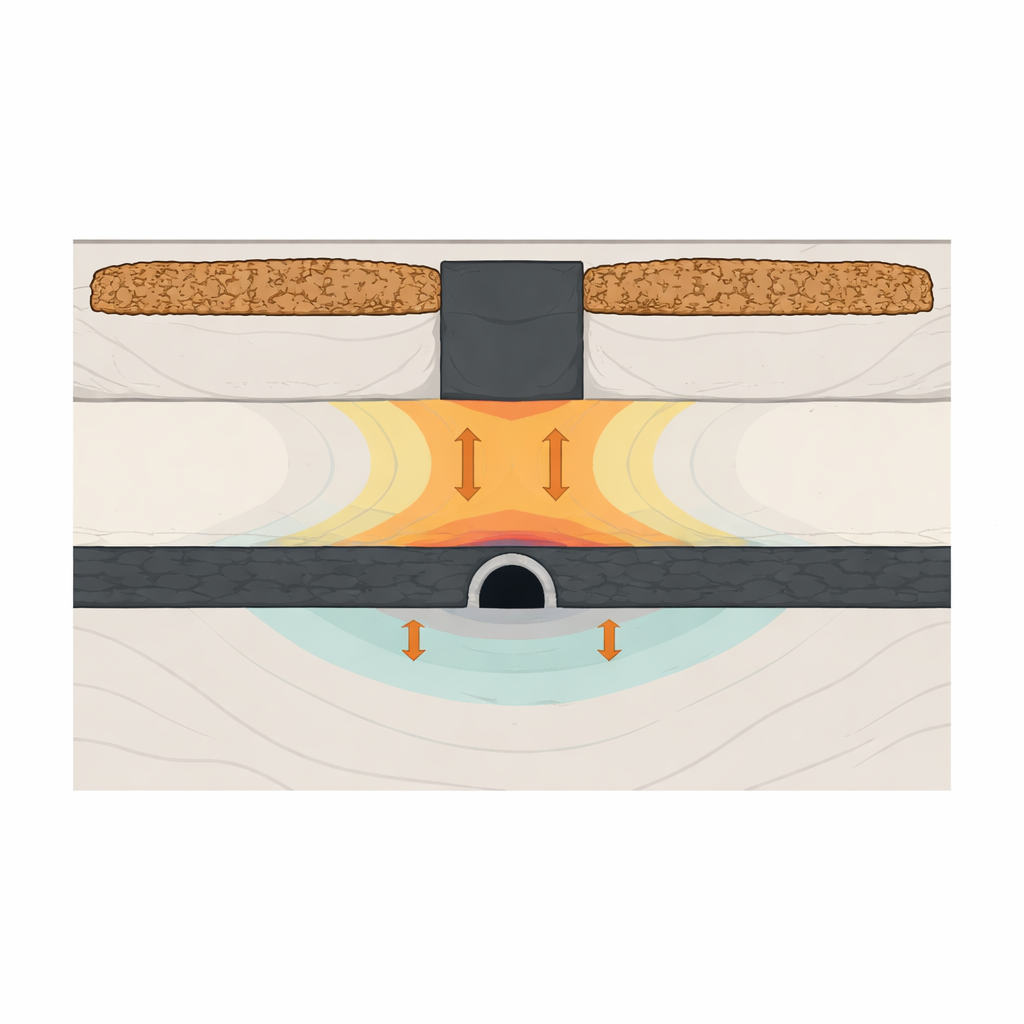
In many coalfields, coal does not occur in a single thick layer but in several seams stacked like a layered cake. At the Meihuajing coal mine, the main seams, called No.2 and No.3, are only 12 meters apart. The upper No.2 seam has already been mined in two large panels, but a 60‑meter‑wide block of untouched coal was left in between as a supporting pillar. On either side of this pillar are mined‑out voids, called goafs, that have caved in and are now filled with broken rock. Together, the solid pillar and the softer goafs change how weight from the overlying rock is carried down into the lower No.3 seam, where new roadways are planned.
Measuring how the rock behaves over time
The researchers first checked whether the upper coal pillar was doing its job. They monitored an existing roadway in the No.2 seam over about two years, after mining there had stopped. Instruments recorded how much the roof separated and how much the walls and floor moved toward each other. The measurements showed only small movements: roof separation of about one to two centimeters at most, and side and floor convergence typically around five to ten centimeters. Because no new mining was taking place nearby, these slow, modest deformations reflected a long‑term, stable state under a static load. This suggested that the 60‑meter‑wide pillar was strong enough to bear the overlying weight and keep the rock structure above largely intact.
Tracing how forces travel through the rock
Next, the team used a classic theory from rock mechanics that treats the rock under the seam as an elastic half‑space—a deep, continuous medium—and applies loads at the top to calculate stresses at depth. They represented the coal pillar and the neighboring goafs as a series of simplified load segments, each with different intensities reflecting stress concentration under the pillar and stress relief in the caved zones. Using mathematical expressions and computer tools, they mapped vertical, horizontal, and shear stresses in the rock below. The results showed a clear pattern: directly beneath the solid pillar, stresses became concentrated, while beneath the goafs they dropped, forming a stress‑decreasing zone. In the lower No.3 seam, the vertical stress was highest just under the pillar and lowest roughly 13 meters away from its edge, under the area corresponding to the goaf. Horizontal stresses changed less dramatically but also indicated a gentler environment away from the pillar, while shear stresses were strongest near the pillar edges.
Choosing where to drive the new tunnel
From a practical standpoint, engineers want to place the roadway where the rock is under relatively low and balanced stress, so it is less likely to squeeze in or break. Based on the calculated stress curves, the authors concluded that the ideal band for the new No.3 seam roadway lies within the vertical stress‑decreasing zone, slightly under the goaf rather than directly beneath the pillar. The absolute minimum in vertical stress occurs about 13 meters from the pillar’s edge, but that position would leave more coal unmined. Balancing safety with resource recovery, they recommend siting the roadway 10 meters from the pillar edge, still within the low‑stress region but closer to the remaining coal, reducing waste while retaining a favorable stress environment.
Why tunnel shape changes rock stability
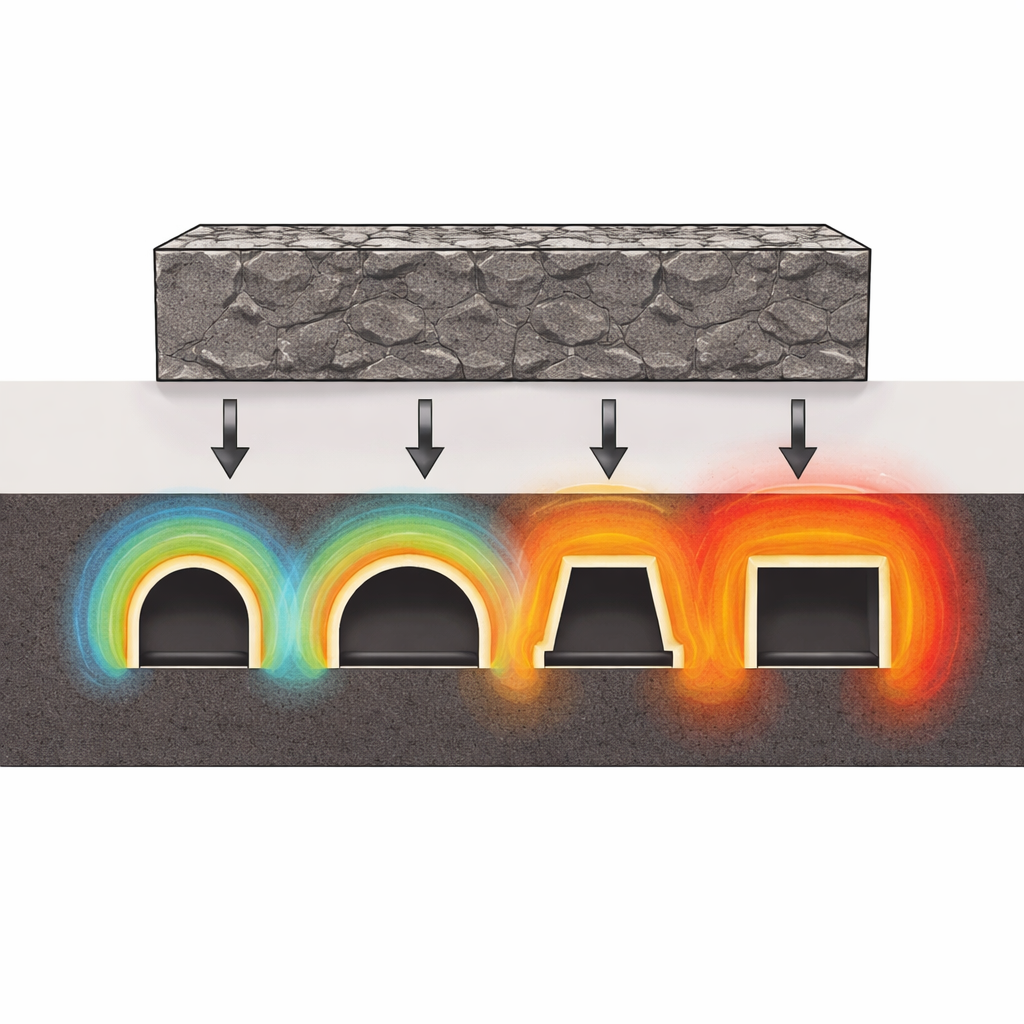
Position is only part of the story; the shape of the tunnel opening also controls how the rock responds. Using a three‑dimensional numerical model (FLAC3D), the researchers built a virtual slice of the mine, including the two seams, the pillar, the caved goafs, and a lower roadway at the preferred location. They tested four cross‑section shapes but kept all at the same width and height: a straight‑wall semi‑circular arch, a three‑centered arch (a more complex arch made of three curves), a trapezoid, and a rectangle. After simulating excavation of each tunnel, they examined how stresses rearranged around it and how deep the surrounding rock yielded, forming a plastic or failed zone. In all cases, the roof and floor above and below the opening experienced pressure relief, while the sidewalls saw some renewed stress buildup.
Finding the safest and simplest design
The comparison revealed that arched shapes handle the load better than straight‑topped ones. The straight‑wall semi‑circular arch had the lowest stress concentration on its most loaded side and the shallowest failure depths in roof, floor, and sidewalls. The three‑centered arch performed almost as well in terms of stability, while the trapezoidal and especially the rectangular tunnel showed higher peak stresses and much deeper failure zones, meaning more rock broke and weakened around them. Because the three‑centered arch is geometrically more complicated to cut and support underground, requiring careful control of multiple radii and connection points, the authors judge it less practical for routine construction. They therefore recommend the straight‑wall semi‑circular arch as the preferred cross‑section: it offers strong stability under the combined influence of the pillar and goafs yet remains relatively straightforward to build and support in the field.
Takeaway for safer and more efficient coal mining
For lay readers, the key message is that small design choices underground—where exactly a tunnel is placed and what outline it has—can make a big difference to safety and efficiency. In this particular mine, the study shows that leaving a sturdy coal pillar in the upper seam, then placing the lower roadway slightly under the caved‑out area instead of beneath the pillar, creates a gentler stress environment. Shaping the tunnel with arched walls and a rounded roof further helps the surrounding rock to “flow” smoothly around the opening, limiting damage. While the precise distances and dimensions will vary from site to site, the combined approach of mapping stress transfer between seams and comparing tunnel shapes provides a roadmap for designing underground roadways that are both safer for miners and better for conserving coal resources.
Citation: Ren, Y., Li, J., Li, Y. et al. Optimizing roadway location and cross section under superposition of residual coal pillars and adjacent goafs in close distance coal seams. Sci Rep 16, 13983 (2026). https://doi.org/10.1038/s41598-026-44345-3
Keywords: coal mine roadway design, residual coal pillar, underground tunnel stability, numerical rock mechanics, multi-seam mining