Clear Sky Science · en
Accelerating discovery of MOFs for hydrogen storage via machine learning in energy related applications
Why this matters for clean energy
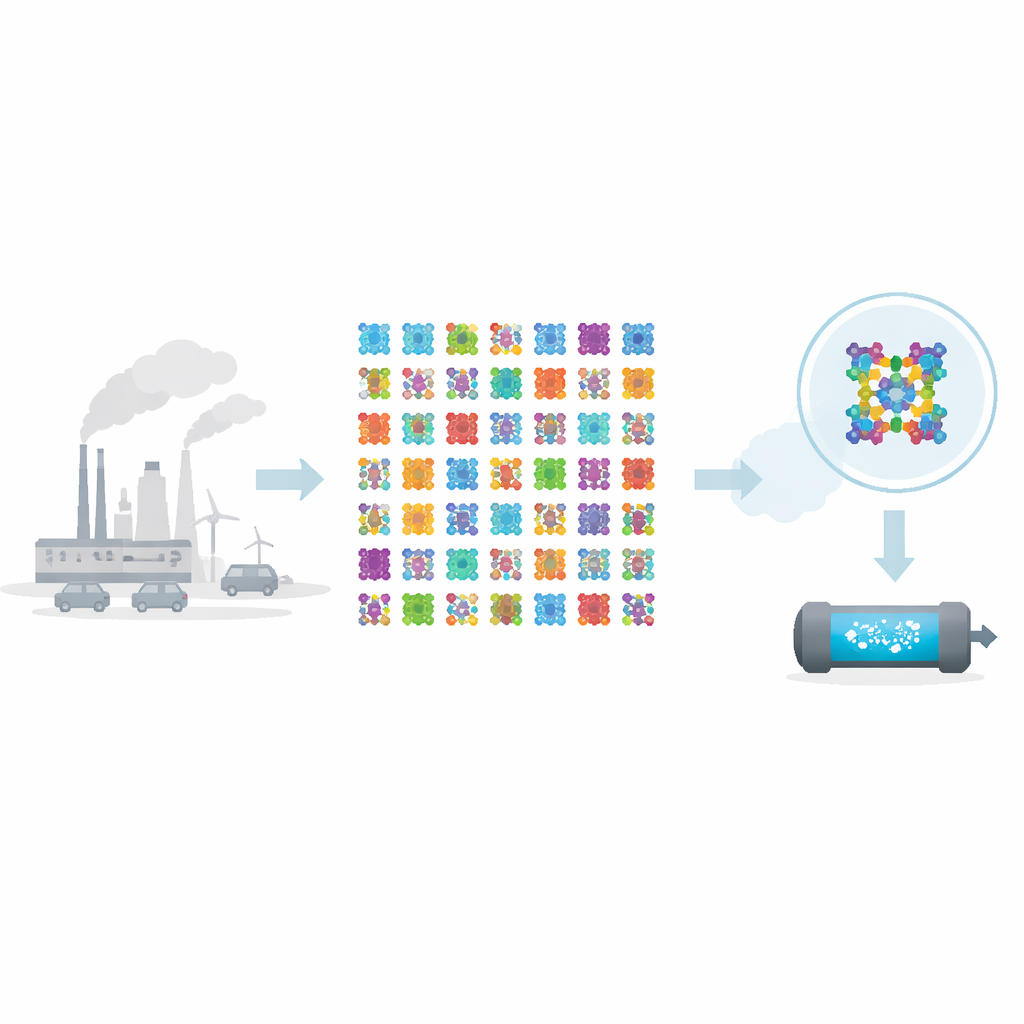
Hydrogen is often hailed as a clean fuel of the future, but there is a stubborn practical problem: it is very light, so packing enough hydrogen into a safe, compact tank for cars, trucks, or ships is difficult. This paper shows how computer‑based methods, especially machine learning, can sift through nearly one hundred thousand advanced porous materials, called metal–organic frameworks (MOFs), to find those that can store hydrogen densely and efficiently. The work points toward faster, cheaper routes to identify the next generation of hydrogen tanks that could help move society away from fossil fuels.
Made‑to‑order sponge materials
MOFs are crystalline materials that look, at the molecular level, like intricate scaffolds with enormous internal surface area and empty space. These tiny “sponges” can grab and release gas molecules such as hydrogen again and again. By swapping out the metal building blocks and organic linkers, scientists can tune the pore size, shape, and openness of MOFs. Properties such as how much empty space they contain (void fraction), how much interior volume is available (pore volume), and how much surface area is exposed to gas molecules turn out to be more important for hydrogen storage than the exact chemical recipe. The challenge is that although databases contain well over 100,000 possible MOF structures, only a small fraction have been made and tested in the lab, and detailed computer simulations for each candidate are very expensive.
Letting computers explore the possibilities
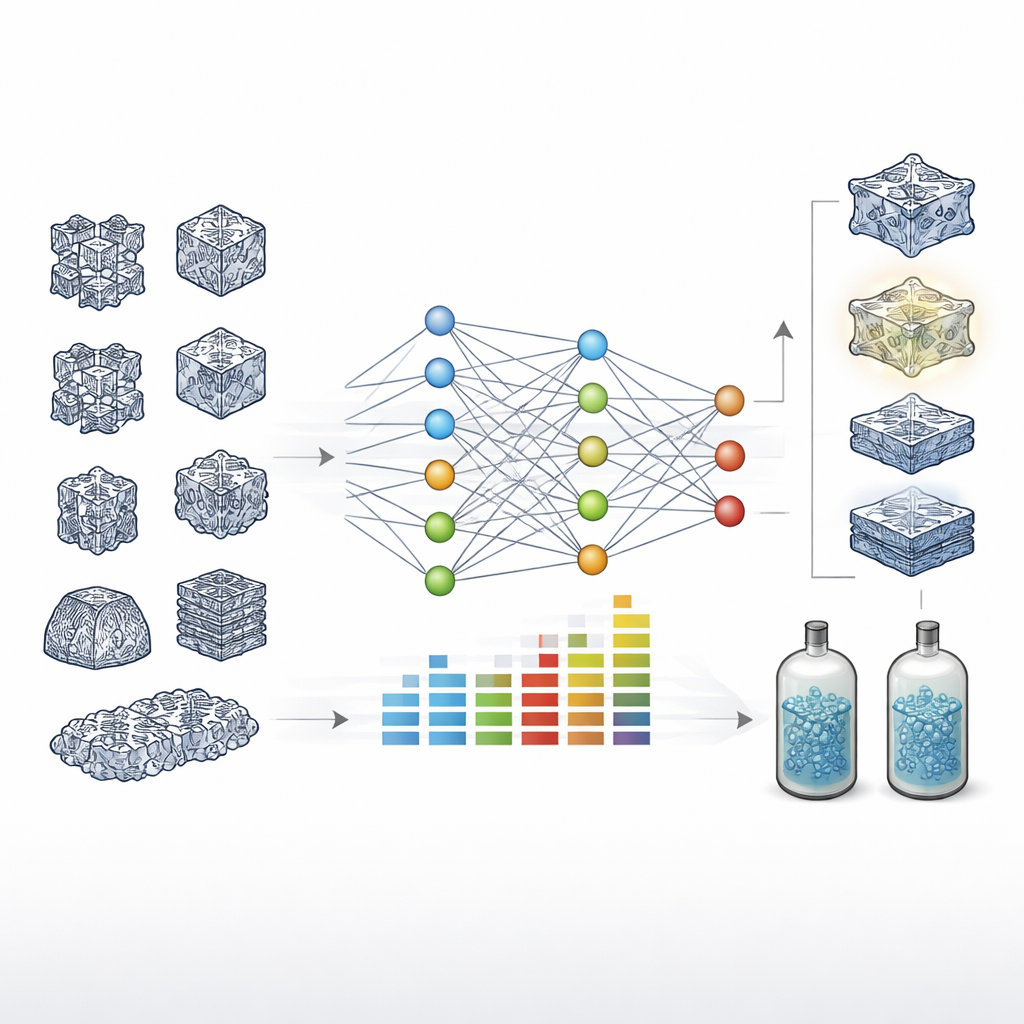
To tackle this bottleneck, the authors combine high‑accuracy gas adsorption simulations with machine learning. They start from an existing database called HyMARC, which lists 98,695 MOFs from several research groups and universities. For each MOF, they use established simulation tools to compute how much hydrogen it can hold and then release under a realistic “temperature–pressure swing” cycle: the material is filled with hydrogen at very low temperature and high pressure, then warmed and depressurized to deliver the gas. From each crystal structure they extract just seven geometric descriptors, including density, pore volume, several measures of surface area, and two characteristic pore diameters. These simple numbers capture how much space and surface the hydrogen molecules can explore inside each MOF.
Teaching neural networks to judge storage capacity
The team then trains two types of neural networks—feed‑forward and pattern‑recognition models—to learn the link between those seven structural descriptors and two key outcomes: how much hydrogen is stored by weight (gravimetric capacity) and by volume (volumetric capacity). A physics‑inspired optimization method, called the Equilibrium Optimizer, automatically adjusts the size and layout of each network to minimize prediction errors. After training on most of the database and reserving a portion for testing, the models reproduce the simulation results with striking accuracy, especially for storage by weight. The analysis also confirms physically sensible trends: MOFs with larger pore volume and higher void fraction generally store more hydrogen by weight, while volumetric storage is maximized at an intermediate density where porosity and packing are well balanced.
Finding standout materials in a crowded field
Armed with these trained networks, the researchers rapidly scan all 98,695 MOFs to flag promising candidates, then check the best of them with full simulations. They use a well‑known MOF called MOF‑5 as a reference point and also apply ambitious U.S. Department of Energy targets for hydrogen storage. Their screening turns up 1,289 MOFs that simultaneously meet or exceed these targets, and, within that group, 12 structures that beat MOF‑5 in both weight‑based and volume‑based performance. Many of these top performers share similar traits—moderate density, substantial but not extreme surface area, and high internal void space—and several come from a hypothetical database assembled by Northwestern University, highlighting the value of exploring not‑yet‑synthesized designs.
What this means for future hydrogen tanks
In plain terms, this study shows that a small set of easy‑to‑compute structural features, combined with well‑designed neural networks, can stand in for far more time‑consuming simulations when searching for hydrogen storage materials. The approach cannot yet guarantee that every suggested MOF will be easy to make or mechanically stable, but it greatly narrows the search to a manageable shortlist for chemists to test. By revealing which geometric traits matter most and spotlighting specific high‑capacity candidates, this work brings practical, compact hydrogen tanks a step closer and illustrates how data‑driven tools can speed up the discovery of materials for a cleaner energy system.
Citation: Khairandesh, S., Lotfi, M., Larimi, A. et al. Accelerating discovery of MOFs for hydrogen storage via machine learning in energy related applications. Sci Rep 16, 14114 (2026). https://doi.org/10.1038/s41598-026-44340-8
Keywords: hydrogen storage, metal-organic frameworks, machine learning, porous materials, energy materials discovery