Clear Sky Science · en
Species-level identification and differentiation of deer antlers using ATR-FTIR spectroscopy and chemometrics
Why deer antlers matter beyond the forest
Deer antlers are more than just striking headgear. They are prized materials for carved ornaments, sturdy furniture, hunting tools, and traditional medicines. This demand has helped fuel a global illegal trade that threatens wild deer populations. When officers seize antlers, they often need to know exactly which deer species they came from—but many antlers look and feel almost identical. This study explores a fast, non-destructive way to tell antlers of similar-looking deer apart using light-based analysis and smart statistics, offering a new tool for wildlife crime investigations.
The hidden trade in a growing bone
Antlers are remarkable bones that grow and shed every year, making them attractive and renewable in theory. In practice, the high value of antlers and their extracts—worth hundreds of millions of dollars globally—has encouraged poaching and trafficking. India, home to several deer species such as spotted deer, sambar deer, and swamp deer, has banned antler trade, including even naturally shed antlers. Yet seizures of large antler consignments continue, underscoring how profitable and persistent this market is. For conservation and law enforcement efforts to succeed, officers need reliable ways to identify which species each seized antler belongs to, even when only small, processed fragments are available.
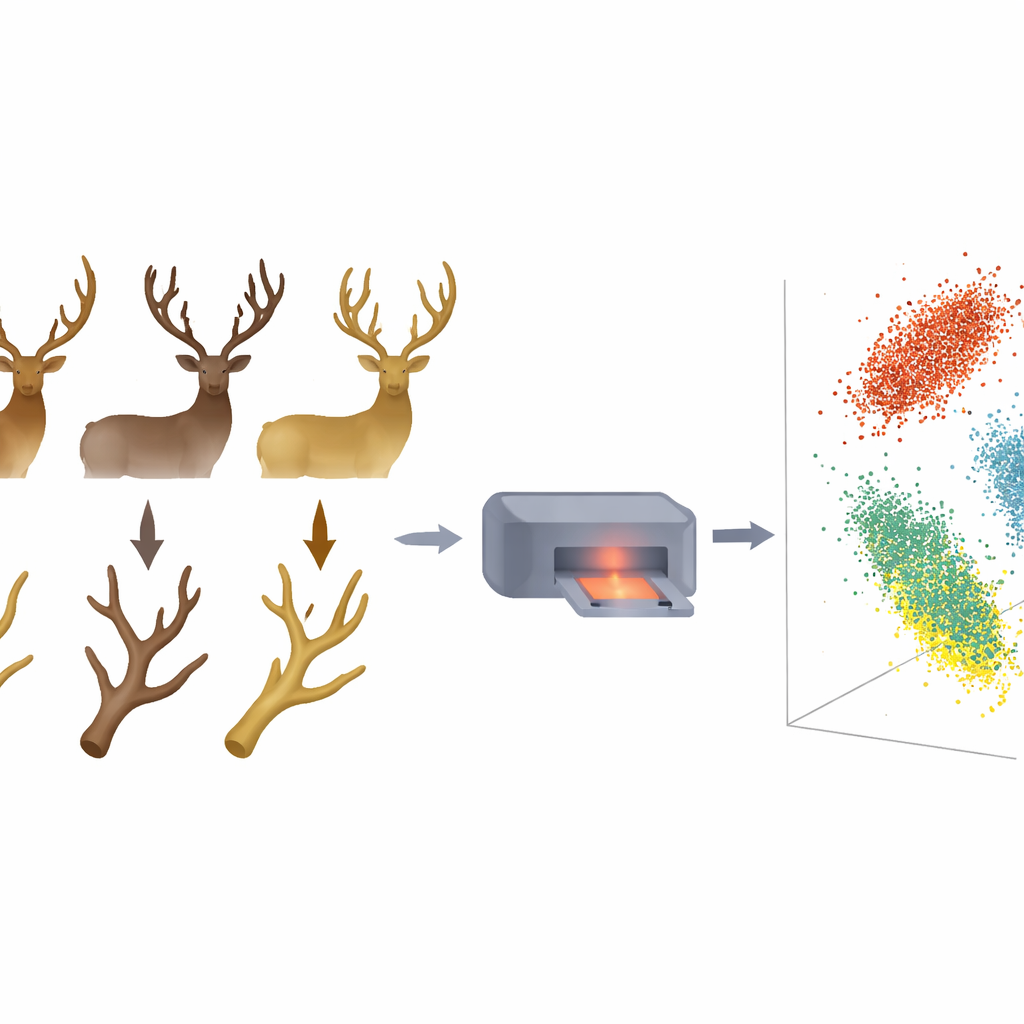
Shining infrared light on bone powder
The researchers turned to a technique called ATR-FTIR spectroscopy, which works by pressing a tiny amount of powdered antler against a special crystal and shining infrared light through it. Different chemical bonds in the sample absorb specific parts of the light, creating a kind of fingerprint curve. Because antlers from different deer species are built from the same main ingredients—minerals such as hydroxyapatite and structural proteins like collagen—their raw fingerprints look extremely similar to the naked eye. The team confirmed that repeated measurements, different positions along the same antler, and different individuals of the same species all gave highly consistent spectra, meaning any differences they later found would likely reflect real species-level traits rather than random noise.
Letting algorithms find patterns our eyes miss
To tease apart subtle differences in these spectral fingerprints, the scientists used chemometrics—mathematical tools that search large datasets for hidden structure. First, they applied principal component analysis, an unsupervised method that rearranges the data into new axes capturing the main directions of variation. This produced three broad clusters corresponding to the three deer species, but with a few samples slipping into the wrong group, limiting accuracy to about 93%. Next, they used a supervised method called partial least squares discriminant analysis, which is designed specifically for classification. By focusing on spectral regions most strongly linked to species identity, this model separated all samples cleanly into their correct groups.
Testing the method like a forensic case
To make sure the approach would hold up outside the training set, the team carried out two independent tests. In the first, they took a separate set of spectra not used to build the model and asked it to classify them. In the second, they performed a blind test with ten antler samples whose species were unknown to the analyst. In both cases, the model correctly identified every single sample, achieving 100% accuracy and perfect scores on standard performance measures. Crucially, the method needs only about 50 milligrams of powder, leaves the rest of the antler intact for future DNA or elemental studies, and avoids harsh chemicals or complex preparation.

What this means for protecting wildlife
This work shows that combining ATR-FTIR spectroscopy with advanced statistical modeling can reliably tell apart antlers from spotted deer, sambar deer, and swamp deer—even when they are processed pieces lacking obvious visual clues. For wildlife forensic laboratories and enforcement agencies, this offers a rapid, cost-effective, and non-destructive way to link seized items to specific protected species, strengthening cases against illegal traders. While more testing on larger numbers of antlers and additional deer species is still needed, the study points toward a future where a small pinch of bone powder and a beam of infrared light can help protect entire deer populations.
Citation: Sharma, C.P., Bhatia, D. & Singh, R. Species-level identification and differentiation of deer antlers using ATR-FTIR spectroscopy and chemometrics. Sci Rep 16, 13708 (2026). https://doi.org/10.1038/s41598-026-44334-6
Keywords: wildlife forensics, deer antlers, spectroscopy, illegal wildlife trade, species identification