Clear Sky Science · en
Assessment of a 40-year-old induction motor using hybrid diagnostic and AI-based predictive techniques
Why Old Motors Still Matter
Across factories, water plants, and power stations, big electric motors quietly keep our world running. Many of these workhorses have been spinning for decades, and replacing them can be costly and disruptive. This article explores whether a 40-year-old industrial motor—long past its usual design life—can still be trusted. By blending classic electrical checkups with thermal imaging and modern artificial intelligence, the researchers show how to decide if an aging motor is a liability or a well‑maintained asset.
An Aging Workhorse Under the Microscope
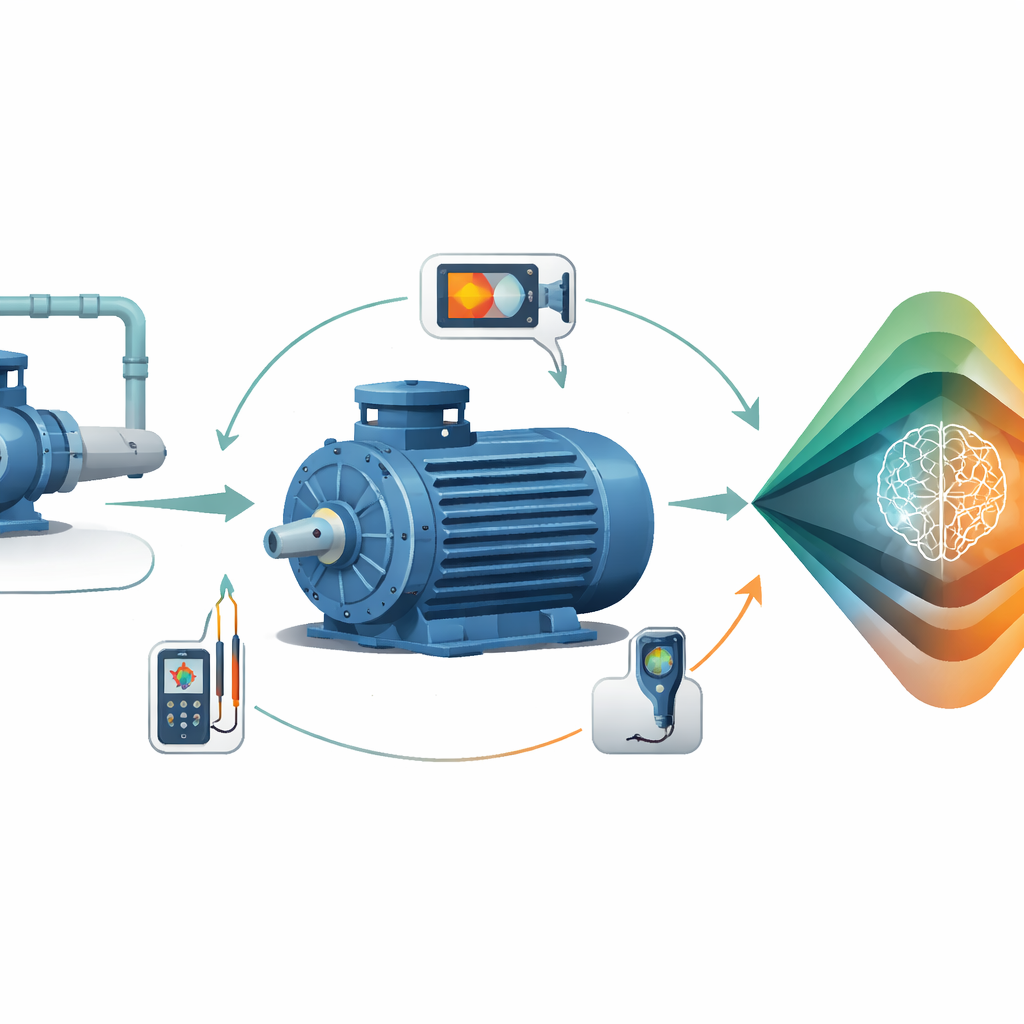
The study focuses on a 150‑kilowatt induction motor that drives a water‑transfer pump and has been in service for about 40 years, far beyond the 20–25 years typically expected. Instead of assuming that age alone is a reason to retire it, the team carried out a full health check. They measured how well the internal insulation still blocks current, how much stray current leaks to ground, and how evenly the windings resist electricity. These tests, taken together, tell whether the hidden "nerves" of the motor are drying, cracking, or absorbing moisture—problems that can lead to sudden and costly failures.
Electrical Checkups and Heat Maps
Several classic tests painted a surprisingly positive picture. Insulation resistance measurements were well above the 1 gigaohm threshold that standards consider acceptable for old motors. One phase showed a strong polarization index—an indicator that insulation dries out properly under voltage—while the other two phases were borderline, hinting at mild aging or moisture. Leakage current, another early warning of breakdown, stayed far below typical danger levels, although one phase again looked weaker than the others. When the team measured the resistance of each winding, they found some imbalance, but not enough to cause hot spots or obvious distress during operation.
To see how the motor behaved under real load, the researchers ran a full performance test. The torque, current, and efficiency curves lined up closely with textbook expectations for a healthy induction motor, even at high slip (the difference between the motor’s speed and the speed of the rotating magnetic field). Infrared thermography—essentially a heat camera—showed surface temperatures rising by about 65 °C above ambient, still acceptable for the motor’s insulation class. The thermal images did reveal mild temperature differences between phases, echoing the uneven electrical readings and pointing to areas that deserve closer watch.
Teaching a Machine to Spot Trouble
Beyond one‑off tests, the team asked whether data from this and similar motors could feed a predictive tool that flags trouble in advance. They assembled a three‑year dataset from several large, older motors, each data point including insulation readings at different times, leakage current, winding resistance adjusted for temperature, thermal indices from infrared images, and basic operating conditions. Using this information, they trained a Random Forest model—a type of decision‑tree ensemble—to sort motor states into "normal" or "insulation at risk." Despite having relatively few true failure examples, the model reached about 87% overall accuracy and could recognize many, though not all, degraded cases. The analysis also showed which measurements matter most: winding resistance and thermal indicators slightly edged out insulation resistance and leakage current, underscoring the value of combining electrical and thermal views.

Projecting the Motor’s Remaining Life
The authors did not stop at current condition; they also asked how the insulation might age in the coming years. Using historical test results from age 25 to 40, they fitted a simple exponential curve to describe how insulation resistance falls over time. This curve matched past data well and predicts that, around 45 years of age, the motor’s insulation resistance would still be close to 2 gigaohms—above the usual safety floor. However, the researchers stress that such forecasts are only as good as the data behind them. Because there are few long‑term measurements and many real‑world influences like temperature swings and contamination, they treat the model as an informed estimate with uncertainty, not a guarantee.
What This Means for Keeping Motors Running
Pulling all strands together, the study concludes that this particular 40‑year‑old motor can remain in service safely, provided it is watched carefully. Its electrical insulation, heat behavior, vibrations, and reliability statistics (with an availability of about 99.94%) all support extended life, even though two phases show early signs of aging. The combined approach—regular electrical testing, thermal imaging, vibration checks, and AI‑assisted analysis—offers plant operators a practical way to decide when to refurbish, rewind, or finally replace costly equipment. In everyday terms, the work shows that an old motor does not have to be retired just because of its age; with good records, smart monitoring, and targeted maintenance, it can keep turning reliably while saving both money and downtime.
Citation: Butukuri, K.R., Giri, N.C., Yemula, P.K. et al. Assessment of a 40-year-old induction motor using hybrid diagnostic and AI-based predictive techniques. Sci Rep 16, 13739 (2026). https://doi.org/10.1038/s41598-026-44319-5
Keywords: induction motor, predictive maintenance, insulation health, thermography, machine learning