Clear Sky Science · en
Effect of biopolymer and plant fiber on soil-water characteristics of sandy soil
Why keeping water in sandy soil matters
For farmers, city planners, and engineers, sandy soil is a mixed blessing: it drains quickly, which prevents flooding, but it also loses precious water just when plants or building foundations need it most. This study explores a greener way to make sandy soil hold onto water longer by mixing in natural "glues" made by microbes (biopolymers) and plant fibers. The authors not only test how well this works, they also build a predictive formula that explains how water moves and stays inside these improved soils.
Natural helpers for thirsty ground
Biopolymers such as xanthan gum can soak up large amounts of water and form soft gels between soil grains, while plant fibers like jute behave like tiny sponges and anchors. Both materials are renewable and less polluting than traditional cement-based soil stabilizers. When mixed into sandy soil, they change the internal pore structure: the gels fill gaps between grains and the fibers weave through the particles. Earlier research showed that these additives boost water-holding capacity, but existing models for soil moisture could not fully describe what happens, especially when both biopolymer and fiber are used together.
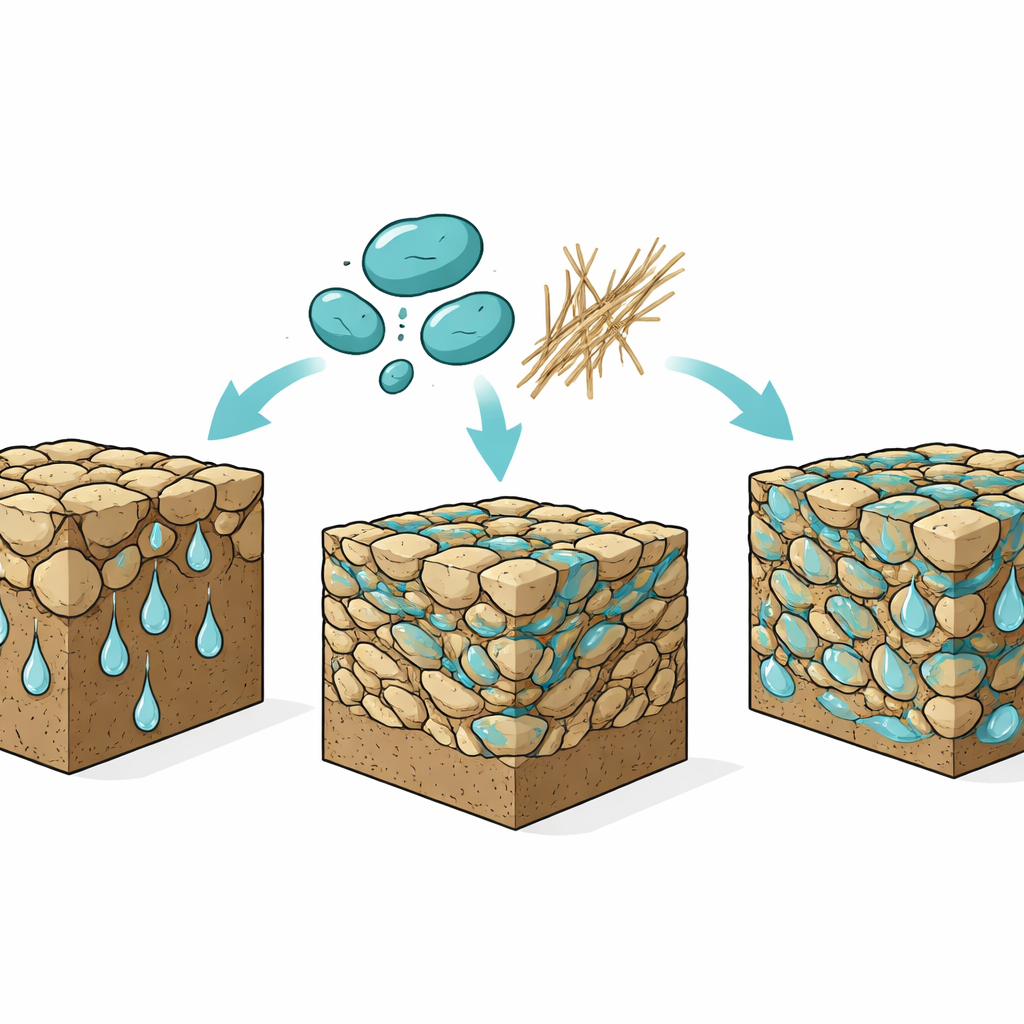
How the new soil model is built
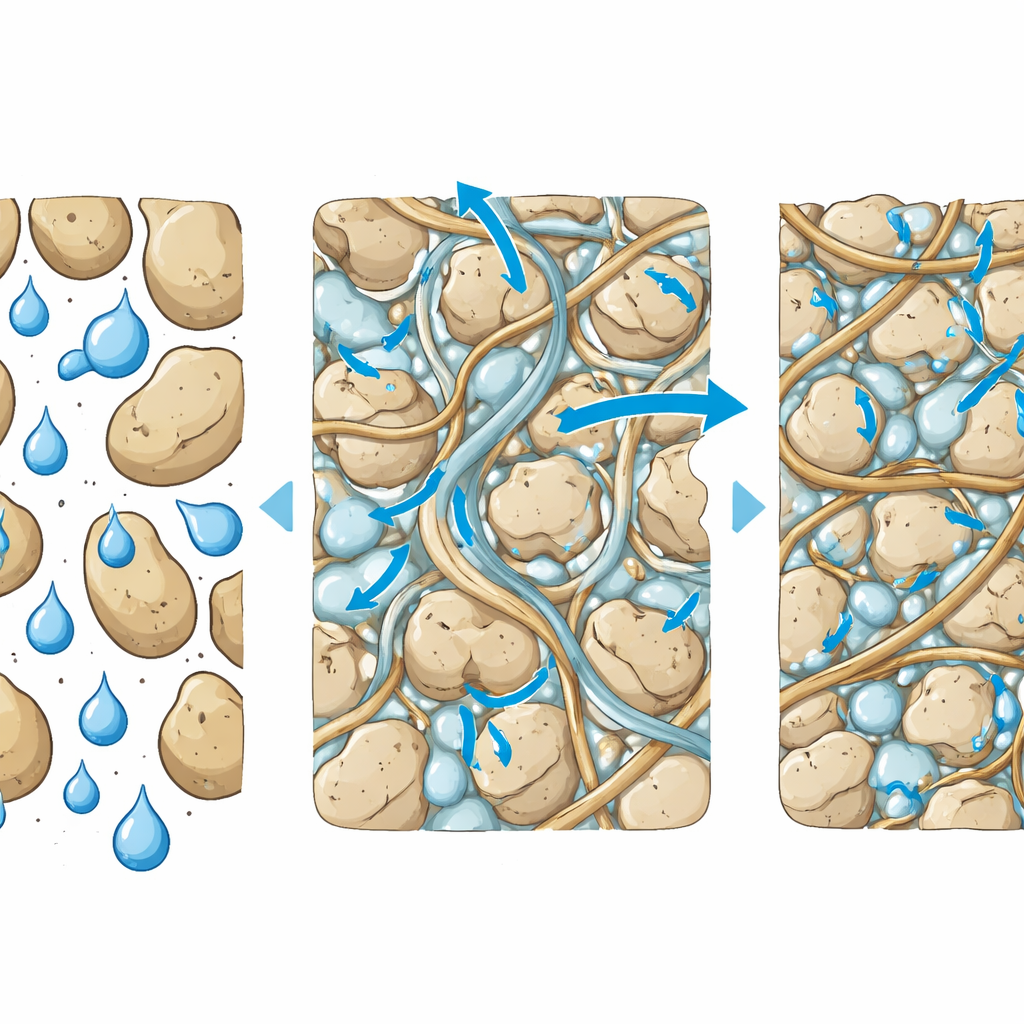
The authors develop a new version of the soil-water characteristic curve, a key relationship that links how tightly water is held in soil (suction) to how much water the soil actually contains. They divide the treated soil into several components: solid grains, biopolymer, plant fibers, air, and three kinds of water. Water can sit inside the swollen biopolymer, inside the plant fibers, or in the remaining pore spaces between everything else. The model tracks how each of these water stores changes as suction increases, and how the swelling or shrinking of the biopolymer and fibers themselves alters the total pore volume of the soil.
Capturing the push and pull inside the soil
A central idea in the model is that biopolymer and fibers do not swell freely once they are packed into soil. As they absorb water, they try to expand, but nearby grains squeeze them, limiting how much water they can take up. The authors introduce correction factors that depend on how much pore space is available: when gels and fibers fill only a small fraction of the pores, they expand almost freely; as they occupy more space, the soil matrix increasingly resists their growth. At the same time, their swelling both blocks existing pores and gently pushes grains apart, creating new voids. The model balances these opposing effects to calculate an effective porosity that then feeds into a familiar semi-empirical soil-water formula.
Putting the equations to the test
To see whether the model matches reality, the researchers perform centrifuge experiments on silty sand samples treated with xanthan gum and jute fibers, alone and in combination, under different compaction levels. Spinning the samples at various speeds creates a wide range of suctions and lets them measure how much water remains in the soil at each step. They find that adding 1.5% biopolymer or 0.6% fiber greatly raises the air-entry value—the point at which air first pushes into the pores—and increases the water content in the saturated state. When biopolymer and fiber are used together, the soil stores even more water at low suctions and still keeps notable moisture at very high suctions, mimicking drought conditions. The model reproduces these curves closely and also fits independent data from other studies that used different biopolymers and fibers.
What this means for real-world soils
In plain terms, the study shows that a carefully chosen mix of natural gel-like substances and plant fibers can turn loose sandy soil into a more water-efficient material, while a new mathematical tool reliably predicts how much water such soil can hold under different drying conditions. This helps designers pick suitable additive types and dosages without testing every possible combination in the lab. For agriculture, landscaping, and geotechnical projects in dry or variable climates, the model offers a way to design soil treatments that conserve water, support vegetation, and improve stability, all while relying on more sustainable materials.
Citation: Dianzhi, F., Dejiang, Z., Jiaxu, J. et al. Effect of biopolymer and plant fiber on soil-water characteristics of sandy soil. Sci Rep 16, 13432 (2026). https://doi.org/10.1038/s41598-026-44309-7
Keywords: sandy soil, biopolymer, plant fiber, water retention, soil stabilization