Clear Sky Science · en
Multi-point collaborative mobile replica node detection protocol based on key negotiation
Guarding tiny wireless helpers
From smart farms to industrial plants, countless wireless sensors quietly watch the world and report what they see. But if an attacker secretly slips fake twins of these sensors into the network, they can spread lies, steal data, and drain batteries. This paper presents a new way to spot such impostor sensors, especially in networks where some devices move around, helping keep future Internet of Things systems safer and longer lived.
Why fake twins are a serious problem
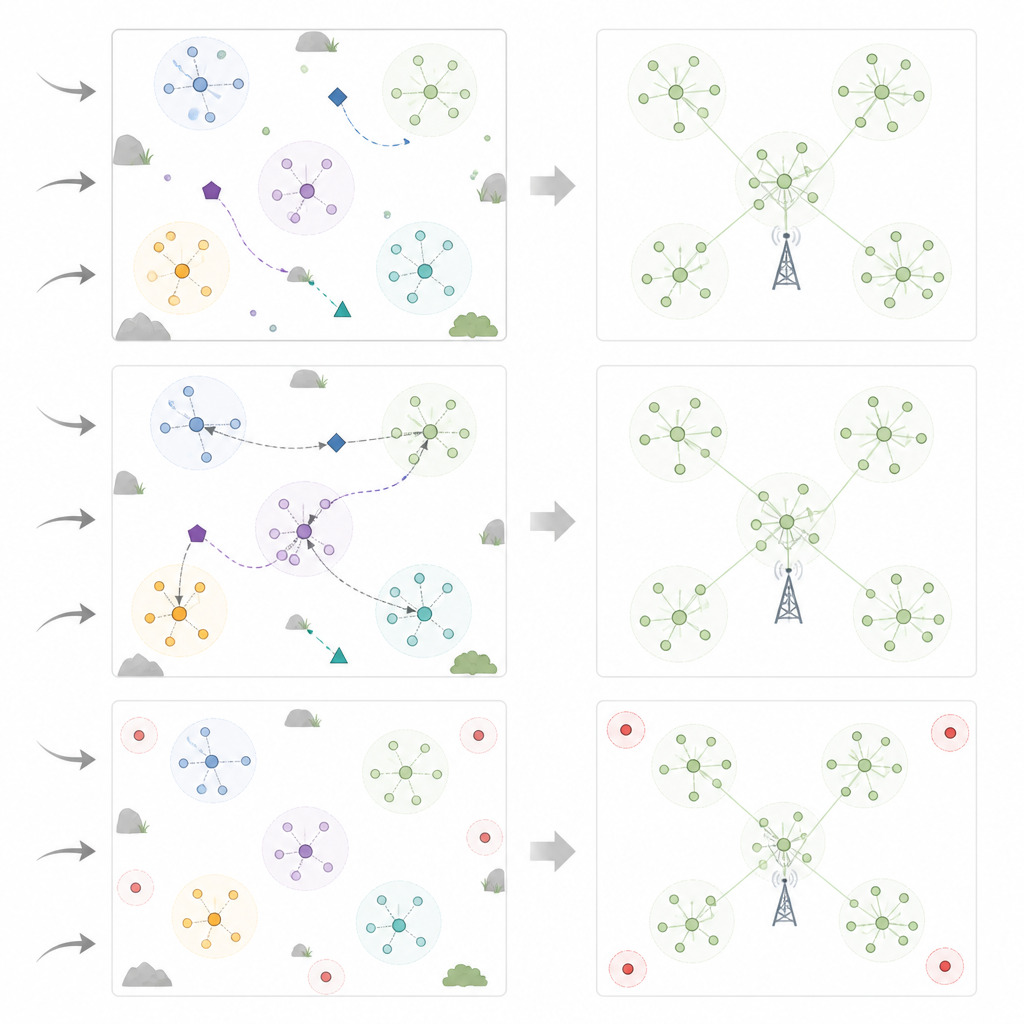
Wireless sensor networks are made of many small, low power devices scattered over an area to measure temperature, motion, pollution, and more. Because these devices are cheap and exposed, an attacker can capture one, copy its identity, and deploy many clones that pretend to be the original. These replica nodes can disrupt routing so messages never reach their destination, feed false readings into data fusion, or throw off time synchronization across the network. Existing defenses mostly assume that sensors never move and often rely on a central base station, which leads to heavy communication near that point, high memory use, and short network life.
A new mix of mobile scouts and local leaders
The authors propose a fresh design called KN MCDP that targets mixed networks where most sensors are static but a few powerful nodes can move. Static sensors are grouped into clusters, each led by a slightly stronger cluster head. These leaders keep compact summaries of which sensor identity appears where in their area. Meanwhile, mobile nodes roam through the network like patrol cars, briefly talking with cluster heads and with one another. Together, these roles create several chances to catch identity clones without flooding the entire network with raw data.
How the protocol checks who is who
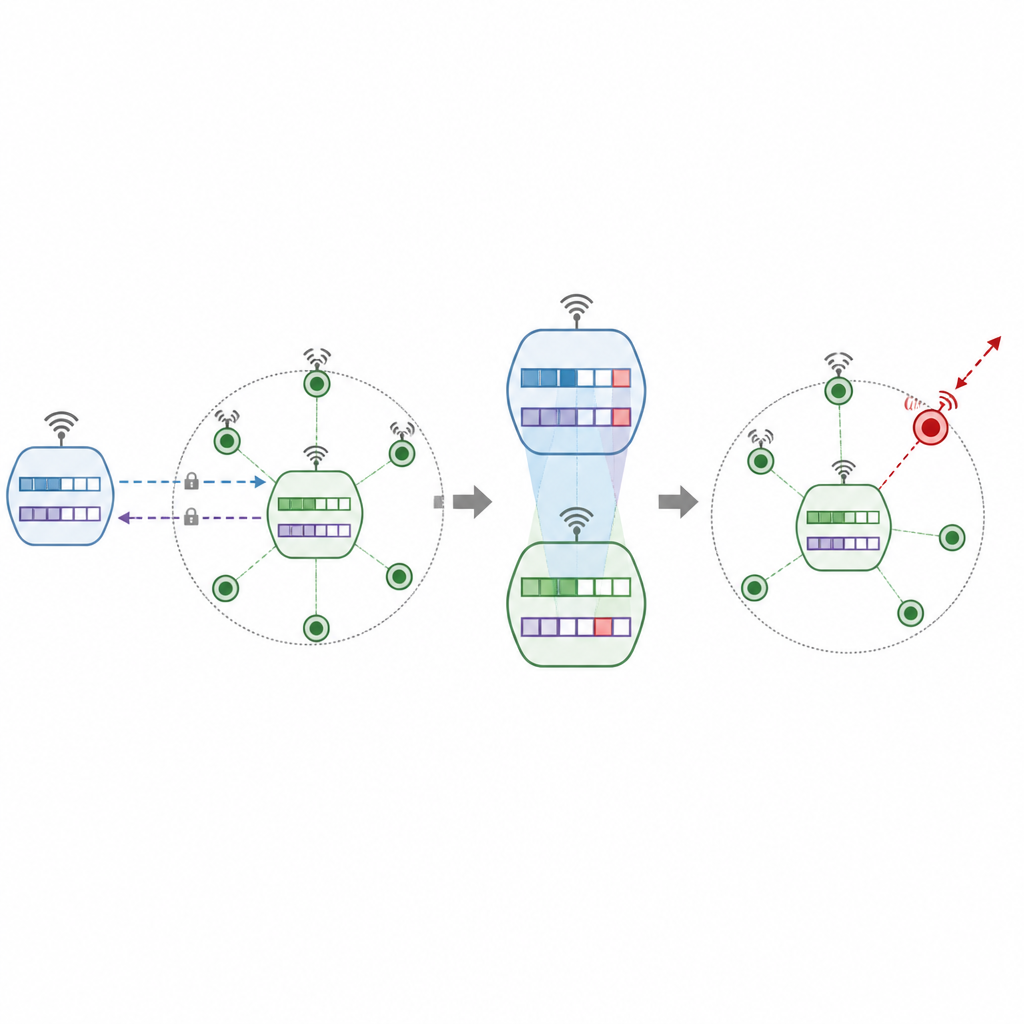
Communication in KN MCDP is wrapped in several layers of protection. First, each exchange is signed so a node can verify who it is talking to. Next, a special mathematical link between node identities is used to derive shared secret keys, after which fast symmetric encryption protects the actual contents. Rather than storing long lists of sensor IDs and locations, both cluster heads and mobile nodes use Bloom filters, a compact way to record whether a given item has been seen. Inside each cluster, when a sensor reports in, the leader checks whether that identity has been seen at a different place in the same round. If so, the node is marked as a replica and the network is told to ignore it.
Roaming checks and shared evidence
Mobile nodes add another layer of scrutiny. As they visit different clusters, they gather compressed location summaries from many leaders. Later, by comparing what they have learned, they can notice when the same identity appears in two far apart places, which should be impossible for an honest sensor. When two mobile nodes meet, they also swap their summaries; if they discover conflicting locations for the same identity, the suspicious one is flagged. In addition, the base station watches how often each mobile node interacts with clusters; abnormal patterns can reveal that a mobile node itself has been cloned.
What the experiments show in practice
To test their design, the authors simulate networks with different numbers of sensors, mobile nodes, and fake replicas. They compare KN MCDP with several well known methods, including a simple central approach and two cluster based schemes. The new protocol maintains a high detection rate close to the best central method, but with far lower communication and energy use. Using Bloom filters sharply cuts the amount of data that nodes must store and transmit, while spreading the detection work across cluster heads, mobile nodes, and the base station helps balance battery drain. As network size grows, competing methods either overload certain nodes or suffer from rising error rates, while KN MCDP continues to operate efficiently.
Stronger sensor networks for a connected world
In plain terms, this work shows how a small team of roaming, well protected devices can help a large crowd of simple sensors watch for impostors. By combining compact data summaries, shared secret keys, and several layers of checking, the KN MCDP protocol spots cloned nodes with high accuracy while keeping wireless chatter and memory needs modest. The result is a sensor network that not only resists a subtle and damaging type of attack but also keeps running longer on limited batteries, an important step for building trustworthy Internet of Things systems.
Citation: Cheng, J., Zhang, Z. & Li, J. Multi-point collaborative mobile replica node detection protocol based on key negotiation. Sci Rep 16, 14771 (2026). https://doi.org/10.1038/s41598-026-44298-7
Keywords: wireless sensor networks, node replication, Internet of Things security, Bloom filter, energy efficient detection