Clear Sky Science · en
Experimental and Monte Carlo simulation study on photons shielding properties of ZrO2-reinforced polyester composites utilizing GEANT4 and MCNP codes
Why safer shields for radiation matter
Hospitals, factories, and research labs all rely on devices that emit high‑energy radiation, such as X‑rays and gamma rays, to see inside the human body, test industrial parts, or study new materials. To protect workers and patients, this radiation must be blocked or reduced by shielding. For decades, heavy and toxic lead sheets have done most of this work. The study summarized here explores a lighter, less hazardous alternative: plastic-based materials reinforced with tiny particles of zirconium oxide that can stop dangerous photons almost as well as lead.
Building a new kind of protective plastic
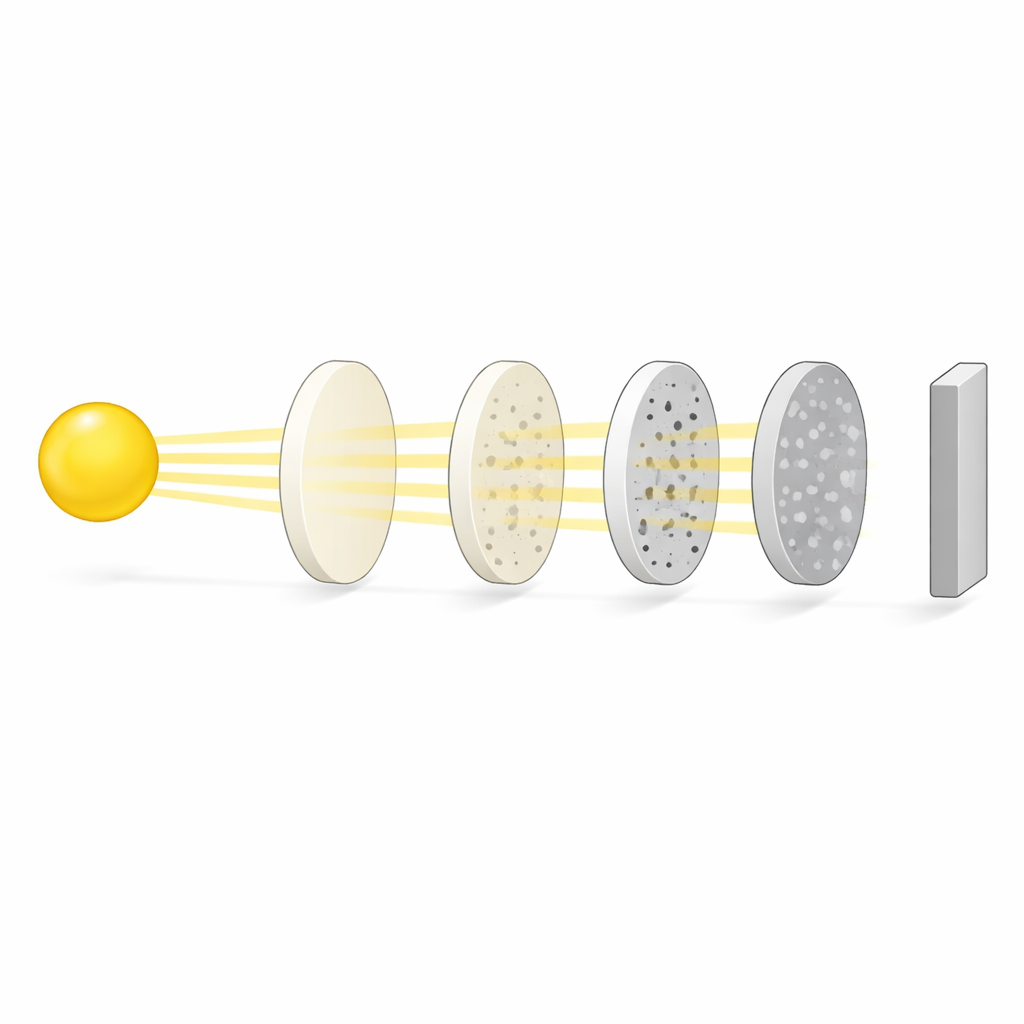
The researchers focused on a common plastic called polyester, which is inexpensive, easy to mold, and already used widely in industry. By itself, polyester does not block gamma rays very effectively, so the team mixed it with increasing amounts of zirconium oxide (ZrO₂), a dense, stable ceramic already used in dental implants and fuel cells. They created four types of circular samples: pure polyester and versions containing low, medium, and higher amounts of zirconium oxide. Simple measurements showed that as more zirconium oxide was added, the samples became slightly denser, hinting that they might also become better shields.
Testing shields with both experiments and virtual models
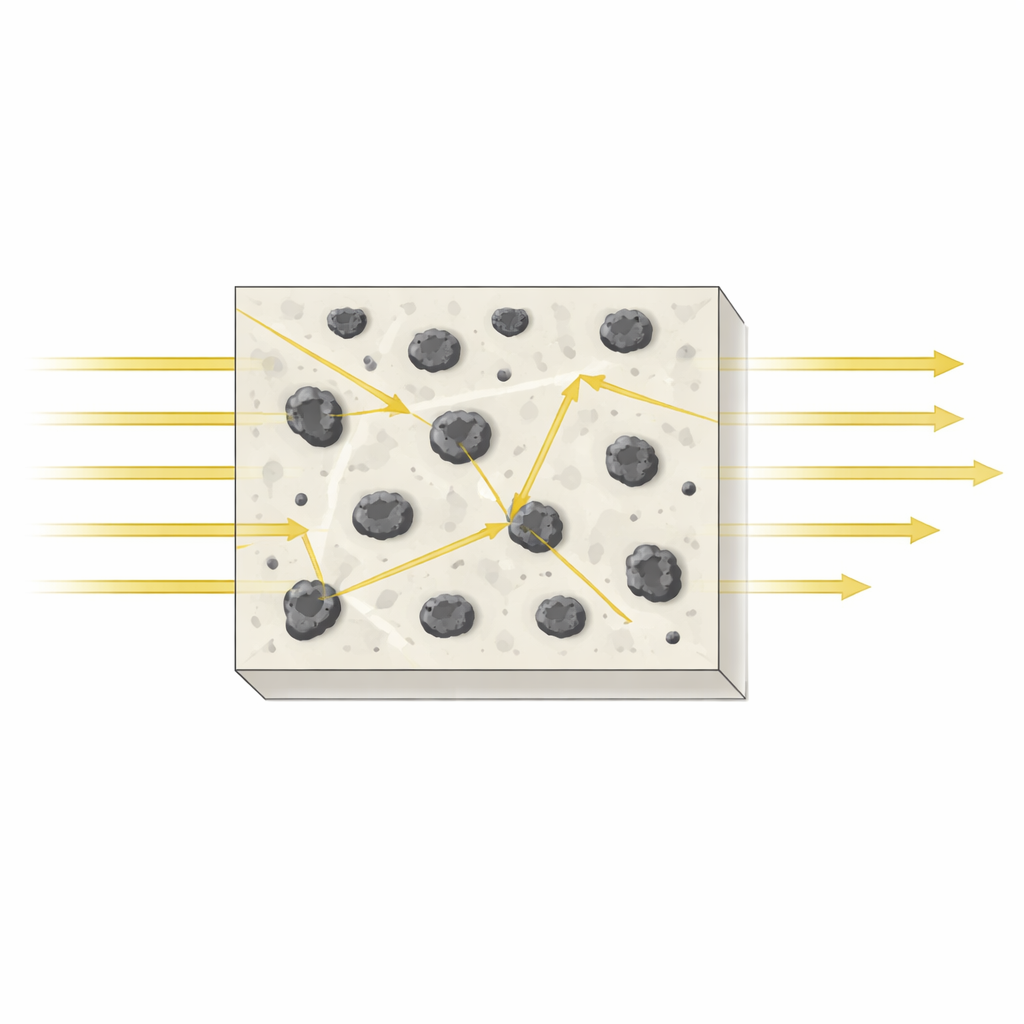
To find out how well these plastics could block radiation, the team fired gamma rays from a cesium‑137 source at the samples and measured how much radiation got through to a detector on the other side. They then repeated the same setup in the computer using advanced Monte Carlo simulation codes, including GEANT4 and MCNP, along with several online tools that calculate how photons travel through matter. These simulations track millions of particles as they scatter, get absorbed, or pass straight through the material, allowing the scientists to estimate key shielding traits such as how quickly radiation intensity drops with thickness and how thick a slab must be to cut the beam in half or to one‑tenth of its original strength.
Looking inside the material
Beyond simple measurements, the team examined the internal structure of their composites. Using X‑ray diffraction, they confirmed that the polyester matrix remained mostly non‑crystalline, while the zirconium oxide particles kept their ordered, crystal‑like structure. Scanning electron microscope images revealed how these particles were distributed within the plastic for low and high loading levels. The presence of clearly visible zirconium oxide grains throughout the polyester showed that the fillers were successfully integrated, an important condition for the material to interact strongly with incoming gamma rays.
How well the new shields perform
Across photon energies spanning those used in medical imaging and industrial checks, all methods pointed to the same trend: adding zirconium oxide steadily improved the material’s ability to block gamma rays. Samples with more filler required less thickness to cut the radiation beam in half or to one‑tenth, and the distance a photon could typically travel before interacting grew shorter. At the energy of cesium‑137 gamma rays, the measured performance closely matched the computer predictions, with differences generally within a few percent. The study also compared these composites to lead by converting their performance into an equivalent lead thickness. As the zirconium oxide content increased, the “lead‑equivalent” value rose, meaning a thin piece of the composite could substitute for a comparable, much heavier layer of lead.
What this means for everyday technology
For a non‑specialist, the main takeaway is that it is possible to make lighter, less toxic shields for gamma radiation by loading common plastics with the right kind of heavy, stable particles. The zirconium‑oxide‑reinforced polyester examined here shows that such materials can approach lead‑like performance in the low to medium energy range relevant to many medical and industrial uses, while remaining easier to handle and shape. Because the experimental results lined up well with multiple simulation tools, these computer methods can now be used with confidence to design and optimize future shielding materials before they are ever made in the lab.
Citation: Abdollahi, M., Jafari, A. & Saray, A.A. Experimental and Monte Carlo simulation study on photons shielding properties of ZrO2-reinforced polyester composites utilizing GEANT4 and MCNP codes. Sci Rep 16, 14529 (2026). https://doi.org/10.1038/s41598-026-44283-0
Keywords: radiation shielding, polymer composites, zirconium oxide, gamma rays, Monte Carlo simulation