Clear Sky Science · en
HEAL: health-enhanced adaptive LoRaWAN for AI-based real-time soldier monitoring and status prediction
Why watching soldiers’ health from afar matters
On today’s battlefields, soldiers may operate far from doctors, in rough terrain where communication is patchy and batteries must last for days. This study explores how wearable health sensors, low-power radio links, and artificial intelligence can work together to keep quiet, constant watch over soldiers’ vital signs. The goal is to spot early warning signs of heat stress, low oxygen, or other problems and alert medics in time, even when the wireless connection is unreliable.
Smart uniforms and distant lifelines
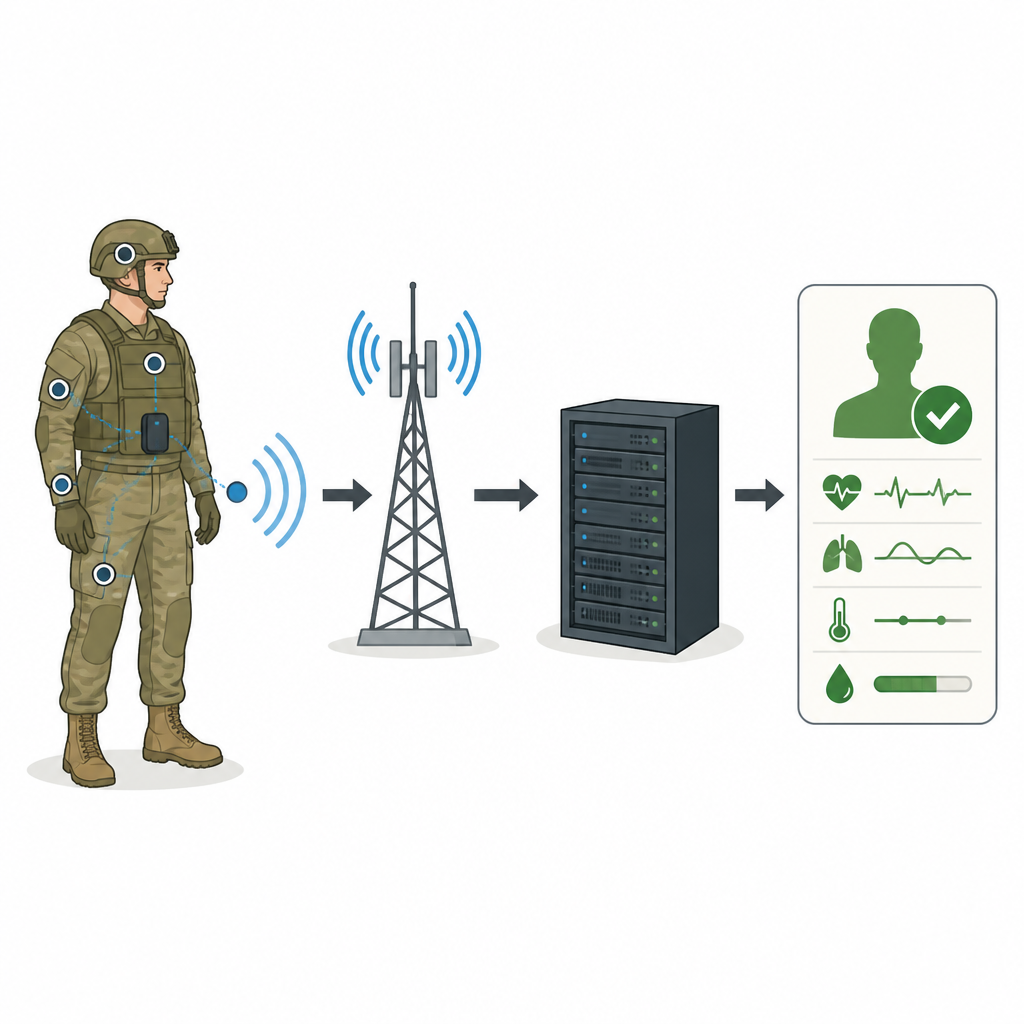
Recent advances in the Internet of Medical Things have made it possible to weave sensors into uniforms, wristbands, or chest straps that track heart rate, temperature, blood oxygen, and more. Earlier systems often relied on short-range links like Bluetooth or Wi‑Fi, which work well near a base station but struggle across hills, forests, or moving convoys. This paper focuses on LoRaWAN, a long-range, low-power radio technology that can send small packets of data over hundreds of meters or even kilometers. The challenge is that this radio link can drop packets, introduce delays, and limit how much data can be sent, all of which can confuse AI models that expect clean, regular readings.
A framework called HEAL
The authors introduce HEAL, a Health-Enhanced Adaptive LoRaWAN framework that connects wearable sensors, a LoRaWAN network, and AI models into one end-to-end system. Each soldier carries small sensors that send selected vital signs through a LoRaWAN gateway to a central server, where AI examines short time windows of readings and classifies health status as Well, Alarming, or Critical. “Adaptive” here means the AI is chosen and tuned to stay accurate even when data arrive late, occasionally missing, or with fewer measurements than would be ideal, reflecting what really happens over a low-power field network.
Teaching AI to read vital signs
To train and test the AI, the researchers used a large public dataset of vital signs rather than real battlefield data. Since the dataset lacked health labels, they asked several large language models to act as automated “labeling assistants,” assigning each record to Well, Alarming, or Critical based on combinations of heart rate, temperature, oxygen level, blood pressure, breathing rate, and blood sugar. A simple rule-based scheme grounded in medical guidelines was then used to check these labels for safety. The team cleaned and balanced the data so that each health class was well represented, then trained and compared 13 different deep learning models that process vital-sign time series, such as LSTM and GRU networks. A bidirectional LSTM model analyzing short windows of three core signals (heart rate, temperature, and oxygen level) achieved about 94% accuracy and a 95% macro F1-score, meaning it handled common and rare health states reliably.
Putting AI into a fragile radio link
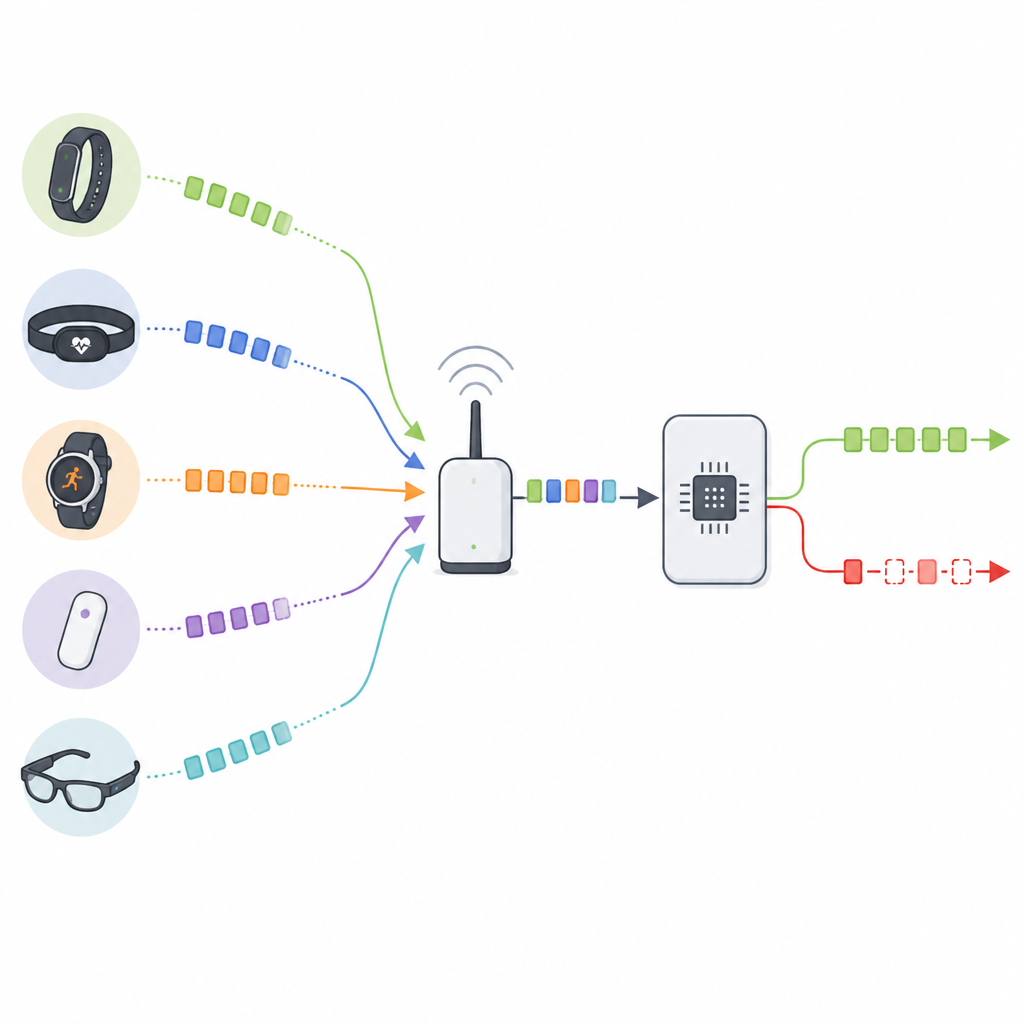
Next, HEAL was tested inside a detailed LoRaWAN simulator that mimics how packets travel, collide, or get lost between moving soldiers and a gateway. The best AI model was deployed on the simulated application server, which received whatever packets made it through and produced health predictions in real time. The study varied the distance between soldiers and gateway (200 to 1000 meters) and the radio spreading factor, which trades airtime for range and reliability. Under favorable conditions, with moderate distances of 200 to 400 meters and lower spreading factors, the network delivered up to 91% of packets while the AI still reached about 93% accuracy. At longer ranges or higher spreading factors, packet delivery and throughput fell and energy per successful message rose, highlighting a clear trade-off between range, reliability, and battery life.
From lab models to real missions
The researchers also examined how well their models carry over from clean lab data to rougher, simulated field data that reflect packet loss and irregular timing. When applied directly, model accuracy dropped into the mid‑70 percent range, but careful fine-tuning on LoRaWAN-style data restored performance above 92%. This shows that training AI with communication-aware examples is crucial if it is to work reliably in real deployments, not just in controlled datasets.
What this means for future soldier care
In plain terms, this work suggests that it is realistically possible to watch over soldiers’ health continuously with low-power wearable devices and long-range wireless links, as long as the AI and network are designed together. A carefully chosen AI model, trained on well-labeled data and adapted to the quirks of the radio channel, can still recognize when a soldier is drifting from well to alarming or critical states even when some readings go missing. HEAL offers a blueprint that could guide future systems for military units, disaster responders, or remote workers, where timely insight into health status must be balanced with limited bandwidth, energy, and connectivity.
Citation: Alghamdi, A., Alotaibi, R. & Alahmadi, H. HEAL: health-enhanced adaptive LoRaWAN for AI-based real-time soldier monitoring and status prediction. Sci Rep 16, 15213 (2026). https://doi.org/10.1038/s41598-026-44274-1
Keywords: soldier health monitoring, LoRaWAN, wearable sensors, AI health prediction, Internet of Medical Things