Clear Sky Science · en
Environmental and economic evaluation of Egyptian cement production using refuse-derived fuel from municipal solid waste
Turning Trash into Building Power
Every day, Egypt’s cities generate mountains of household trash, much of which ends up in open dumps. At the same time, the country’s cement factories burn large amounts of coal and gas, releasing climate‑warming gases. This study explores a simple but powerful idea: what if part of that trash could be cleaned, processed into a fuel, and then used to run cement plants—cutting both pollution and waste at once?
Why Waste and Cement Are So Closely Linked
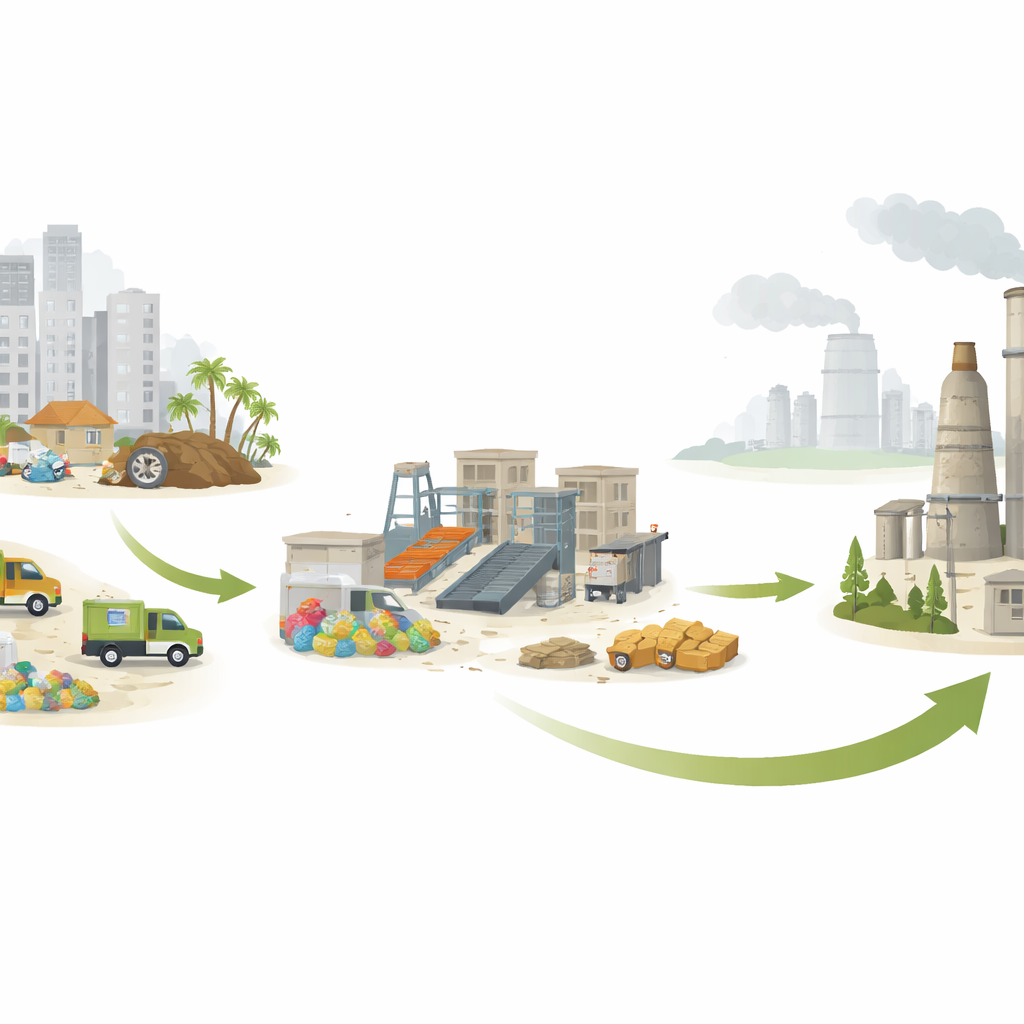
Cement is the backbone of modern construction, but it comes with a heavy environmental price. Producing one ton of cement typically requires a lot of energy and releases around 0.8 tons of carbon dioxide, both from burning fuel and from heating limestone. In Egypt, most of this energy still comes from fossil fuels, while about 28 million tons of municipal solid waste are generated each year and largely dumped in the open. The authors saw an opportunity to connect these two challenges: turn part of the waste into a fuel known as refuse‑derived fuel (RDF) and feed it into cement kilns, replacing coal and natural gas.
How Garbage Becomes a Usable Fuel
The study examined an RDF plant in Alexandria that processes mixed household waste. Trucks deliver waste, which is then sorted to remove recyclables and bulky items. The remaining material is shredded, screened, dried to lower its moisture, shredded again to a uniform size, and passed through air separation to remove dust and very light fragments. From about three tons of mixed waste, roughly one ton of RDF is produced—rich in plastics, paper, textiles and wood, with enough energy content to burn well in cement kilns. While making RDF does consume electricity and diesel, especially in the drying step, it also diverts waste away from dumps and reduces the need to mine and transport fossil fuels.
Testing Different Fuel Mixes in Cement Plants
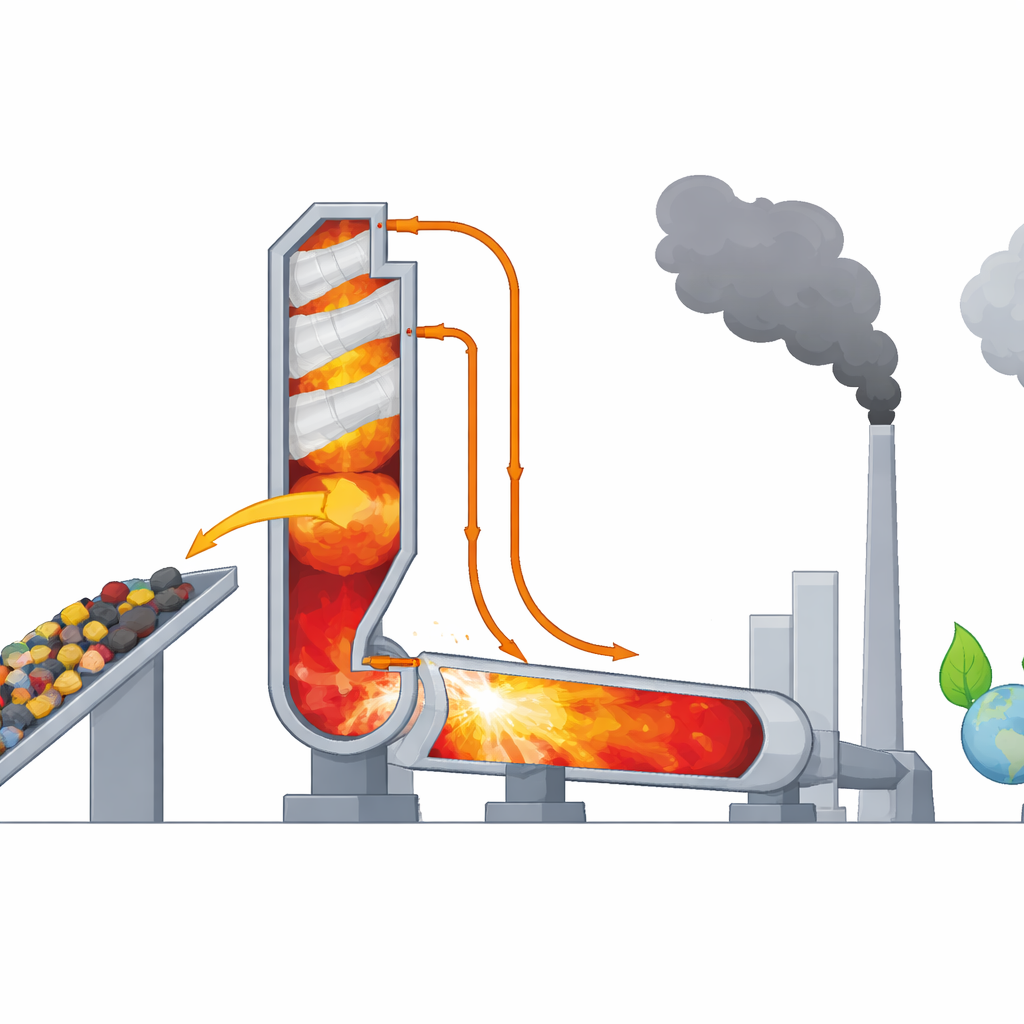
To see what difference RDF makes, the researchers used a life‑cycle assessment, a method that tracks environmental impacts from raw material extraction through to the factory gate. They modeled five scenarios for producing one ton of cement: from today’s fossil‑fuel‑only setup to full replacement of coal and gas with RDF. In each case, the overall heat needed by the kiln was kept the same, only the fuel mix changed. As the share of RDF rose from 0 to 100 percent, nearly all impact measures—such as climate‑warming gases, acid‑forming emissions, and toxic pollutants affecting water and soil—fell steadily. In the full‑RDF scenario, the global warming impact dropped by about 19 percent, and fossil fuel use by more than 60 percent, compared with the all‑fossil baseline.
Balancing Environmental Gains and Money Matters
The team also examined costs for both RDF production and cement manufacturing. Producing RDF requires investment in storage, handling and safety systems, plus ongoing expenses for maintenance, electricity and labor. Even so, the resulting fuel turned out to be cheaper per unit of energy than importing coal and buying natural gas. For a cement plant using just 20 percent RDF, operating costs per ton of cement fell by roughly six dollars, while overall profits remained almost unchanged. When larger substitution rates were considered, the savings in fuel purchases and the potential income from accepting waste (gate fees) made RDF one of the most attractive options financially, especially in a country that relies heavily on imported fossil fuels.
What This Means for Cleaner Cities and Stronger Roads
In plain terms, this study shows that turning sorted household waste into fuel for cement plants can be a “two birds with one stone” solution: less garbage rotting or burning in dumps, and cleaner, cheaper cement production. While there are technical challenges—such as controlling emissions of trace metals and dioxins, and keeping RDF quality consistent—the results indicate that high levels of RDF use can significantly cut climate‑changing emissions and fossil‑fuel demand without hurting plant economics. For countries facing rapid urban growth and mounting waste, using garbage to power the factories that build their cities offers a practical path toward a more circular, less polluting economy.
Citation: Ali, A., Abuarab, M.E., Ibrahim, M.M. et al. Environmental and economic evaluation of Egyptian cement production using refuse-derived fuel from municipal solid waste. Sci Rep 16, 11369 (2026). https://doi.org/10.1038/s41598-026-44273-2
Keywords: refuse-derived fuel, cement production, municipal solid waste, life cycle assessment, waste-to-energy