Clear Sky Science · en
Ground control strategies for longwall top-coal caving panel in extra-thick coal seams with thick-hard roof
Why taming the rock above coal mines matters
Deep coal mines don’t just wrestle with coal; they also battle the rock ceiling above the seam. In some Chinese mines, this roof rock is extremely thick and strong, forming huge overhanging slabs above long tunnels where machines slice out coal. When these giant rock plates finally snap, they can release energy on the scale of explosions, damaging equipment, crushing supports, and threatening workers’ lives. This study explores why those failures are so violent and tests a way to gently weaken the rock in advance so that it breaks in smaller, safer steps instead of in a single catastrophic collapse. 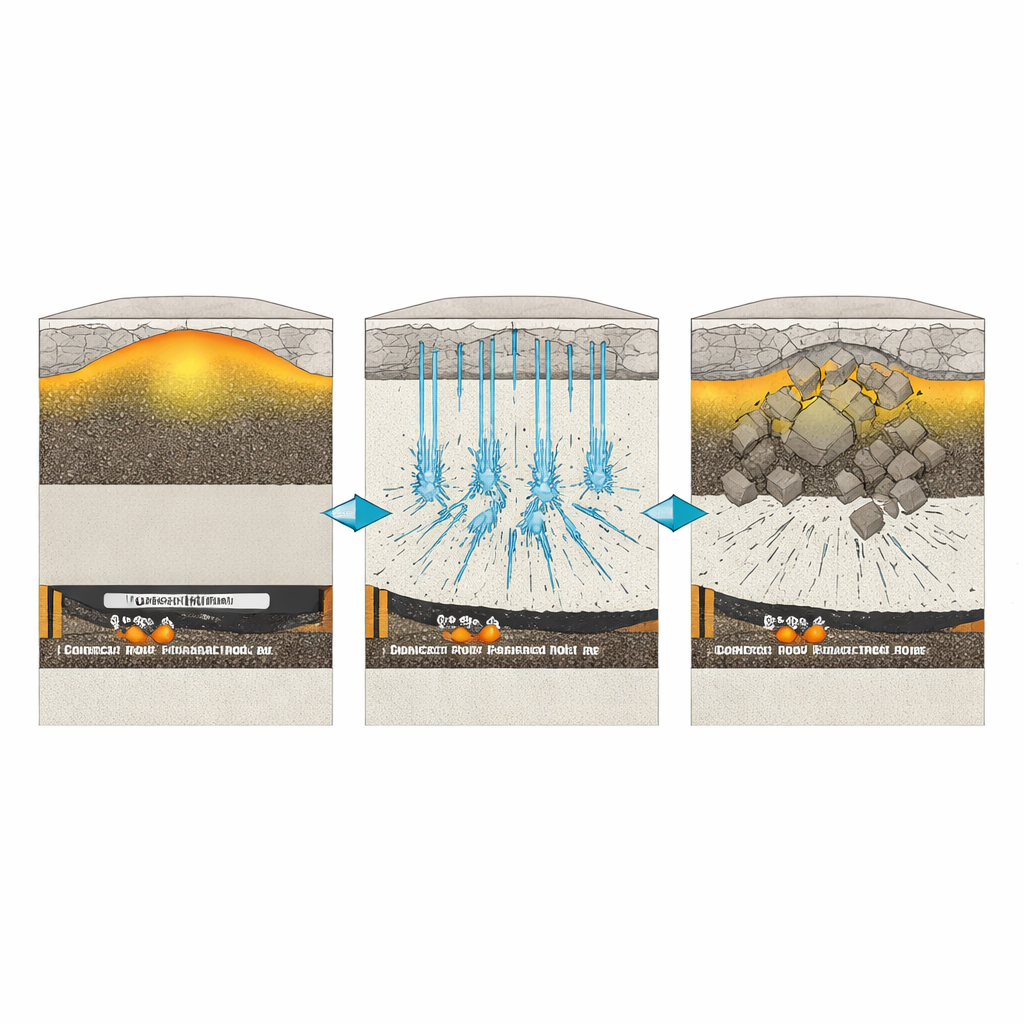
Hidden danger above the mining face
The researchers focus on a mine in Xinjiang, China, where an extra-thick coal seam lies beneath several layers of hard sandstone and mudstone. As a longwall mining machine advances, the soft layers just above the coal fall in quickly, filling the empty space. But the thicker, stronger sandstone higher up behaves like a solid bridge, staying suspended as more and more coal is removed beneath it. Over time, this bridge bends and stores large amounts of strain energy, like a massive stone spring. When the span grows too long, the roof breaks suddenly, sending shock waves through the surrounding rock and causing the floor and sidewalls of tunnels to deform dramatically. In the studied roadway, the walls squeezed inward by more than a meter, and support systems were frequently damaged.
Measuring how much energy the rock can unleash
To understand and control these violent events, the authors build a mechanical model that treats the hard roof as a bending beam of rock. Using principles from material and elastic mechanics, they calculate how the roof behaves just before its first major break and during later, repeated breaks as mining continues. The model links total released energy to key factors: how thick the coal seam is, how thick and strong the hard roof is, how thick the softer immediate roof below is, and how heavy the overlying rock load is. The calculations show that deeper mining, a thicker and stronger hard roof, and a thicker mined coal seam all increase the stored energy and the violence of failure. A thicker immediate roof, by contrast, shifts the break farther from the working face and dampens the stress waves that reach the tunnels. Crucially, the first major break of the main roof releases more than twice the energy of subsequent cycles, highlighting it as the most dangerous stage.
Weakening the roof on purpose
Rather than waiting for the hard roof to fail on its own, the team proposes deliberately weakening it in a controlled way using water-driven fracturing. 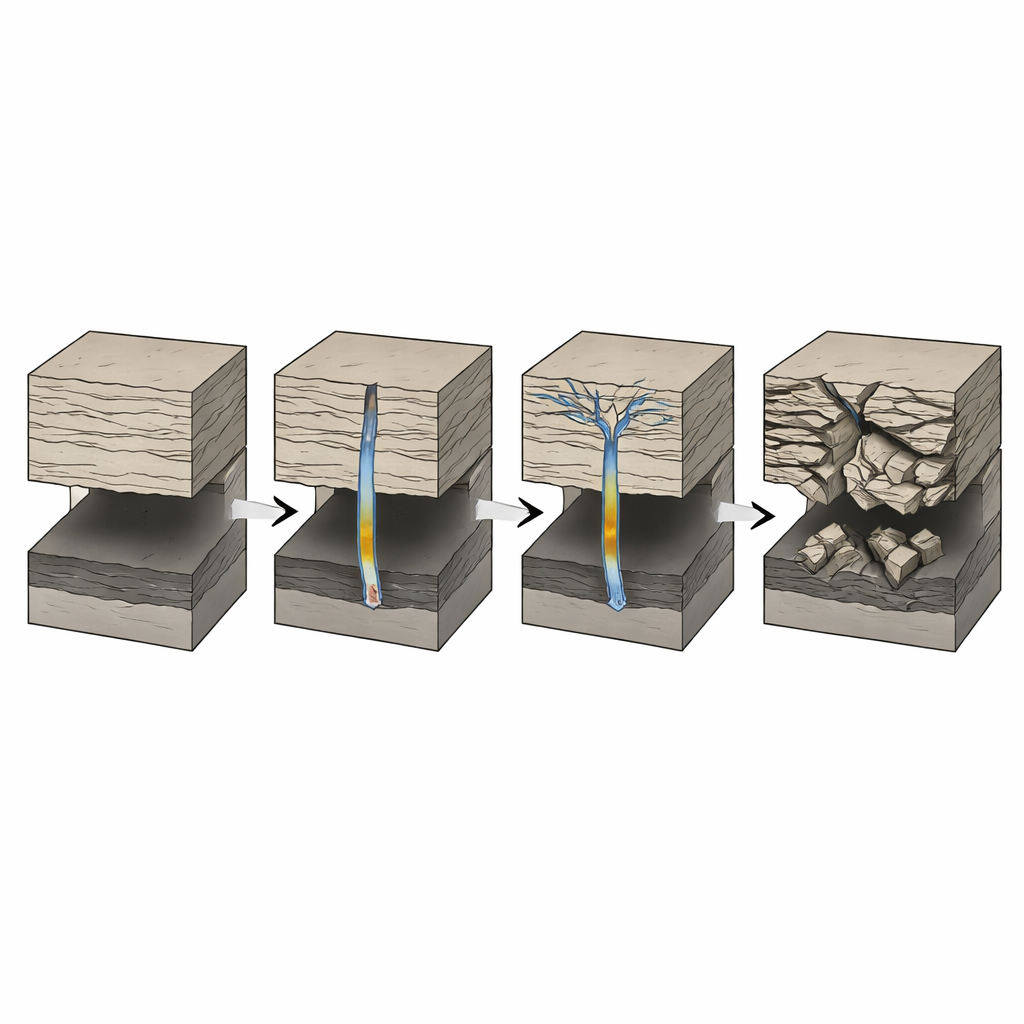
What happened when the method was used in the mine
The approach was applied on the 15,311 south longwall face of the Xinjiang mine, with specific patterns for borehole spacing, depth, and fracturing intervals. Sensors in the tailgate tunnel tracked how the rock around the roadway moved as the face advanced. After hydraulic fracturing, the coal pillar side moved inward by about 236 millimeters and the solid coal side by 135 millimeters, while the roof and floor converged by 287 millimeters—deformations that remained manageable for safe operations. Even more important, the distance the face had to travel before the first major roof pressure event shrank from 45 meters to 18 meters, and the typical spacing between later pressure events dropped by about 35 percent compared with mining without fracturing. These changes show that the roof was breaking sooner, in smaller increments, rather than growing into a large, dangerous overhang.
Turning sudden shocks into manageable shifts
In everyday terms, the study shows that a thick, hard rock roof above a coal seam can act like a huge, loaded spring that suddenly snaps, threatening miners and machines. By understanding how much energy this rock can store and which factors control that energy, engineers can design strategies to release it gradually. The directional hydraulic fracturing method tested here turns a single massive break into a series of smaller, earlier collapses, shrinking the hazardous overhanging roof and softening the blows of ground pressure. This makes it possible to mine very thick coal seams under tough roofs more safely and efficiently, offering a practical template for similar deep mines worldwide.
Citation: Wang, R., Zhang, Wg., Wang, Hs. et al. Ground control strategies for longwall top-coal caving panel in extra-thick coal seams with thick-hard roof. Sci Rep 16, 13919 (2026). https://doi.org/10.1038/s41598-026-44269-y
Keywords: longwall mining, hard roof fracturing, hydraulic fracturing, rock burst control, coal mine safety