Clear Sky Science · en
Individual differences in musical melody perception moderate the speech-to-song illusion in Mandarin Chinese listeners
When Speech Starts to Sound Like Song
Most of us have had the strange feeling that a spoken phrase, when repeated again and again, suddenly starts to sound like singing. This odd shift in perception is called the speech-to-song illusion. The study described here asks whether people who grow up speaking Mandarin Chinese, a language that relies heavily on pitch to distinguish word meanings, experience this illusion in the same way as speakers of languages like English or German. The answer sheds light on how our everyday language experience tunes the way we hear both speech and music.
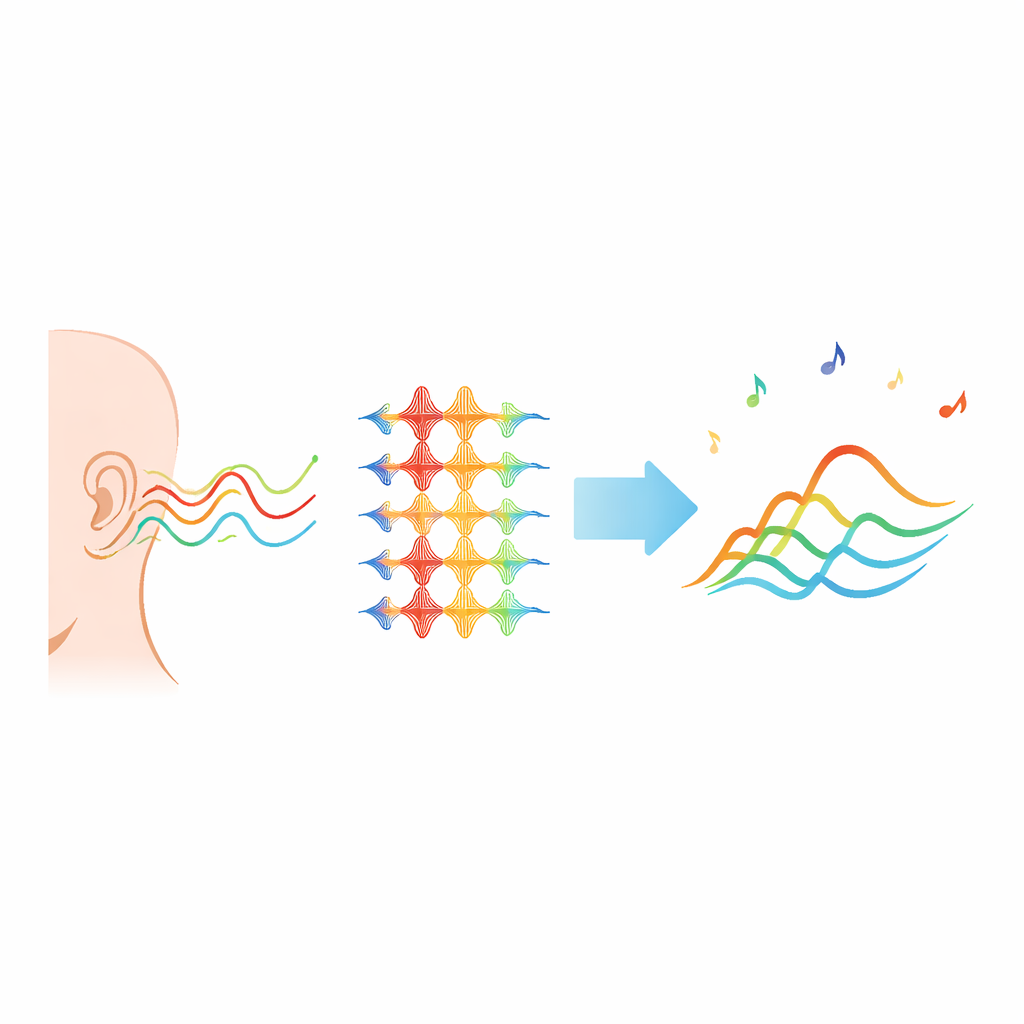
From Everyday Talk to an Auditory Trick
In many non-tonal languages, repetition can turn an ordinary sentence into something that sounds musical. Earlier research has shown that this illusion depends strongly on how pitch is structured in the sentence and on a listener’s ability to pick out melody and rhythm. Tonal languages such as Mandarin use pitch patterns on almost every syllable to encode word meanings. This means Mandarin speakers must pay close attention to pitch from infancy, and they typically become very good at hearing musical melodies as well. Curiously, small earlier studies suggested that, despite their pitch skills, tonal language speakers might actually be less prone to hearing the speech-to-song illusion than non-tonal language speakers.
Testing Mandarin Listeners and Their Musical Ears
To explore this puzzle, the researchers recruited 84 Mandarin speakers, mostly young adults in Hong Kong. Participants first heard single Mandarin sentences and rated how much they sounded like speech or like song on an eight-point scale. Later, they heard looped versions of the same sentences, each repeated eight times, and rated them again. The sentences had been carefully designed in two types: high-sonority phrases, rich in vowels and voiced sounds that carry pitch clearly, and low-sonority phrases, packed with voiceless consonants that interrupt pitch but emphasize rhythmic pulses. Between these two listening tasks, participants completed the Musical Ear Test, a standard tool that separately measures how well people can detect changes in short melodies and in rhythmic patterns.
What Changed After All That Repetition
On average, Mandarin listeners did experience the speech-to-song illusion: after repetition, they rated the sentences as slightly more song-like than at first hearing. However, this effect was modest compared with what has been reported for non-tonal language speakers, and it did not depend on whether the sentence was designed to highlight melody or rhythm. Contrary to one popular idea, there was no sign that better rhythm perception or more rhythmically regular sentences made the illusion stronger. Instead, the most striking factor was individual ability to perceive melody. Listeners who scored relatively low on the melody part of the Musical Ear Test showed a clear jump in song-like ratings after repetition, while those with higher melody scores showed almost no change at all.

Why Weaker Melody Skills Can Help the Illusion
The authors suggest that for Mandarin speakers, strong melody perception may actually work against the speech-to-song illusion. Because pitch patterns in Mandarin carry word meaning, listeners with sharp pitch and melody skills may encode these patterns very faithfully as part of language, holding on tightly to their “speech” interpretation even under repetition. Listeners with weaker melody skills, by contrast, may be more willing—without realizing it—to let these precise tonal patterns drift toward smoother, song-like shapes in their mind. In them, repetition seems to encourage a mild distortion of pitch that frees the sounds from their original word meanings and allows a new, musical interpretation to emerge.
What This Means for Language and Music
In plain terms, the study shows that Mandarin speakers can hear speech turn into song, but the effect is softer and more selective than in many other languages. It depends less on the physical rhythm of the sentence and more on how faithfully a listener normally tracks pitch and melody. Those who are very precise at hearing melody seem to keep speech as speech; those who are a bit looser in their pitch encoding are more easily swept into the illusion. This finding strengthens the idea that our lifelong experience with a particular language shapes not only how we understand words, but also how we experience music-like qualities in everyday sounds.
Citation: Rathcke, T.V., Canzi, M. Individual differences in musical melody perception moderate the speech-to-song illusion in Mandarin Chinese listeners. Sci Rep 16, 10523 (2026). https://doi.org/10.1038/s41598-026-44268-z
Keywords: speech-to-song illusion, Mandarin tone, melody perception, language and music, auditory illusions