Clear Sky Science · en
Classification of anterior cruciate ligament injury profiles through running analysis: a machine learning approach
Why knee injuries matter to active people
For many athletes and active people, an injured knee ligament can be a turning point that changes how they move for life. The anterior cruciate ligament, or ACL, is a key stabilizer in the knee, and tears are common in sports that involve cutting, jumping, and sudden stops. Even after surgery and months of rehab, people often do not return to their previous level of play, and they may face a higher risk of early arthritis. This study explores whether computers can spot tiny changes in how people run after ACL surgery, changes that are too subtle for the eye or standard tests to catch.
How the study looked at running patterns
The researchers recruited 30 young athletes: 15 who were healthy and 15 who had undergone ACL reconstruction within the past 5 to 8 months. All were pain free, cleared by their therapists, and competing at similar levels in sports like soccer, futsal, martial arts, and volleyball. Each athlete ran on a special instrumented treadmill at a steady speed while sensors under the belt recorded how their feet contacted the surface. From this setup, the team measured basic features of running such as how long each step and stride lasted, how long the foot stayed on or off the ground, how far each step traveled, and how quickly forces and the center of pressure moved under the feet.
Turning complex motion into usable data
Running is a highly repetitive action, so even small changes in timing or loading can add up over thousands of steps. The treadmill captured 2,470 individual strides across all participants, creating a rich but complex dataset. To make sense of it, the researchers first standardized the numbers so that no single measure dominated just because it had a larger scale. They then used a mathematical method to compress the data while keeping most of the important variation. From there, they focused on 11 key running features, including stride time, stance time, swing time, step and stride length, peak vertical force, how quickly that force rose, and how fast pressure moved forward and side to side under the foot. 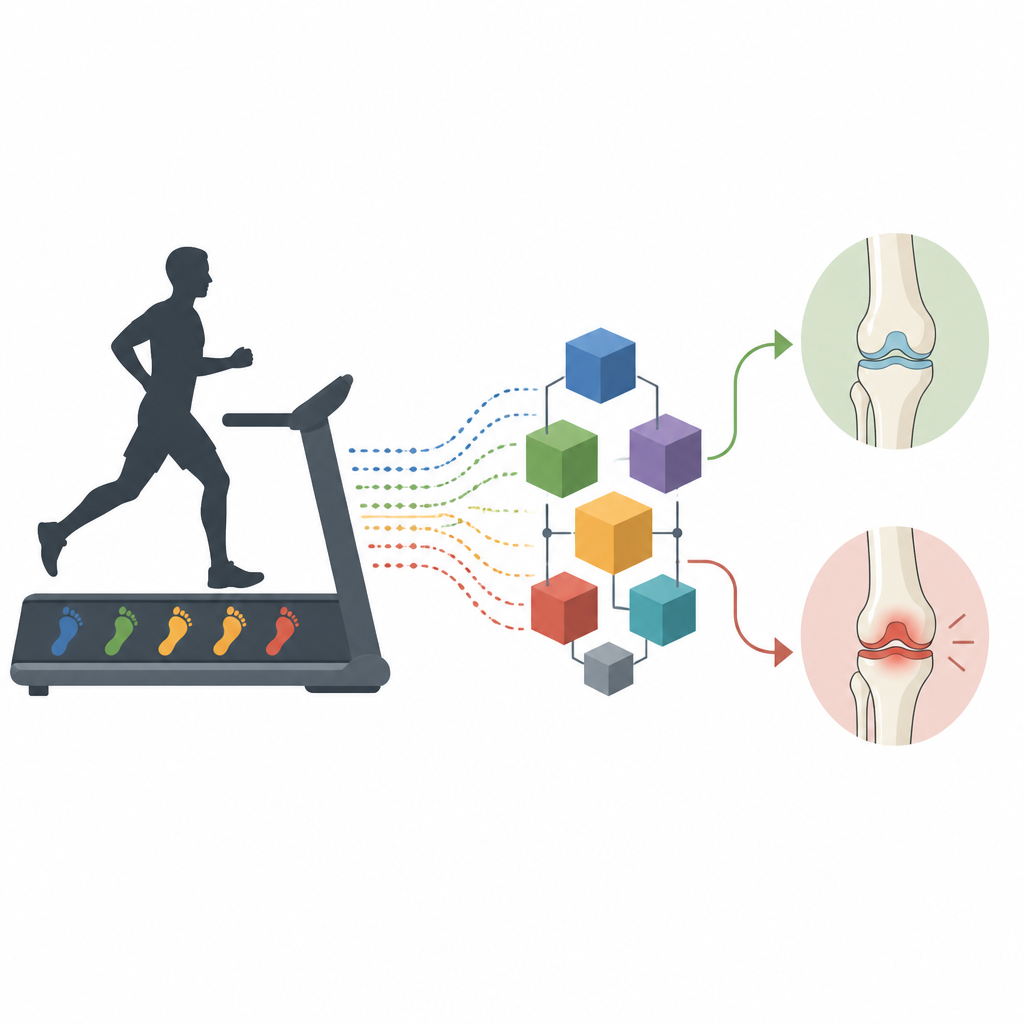
Letting computers sort healthy and injured runners
With these measured features in hand, the team trained several kinds of computer programs known as machine learning models to tell apart healthy runners from those with an ACL history. They tested a range of common tools, including decision trees, random forests, support vector machines, and neural networks. To avoid fooling themselves, they used a careful testing approach in which strides from any one person were kept either entirely in the training set or entirely in the test set. This way, the models had to generalize to new people, not just new steps from the same person. The star performer was a simple method called K nearest neighbors, which compares each new stride to similar ones it has seen before. It correctly classified strides with very high accuracy and almost perfect ability to separate the two groups. 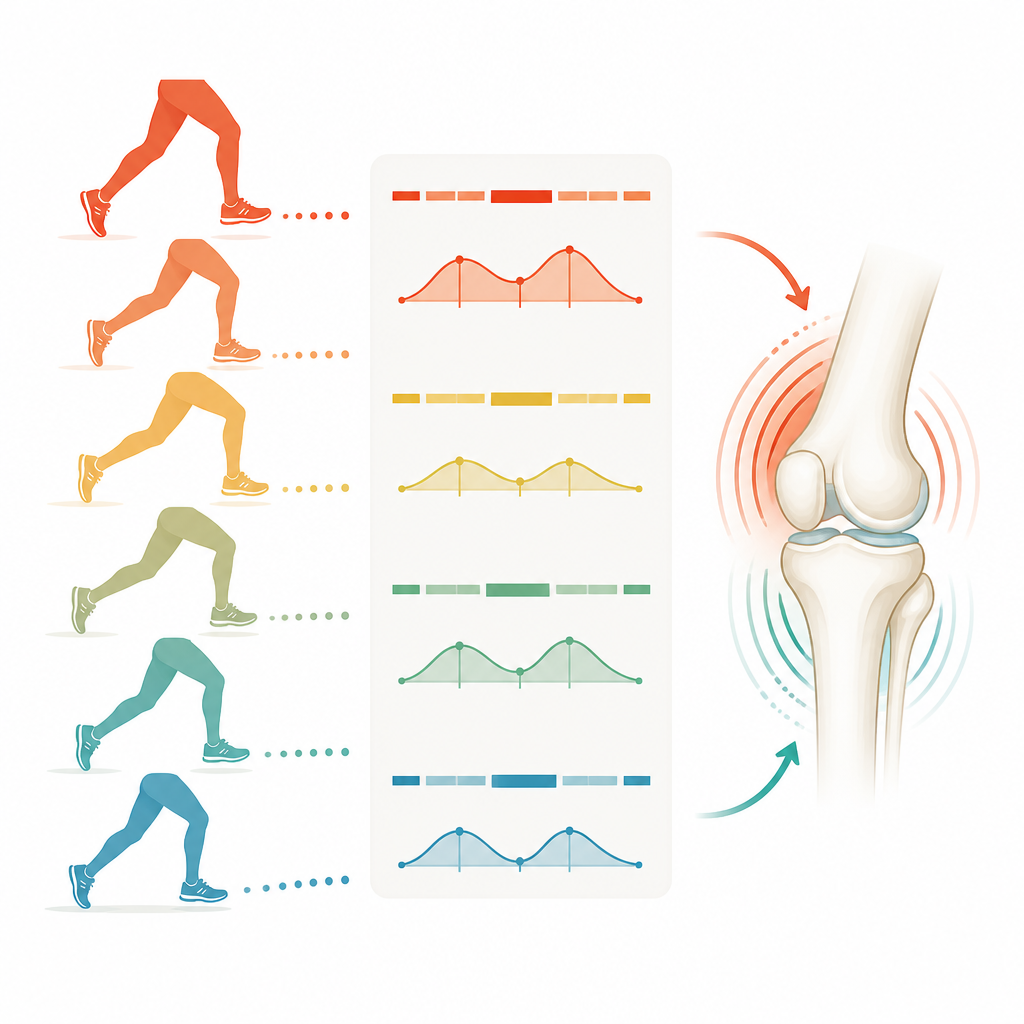
What matters most in a runner’s stride
Beyond just labeling runners as healthy or ACL repaired, the authors wanted to know which parts of the running pattern carried the most useful information. Across several models, timing features rose to the top. Stride time, stance time, and swing time were especially important, along with how quickly the center of pressure moved forward under the foot. These results match earlier research showing that, after ACL surgery, people often change how long they spend on each leg and how they load their joints, even if their running looks normal to observers. While a more straightforward decision tree model was easier to interpret, it did not handle the complexity of the data as well as models that combine many trees or rely on many neighbors.
What this could mean for rehab and return to sport
The study suggests that carefully collected treadmill data, paired with modern computer analysis, can reveal lingering changes in how people run after ACL reconstruction. For everyday athletes, this could one day translate into quick, data-based checks during rehab that highlight whether their stride has truly normalized or still carries patterns linked with extra stress on the knee. Clinicians could focus training on improving timing and coordination across the stride rather than only on strength or pain levels. If integrated into wearable devices or real-time feedback systems, similar models might help spot re-injury risks earlier and guide more tailored exercise plans, with the long-term aim of lowering the chance of chronic knee problems like early arthritis.
Citation: Tavakoli, H., Ataabadi, P.A., Khezri, D. et al. Classification of anterior cruciate ligament injury profiles through running analysis: a machine learning approach. Sci Rep 16, 15010 (2026). https://doi.org/10.1038/s41598-026-44264-3
Keywords: ACL injury, gait analysis, machine learning, running biomechanics, sports rehabilitation