Clear Sky Science · en
Metamorphic evolution of amphibolite from Proto-Tethys South Altyn orogen and its geological significance
Rocks That Tell a Deep-Earth Story
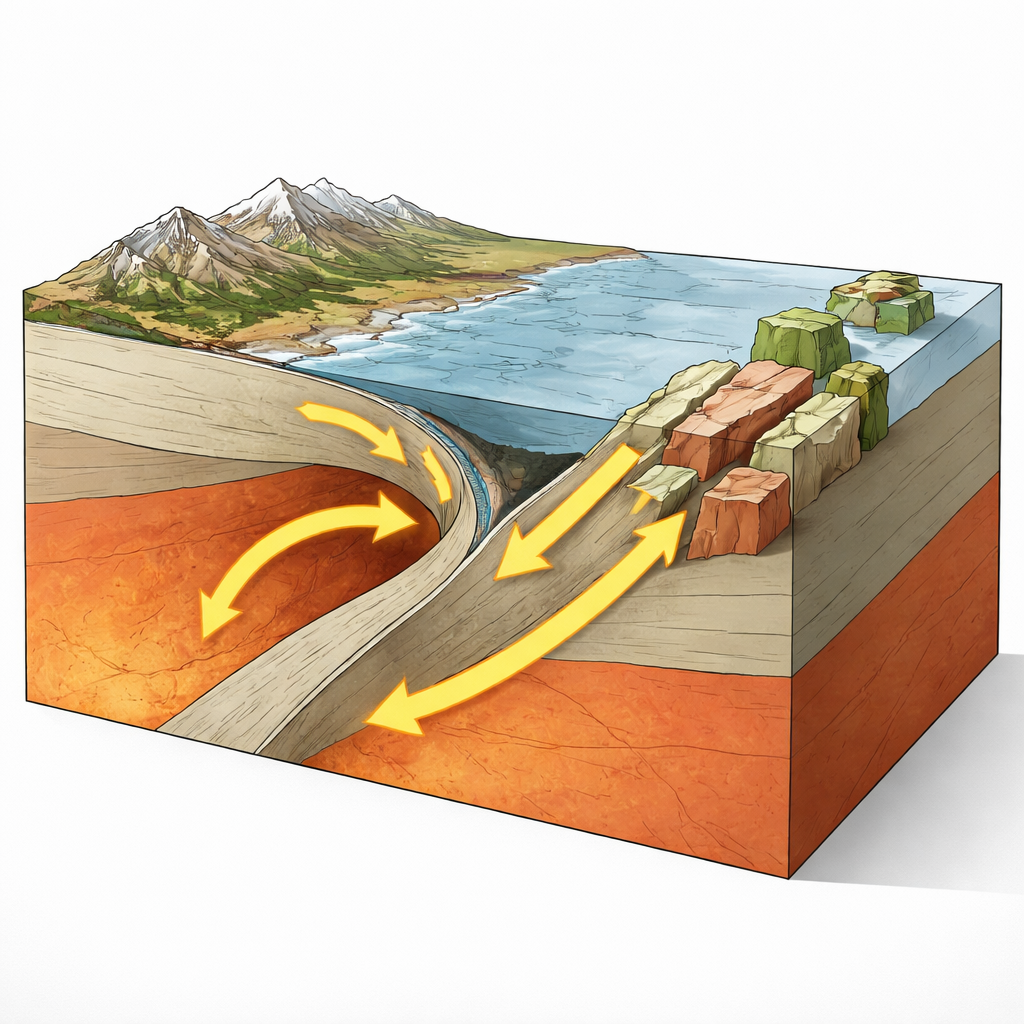
Mountain belts do more than shape the skyline—they are the surface fingerprints of vast, hidden journeys deep inside our planet. This study looks at a particular kind of dark, dense rock called amphibolite from the South Altyn region on the northeastern edge of the Tibetan Plateau. By examining tiny minerals locked inside these rocks, the authors show that pieces of ancient continental crust once plunged to great depths, endured crushing pressures, and later rose back toward the surface. Their detective work helps answer a big question in Earth science: when continents collide, does the entire slab dive deep into the mantle, and why do some rocks remember that ordeal while others seem to forget?
A Remote Corner at the Edge of Tibet
The South Altyn Tagh belt lies where several crustal blocks meet at the northeastern margin of the Tibetan Plateau. It is famous for rare rocks that formed at extremely high pressures, including eclogites and rocks that once contained minerals stable more than 300 kilometers down. These high-pressure rocks are scattered among more ordinary-looking, medium-grade rocks such as amphibolites and schists. Because the latter lack obvious “deep” minerals, geologists have long debated whether they ever went very deep or formed at shallower levels. In the Munabulake area, previous research had confirmed only high-pressure but not ultra-deep conditions, leaving open whether the region recorded the full story of continental subduction.
Reading Time Capsules in Tiny Crystals
The authors targeted narrow lenses of amphibolite enclosed within high-pressure pelitic gneiss. At first glance, the amphibolite appears typical: a medium-grained mix of green amphibole, pale plagioclase, and quartz, with minor accessory minerals. Chemical analyses show that its original, pre-metamorphic rock was a basalt of within-plate origin, likely formed during rifting events that helped break apart an ancient supercontinent. To probe its deeper history, the team turned to zircon and titanite—durable accessory minerals that grow during metamorphism and trap microscopic inclusions. Using imaging, spectroscopy, and precise uranium–lead dating, they reconstructed when and under what conditions the rock changed.
Two Lives of a Single Rock
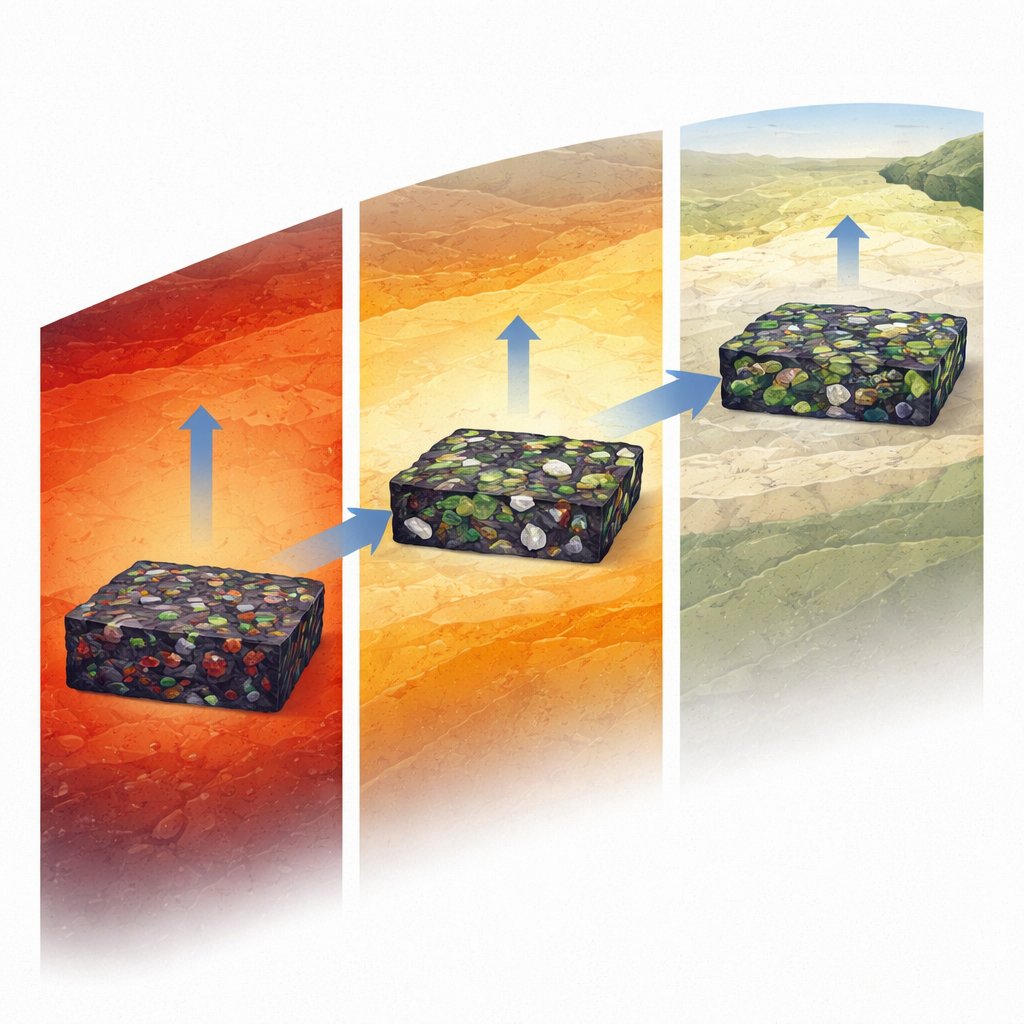
Zircon grains from the amphibolite preserve a remarkable suite of inclusions: garnet, omphacite (a high-pressure pyroxene), rutile, and quartz. Together, these minerals are the hallmark of eclogite-facies conditions, which occur when rocks are carried to great depths during subduction. The chemical signature of these zircons—especially their pattern of rare earth elements—also matches growth in a high-pressure, plagioclase-free environment. Dating shows that this deep burial event peaked about 502 million years ago. In contrast, titanite crystals in the same rock contain inclusions of amphibole and plagioclase, minerals that form under lower-pressure, amphibolite-facies conditions. Their ages cluster around 437 million years ago, roughly 60 million years younger, capturing a later stage as the rock rose and re-equilibrated at shallower crustal levels.
Tracing the Path From Depth to Surface
By combining these age constraints with computer models of mineral stability, the authors outline a full pressure–temperature–time path for the rock. First, a basaltic slice of continental crust was dragged down to eclogite conditions during the Early Paleozoic, as part of a larger continental slab sinking beneath an adjacent plate. Later, as that slab began to rise, the same slice passed through warmer but lower-pressure levels where amphibole and plagioclase became stable. During this stage, fluids and heat overprinted much of the original high-pressure mineralogy, leaving only microscopic relics in zircon to attest to the earlier journey. The resulting amphibolite therefore represents a “retrograded eclogite”—a rock that once recorded extreme depths but now mainly shows medium-grade features.
What This Means for Earth’s Moving Continents
The study’s findings extend beyond one remote valley. They show that even ordinary-looking amphibolites in South Altyn can be survivors of deep subduction, with their high-pressure history preserved only in tiny mineral inclusions and subtle chemical patterns. When these results are integrated with previous work on nearby eclogites, granulites, and high-pressure peridotites, a consistent picture emerges: around 500 million years ago, the entire South Altyn continental slab likely sank to great depths and was later exhumed in a complex, uneven way. Some rocks rose quickly and kept their extreme conditions intact; others, like the studied amphibolite, were heavily reworked during the return journey. For non-specialists, the key message is that the solid continents beneath our feet are anything but static—they can dive deep into the planet and come back again, leaving behind rock records that scientists are only now learning to fully decode.
Citation: Zhang, S., Ma, T., Gai, Y. et al. Metamorphic evolution of amphibolite from Proto-Tethys South Altyn orogen and its geological significance. Sci Rep 16, 13819 (2026). https://doi.org/10.1038/s41598-026-44259-0
Keywords: continental subduction, high-pressure metamorphism, amphibolite, Tibetan Plateau, eclogite