Clear Sky Science · en
Coherent OAM generation from discrete chaotic phase surfaces
Twisting Light from Chaos
Light beams can carry a kind of "twist" known as orbital angular momentum, or OAM. This twist lets a single beam act like many distinct channels at once, which is attractive for ultra‑fast communications and sensitive measurements. But real optical devices are messy and imperfect, full of random variations that usually scramble these delicate twists. This paper shows something surprising: if that randomness is organized in just the right way, chaotic surfaces can actually generate clean, well‑defined twisted beams on demand.
Why Twisted Light Matters
Twisted light has already been used to send data at terabit‑per‑second rates through free space, by stacking many OAM channels together like lanes on a highway. Traditionally, those channels are created with carefully crafted devices—spiral phase plates or precisely programmed spatial light modulators—that impose smooth, predictable patterns on the wavefront. Randomness is usually treated as the enemy: atmospheric turbulence, fabrication defects, or deliberate scrambling all tend to smear out the twist, washing away the very structure engineers are trying to use. 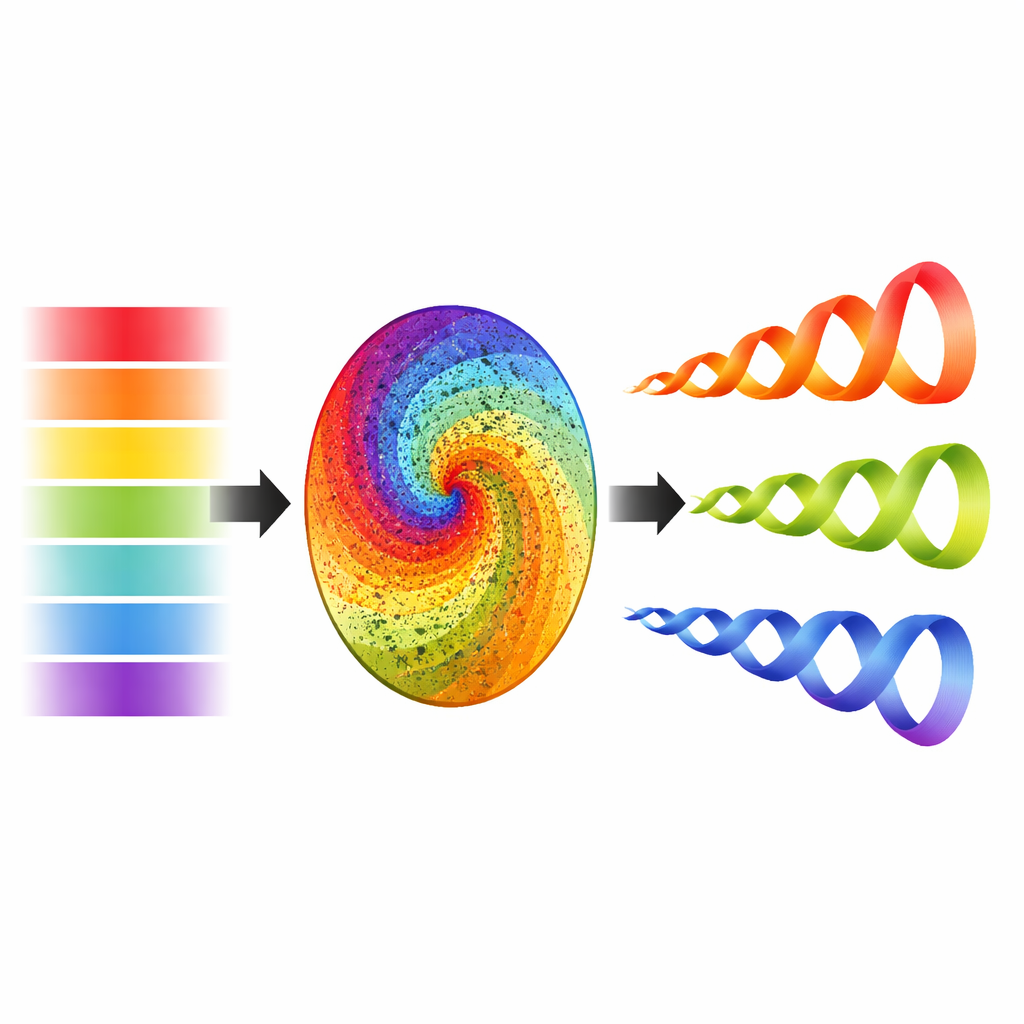
Hidden Order in Chaotic Surfaces
The author models a phase surface—the optical element that reshapes the wavefront—as the sum of two ingredients. The first is a global "bias" that winds the phase around the beam by an integer number of turns, like a coarse spiral staircase. The second is a fine‑grained random pattern that varies from realization to realization. Crucially, the bias is not arbitrary: it is allowed to take only certain whole‑number values, chosen from a discrete list with specified probabilities. When many such random surfaces are applied in sequence and their outputs are averaged coherently (keeping track of phase, not just brightness), a remarkable pattern emerges. Modes whose twist matches one of the chosen integers build up constructively, while all others cancel out exactly because the underlying twist functions are mathematically orthogonal.
Allowed Lines and Forbidden Gaps
This behavior leads to a clear "level structure" in the spectrum of twisted light. Each possible twist value either belongs to an allowed set, where coherent power can appear, or a forbidden set, where it is rigorously driven to zero in the averaged beam. The strength of each allowed mode is set by the square of its probability in the bias distribution: picking a bias value more often makes that twist much brighter, while never picking it removes it entirely. For a common choice in optics—bias values following a bell‑shaped (Gaussian) distribution over integers—the resulting coherent spectrum also follows a Gaussian shape when plotted in scaled coordinates, collapsing different devices onto a single universal curve. Importantly, random roughness on the surface simply multiplies all allowed lines by the same suppression factor; it does not blur the distinction between allowed and forbidden modes as long as the bias remains strictly discrete.
Beyond Ideal Beams and Static Devices
The same logic extends to more complex beams and dynamic operation. For vector beams that also carry spin (the polarization of light), the selection acts on the total angular momentum—the sum of spin and orbital parts—allowing precise engineering of combined spin‑orbit states. By changing the discrete bias pattern in time, one can build a bank of "coherent filters" that switch which twists are allowed in each time slot. In such a scheme, the active channels in one slot become perfectly dark in another, much like time‑division multiplexing in conventional communications but implemented directly in the twist degree of freedom. Large‑scale numerical simulations with tens of thousands of random surfaces confirm the theory: allowed modes stand out cleanly, while even "internal" forbidden modes nestled between them are suppressed by more than four orders of magnitude. 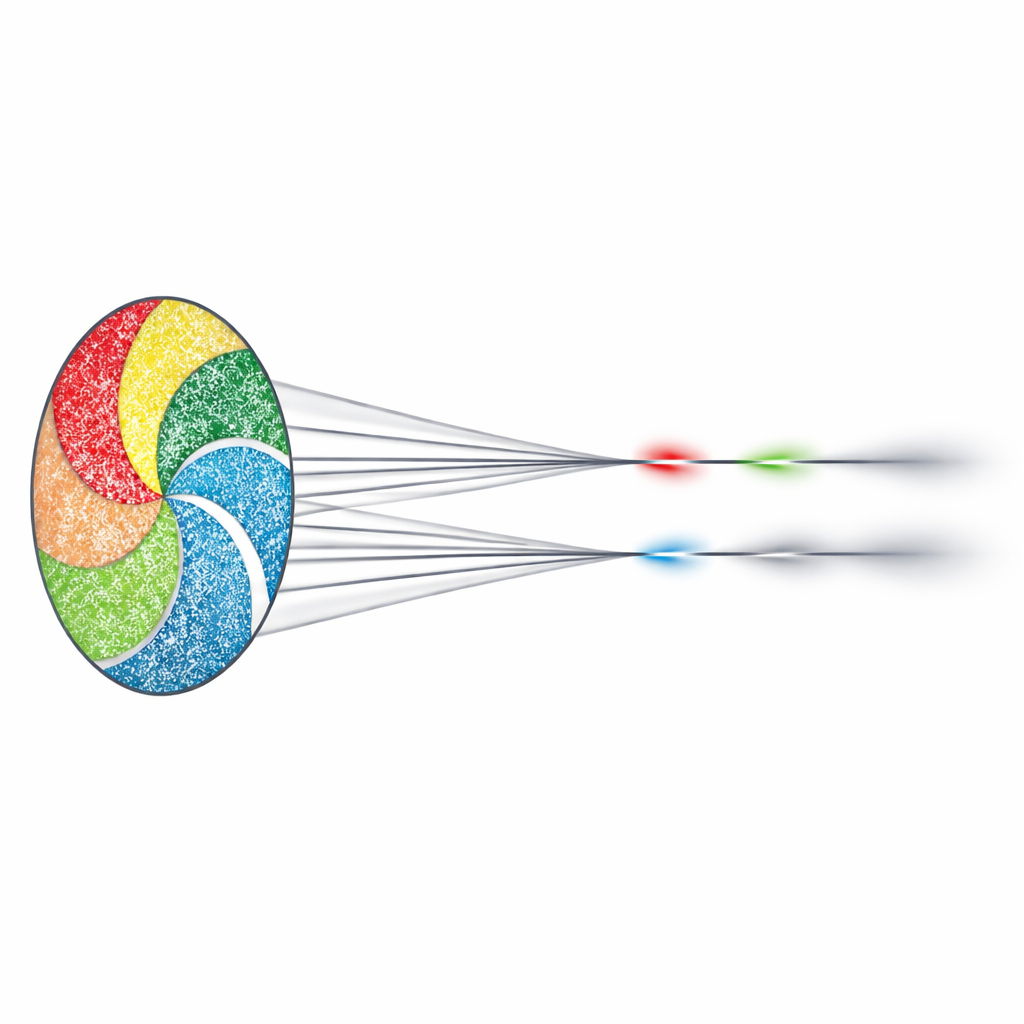
From Theory to Practical Light Shaping
To a non‑specialist, the key message is that randomness need not always be a nuisance in advanced optics. By constraining a noisy phase surface so that its built‑in twist comes only in whole‑number steps, it is possible to create a beam whose average behavior is as clean and quantized as if it had passed through perfect, deterministic optics. This offers straightforward design rules for devices such as spatial light modulators or metasurfaces that generate or filter twisted light with high contrast, without demanding atom‑level fabrication precision. The work suggests new ways to pack more information into light beams and to build robust, reconfigurable optical links and sensors that rely on the hidden order embedded within engineered chaos.
Citation: Moriya, N. Coherent OAM generation from discrete chaotic phase surfaces. Sci Rep 16, 13682 (2026). https://doi.org/10.1038/s41598-026-44256-3
Keywords: orbital angular momentum, structured light, optical communications, phase screens, metasurfaces