Clear Sky Science · en
RT-FogNet: real-time ship detection under low-visibility conditions in inland waterways
Seeing Ships Through Fog
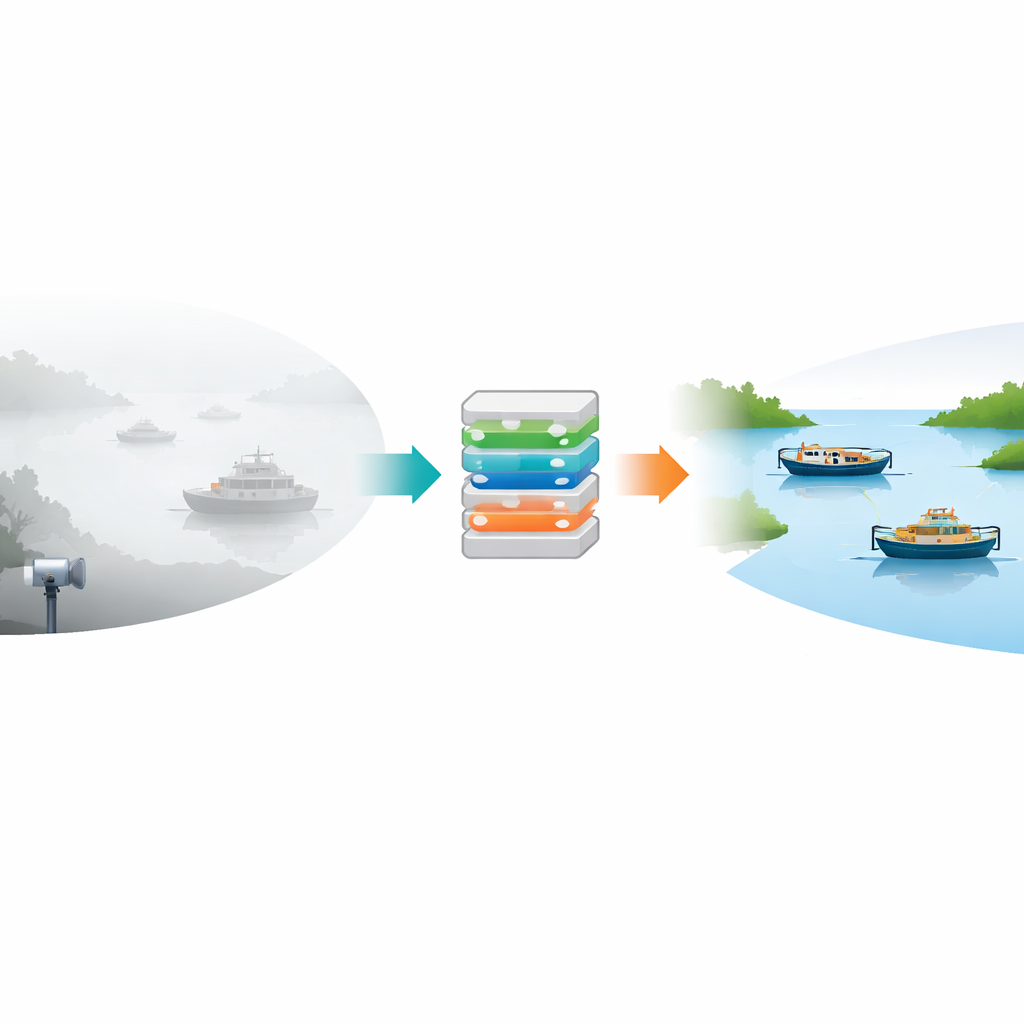
When rivers and canals are shrouded in fog or glare, human lookouts and cameras can struggle to spot passing boats in time. This is more than an inconvenience: missed or late detections can threaten traffic safety, slow down logistics, and complicate rescue efforts. This study introduces RT-FogNet, a smart camera system designed to reliably detect ships in inland waterways even when visibility is poor, while still running fast enough for real-time use on ordinary monitoring equipment.
Why Rivers Are Harder Than Open Seas
Unlike open oceans, inland waterways are narrow, crowded, and visually messy. Fixed cameras along riverbanks must cope with bridges, buildings, reflections on the water, and frequent bad weather. Fog, heavy humidity, strong backlight from the sun, and nighttime lighting all reduce contrast and blur ship outlines. Existing computer-vision detectors, including many popular deep learning models, were usually trained on clearer images from satellites, aircraft, or coastal scenes. As a result, they often fail when moved to real inland rivers, missing small or distant vessels and confusing reflections or background structures with actual ships.
A Smart Two-Step Eye for the River
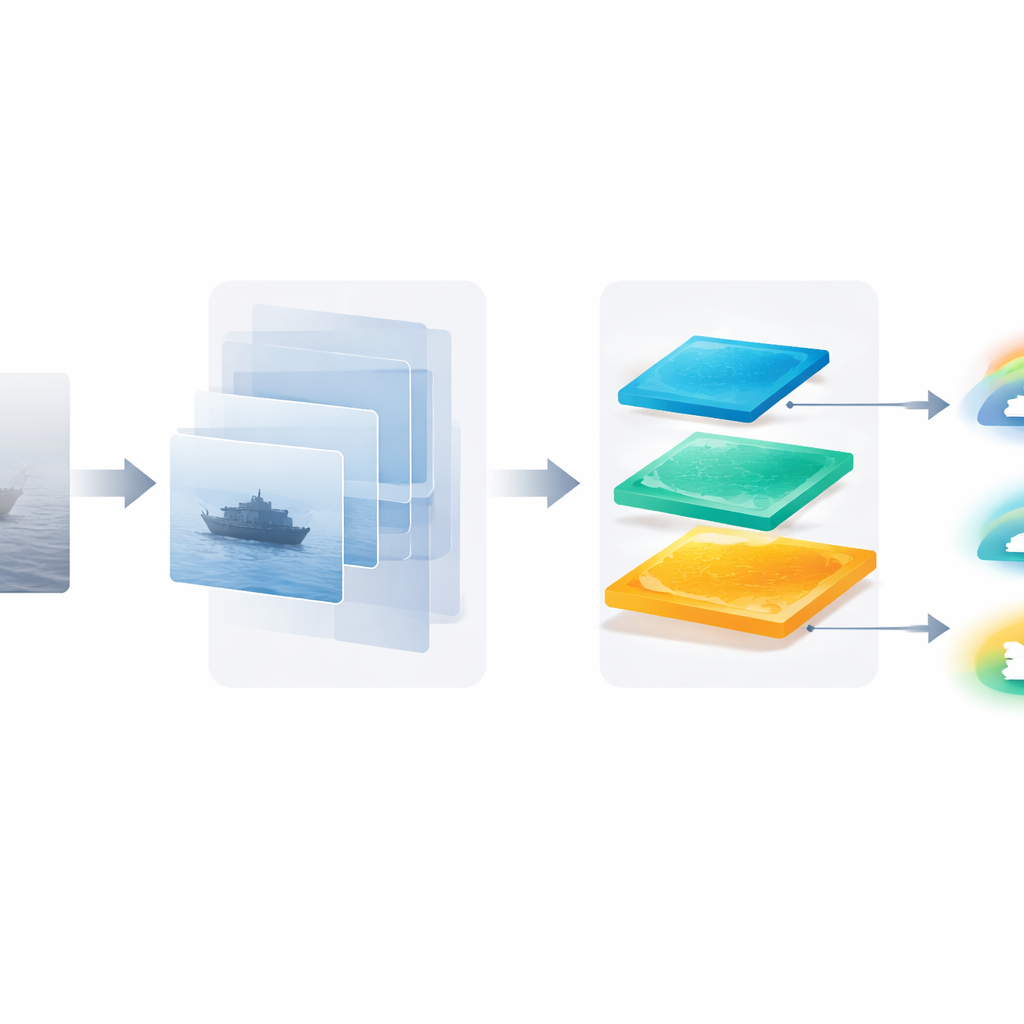
RT-FogNet approaches the problem as a two-step process tailored to what a river camera really sees. First, it quickly checks the incoming image to decide whether visibility is poor. If the view is clear, the picture goes straight to the detection step, saving time and energy. If the scene is foggy or low-contrast, the image is routed through a special dehazing unit called the Water Surface Image Dehazing (WSID) module. This unit is trained not just to make images look nicer to humans, but specifically to preserve the outlines and shapes of ships while removing haze and suppressing misleading reflections on the water surface.
How the System Learns to See Through Haze
The WSID module is built using a training strategy borrowed from state-of-the-art image restoration, but compressed and tuned for speed. A larger "teacher" network first learns to clear fog from synthetic training images. A smaller "student" network then learns to mimic the teacher’s results while using far fewer calculations, making it practical for real devices. After that, the student is further adjusted on real foggy river scenes so it works well outside the lab. Downstream, an enhanced detection engine, based on the latest YOLOv10 model, processes the dehazed or original images. A key addition is a new feature-processing block that uses carefully arranged filters to look at both fine details and broader regions of the image without blurring away small vessels. This helps the system find ships of many sizes, from tiny distant boats to large tankers.
A New Test Bed Built on Real Rivers
To judge whether RT-FogNet truly works in practice, the authors built a new Inland Waterway Ship Dataset (IWSD). It contains more than nine thousand images captured by fixed cameras along busy Chinese rivers, including the Yangtze and Wulong. The dataset covers nine types of vessels and a wide mix of conditions: clear days, overcast weather, rain and fog, bright glare on the water, and night scenes with harsh artificial lights. Many of the ships are small in the image, as they are far from the camera, and the categories are unbalanced in number, reflecting real traffic patterns. Because more than half of the images are taken under challenging visibility, IWSD serves as a demanding test for any ship detector.
How Much Better Is the New Approach?
When tested on a standard general-purpose dataset, on an existing coastal ship dataset, and on the new inland river dataset, RT-FogNet consistently achieves strong accuracy while remaining fast enough for real-time operation. On the especially difficult IWSD data, the full version of RT-FogNet that includes the dehazing step improves average detection scores by more than 15 percentage points over a strong baseline detector, with particularly large gains on small and hard-to-see vessels. Even with the extra dehazing step, the system still processes hundreds of images per second on modern hardware, making it suitable for live river monitoring.
What This Means for Waterway Safety
For a non-specialist, the main takeaway is that RT-FogNet shows how combining scene-aware image cleaning with a streamlined detection engine can make camera-based river monitoring both more reliable and more practical. Instead of simply sharpening pictures for the human eye, the system is tuned to protect the visual clues that matter for locating ships, even in thick fog or harsh lighting. The authors’ new inland dataset and their tested design provide a blueprint for safer, smarter monitoring of busy waterways, with the potential to reduce accidents and improve traffic management in real-world river and canal networks.
Citation: Yuan, P., Xu, C., Tan, X. et al. RT-FogNet: real-time ship detection under low-visibility conditions in inland waterways. Sci Rep 16, 14094 (2026). https://doi.org/10.1038/s41598-026-44253-6
Keywords: ship detection, foggy waterways, computer vision, smart surveillance, river traffic safety