Clear Sky Science · en
Entropy and seasonal isotopic duality reveal the sustainability paradox of the upper Ganga River
Why sacred headwaters matter to everyday life
The upper Ganga River is often imagined as a pure mountain stream, fed by glaciers and sheltered from human influence. This study shows that even these revered waters, high in the Himalaya between Gangotri and Haridwar, are already carrying clear fingerprints of modern society. By tracking how the river’s chemistry and the “fingerprints” of its water molecules change from the monsoon to the dry season, the researchers reveal a hidden sustainability paradox: the very stretch of river that millions regard as pristine is quietly recording the impact of agriculture, towns, dams and climate-driven shifts in flow.
From ice and rock to a working river
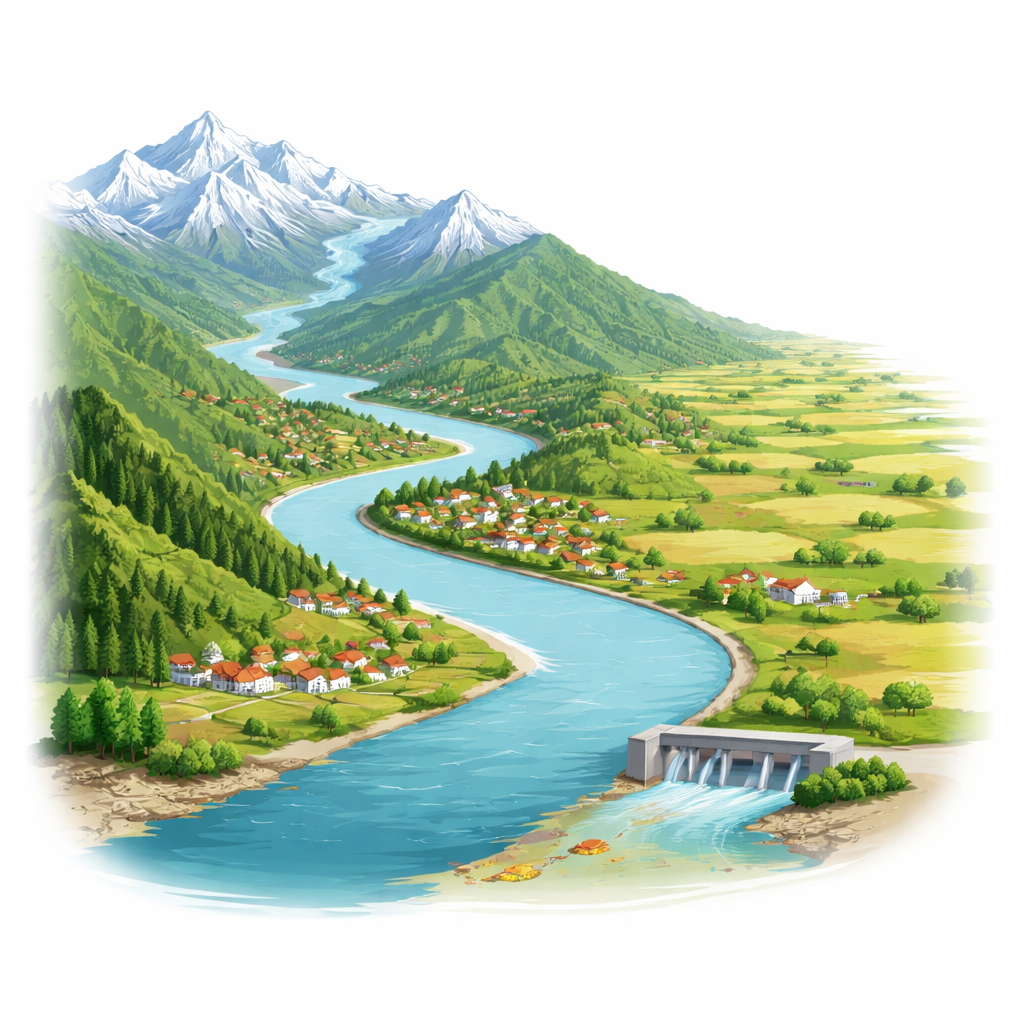
The 255‑kilometer journey from the Gangotri glacier to Haridwar takes the Ganga through steep valleys, shifting rock types, pilgrimage towns and emerging plains. As meltwater and rain carve their way downhill, the river dissolves minerals from crystalline rocks, carbonates and alluvial sediments, picking up naturally occurring calcium, magnesium and bicarbonate along the way. At the same time, it begins to receive runoff from farms, sewage from settlements, and water diverted or stored by hydropower projects. Because river water blends everything that happens upstream, this reach acts as a sensitive test stretch for how geology, climate and human pressure combine to shape water quality.
Two seasons, two hidden personalities
A key finding is that the river behaves like two different systems across the year. During the monsoon, intense rainfall and glacier melt create high, fast flows. These large volumes of water dilute most dissolved substances, so the river appears chemically simple and relatively uniform from place to place. The water is dominated by mineral signals from weathered rock, and the isotopic “fingerprints” of oxygen and hydrogen in the water cluster along a line typical of fresh rain. In this season, human-derived pollutants are present but largely masked by the sheer quantity of water rushing through the channel.
When the river slows, problems surface
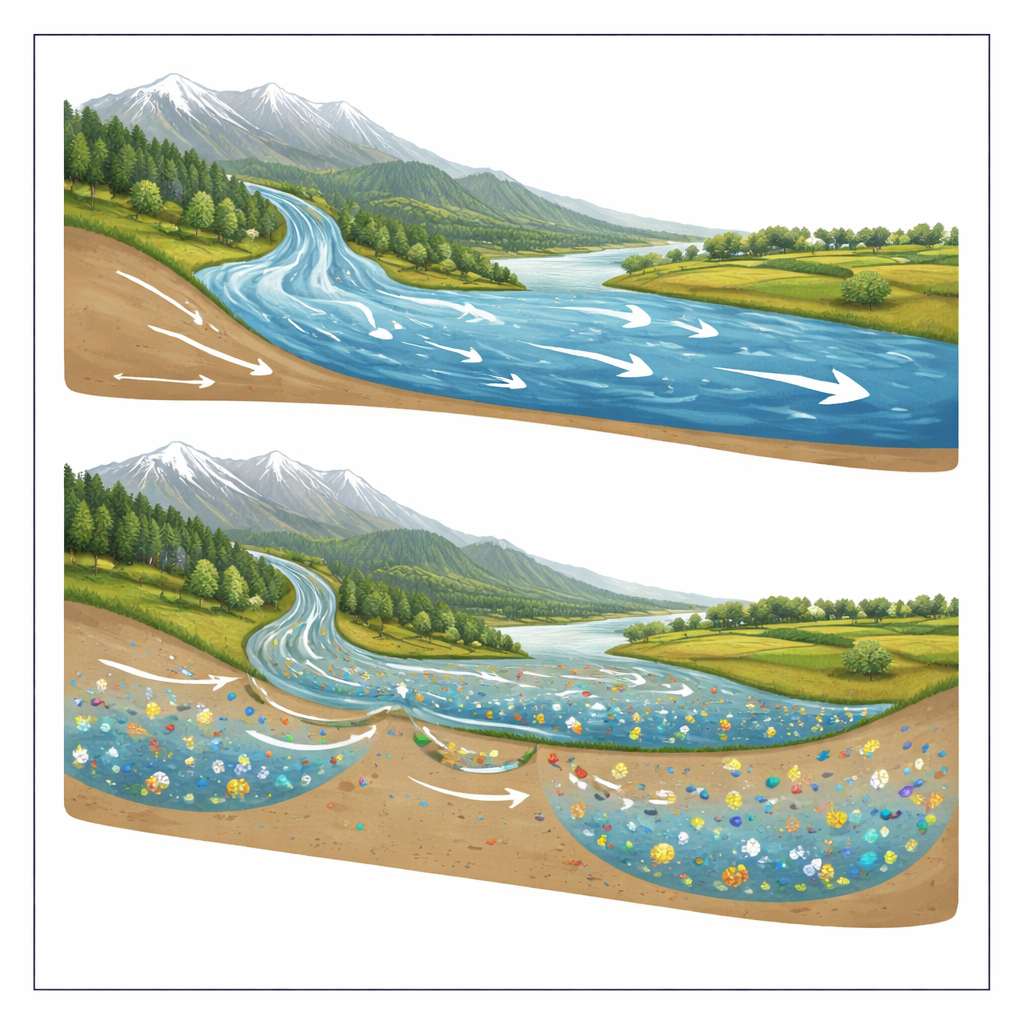
After the monsoon, flows drop, residence times increase, and groundwater contributes a larger share of the river’s volume. Under these low‑flow conditions, the picture changes sharply. The same stretch of river now shows higher levels of dissolved salts and hardness, stronger imprint of underlying rock, and clearer signatures of human activity. Nitrate, chloride and potassium—classic markers of fertilizers, sewage and urban runoff—stand out more clearly, especially near hydropower diversions and downstream towns. Water from reservoirs and subsurface pathways also has more time to evaporate and mix, enriching heavier water isotopes and concentrating solutes. The study’s multivariate statistics show that what looked like a broadly similar river in the monsoon becomes a patchwork of distinct, more impacted zones in the post‑monsoon period.
Reading disorder as a warning signal
To distill this complex chemistry into a single measure, the authors use an entropy‑based water quality index, which treats water quality as a question of “disorder” across many parameters rather than just checking a few thresholds. This index reveals that more than half of the samples fall into a “very poor” category, with conditions generally worse after the monsoon than during it. Even the headwaters, while still better than downstream reaches, show measurable human signals such as non‑zero nitrate and chloride. The analysis highlights an uncomfortable reality: monsoon floods temporarily tidy up the system by diluting and flushing pollution, but the underlying pressures return—and become more legible—once the river slows.
What the paradox means for people and policy
For a layperson, the study’s conclusion is clear and sobering. The upper Ganga, long treated as an untouched source against which downstream pollution is measured, is already part of the human‑dominated water cycle. The river’s apparent purity during the rains can mislead managers into underestimating chronic stress that reappears each dry season. Protecting this lifeline for hundreds of millions of people will require monitoring that spans seasons, methods that capture subtle multi‑factor deterioration, and governance that recognizes headwaters as early‑warning sentinels rather than guaranteed clean baselines. In short, even the holiest Himalayan waters are telling us that the Anthropocene has reached the roof of the world.
Citation: Kumar, M., Tripathi, S., Singh, R. et al. Entropy and seasonal isotopic duality reveal the sustainability paradox of the upper Ganga River. Sci Rep 16, 14273 (2026). https://doi.org/10.1038/s41598-026-44251-8
Keywords: Ganga River, Himalayan headwaters, water quality, monsoon seasonality, anthropogenic pollution