Clear Sky Science · en
Mathematical modeling of sequential Dengue–Zika infections: dynamic insights into antibody-dependent enhancement and neutralization effects
Why back-to-back mosquito infections matter
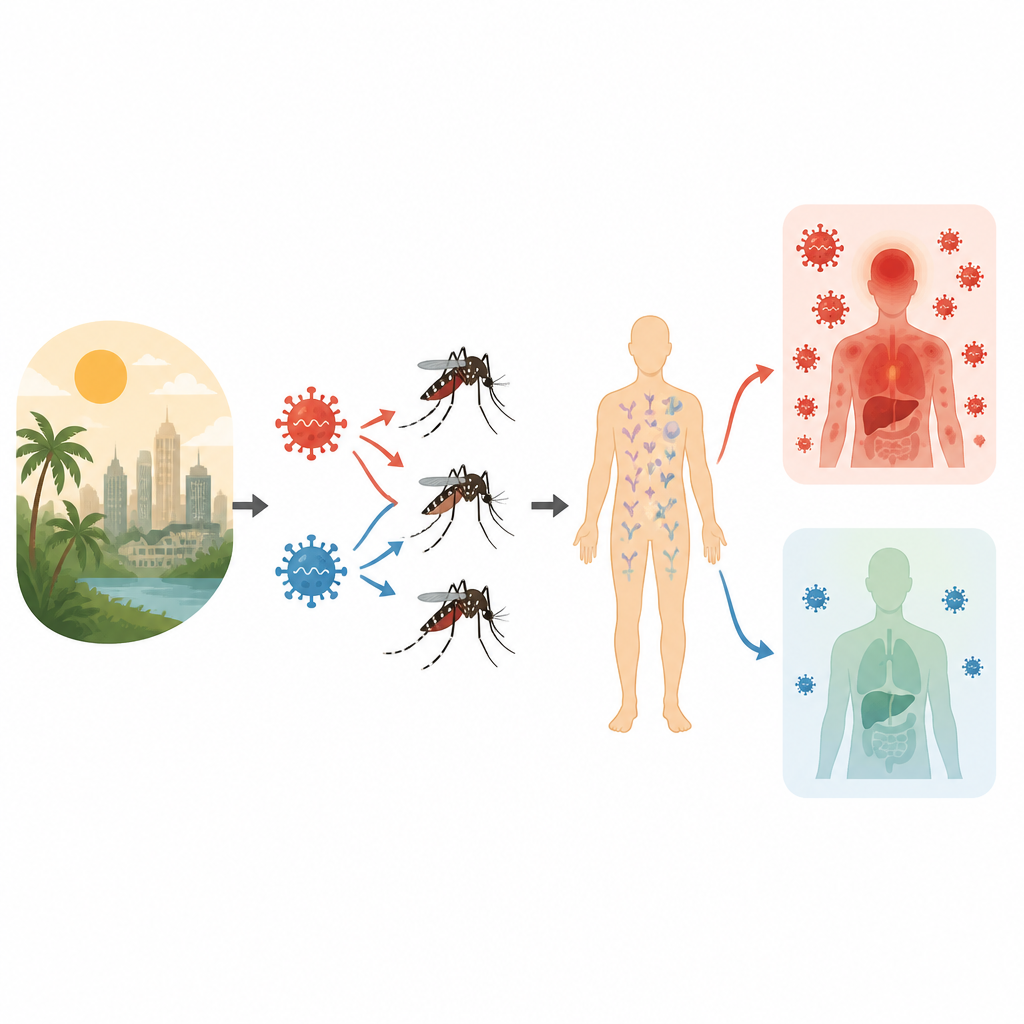
For many people living in tropical cities, dengue and Zika are not one-time threats. A person might first catch dengue and years later be bitten by a mosquito carrying Zika, or the other way around. In these back-to-back infections, the immune system’s leftover antibodies from the first illness can sometimes make the second infection worse, but under other conditions they can actually help to tame it. This study uses a detailed mathematical model to untangle when past infection turns into a hidden danger and when it becomes a quiet shield.
Two related viruses, one shared mosquito
Dengue and Zika belong to the same virus family and are spread mainly by the Aedes mosquito, which thrives in warm, crowded neighborhoods with standing water. Because these viruses are closely related, the antibodies the body makes after one infection can “recognize” the other. Clinical and lab studies have shown that people who already had dengue may face a higher risk of severe Zika, and that past Zika can also alter the course of later dengue. Outbreaks in Brazil and on Pacific islands, where both viruses circulate together, have highlighted these complex patterns and motivated the need for careful analysis.
When antibodies help the virus instead of the person
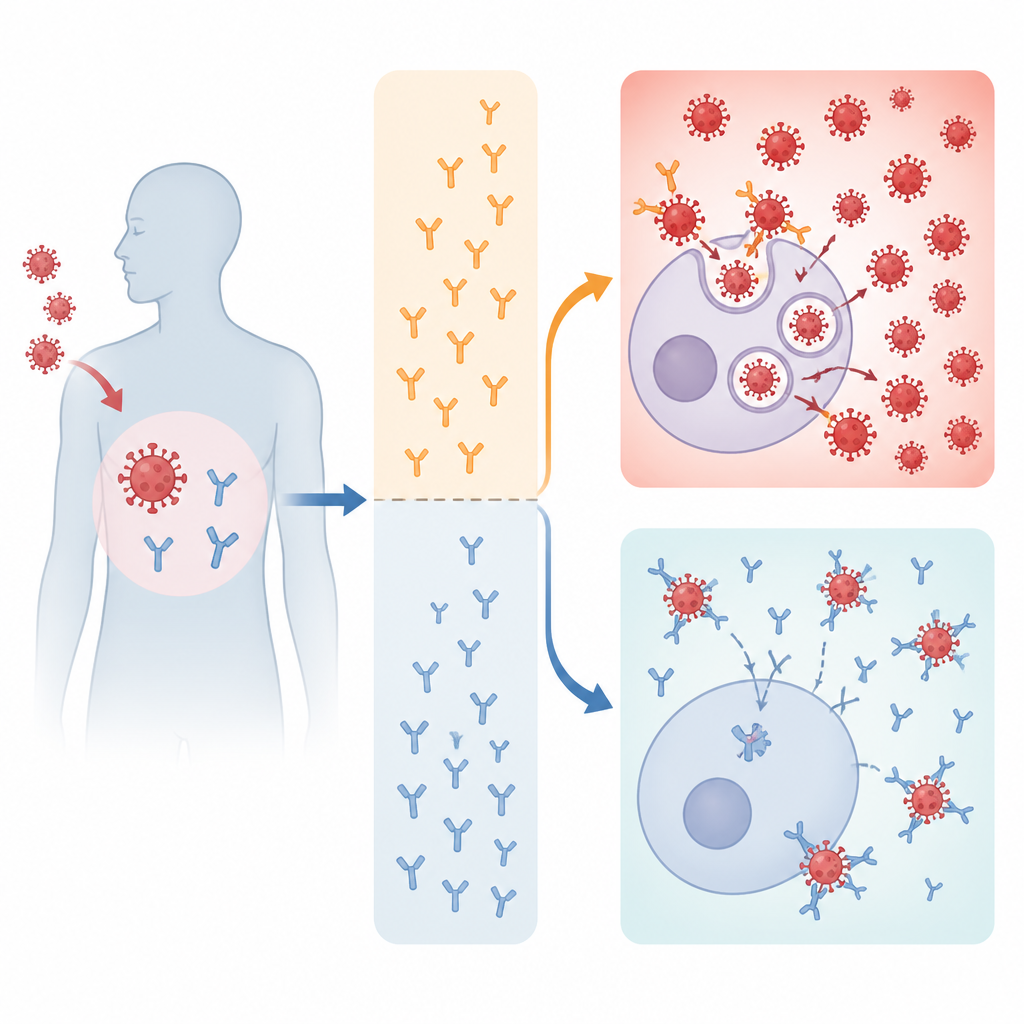
A key piece of this puzzle is a process called antibody-dependent enhancement. At certain levels, leftover antibodies from a first infection can latch onto a related virus without fully disabling it. Instead, they act like a pass that helps the virus slip into cells more easily, leading to a higher viral load and more serious disease. Most previous models of dengue and Zika have focused almost entirely on this harmful side. However, laboratory evidence suggests that when antibody levels are higher, the same molecules can switch roles and neutralize the invading virus, leading to milder or even blocked infection.
Building a step-by-step map of human and mosquito infections
To explore these competing effects, the authors built a mathematical model that tracks both humans and mosquitoes through different stages: never infected, currently infected with dengue or Zika, recovered from one virus, and then secondarily infected with the other. The model includes how mosquitoes become infected when they bite sick people, how they then pass viruses on to others, and how antibody levels from a first infection can either enhance or neutralize a second infection. The team examined four key situations: dengue circulating alone, Zika alone, dengue followed by Zika, and Zika followed by dengue. They derived conditions under which the viruses fade out versus persist, and where sequential infections become possible.
Discovering turning points where protection kicks in
A central result of the work is the identification of threshold values for the enhancement factor that represents how strongly antibodies assist a second infection. Below these thresholds, leftover dengue antibodies may allow Zika to spread more easily, and leftover Zika antibodies may do the same for dengue. But when the enhancement factor rises beyond a cut-off, the system flips into a neutralizing regime: antibodies now reduce the number of secondary infections instead of boosting them. Using real-world case data from Espírito Santo state in Brazil, the researchers calibrated their model and showed how these thresholds align with observed patterns, such as Zika cases rising gradually after large dengue waves.
What this means for vaccines and public health
In simple terms, the study shows that the same cross-reactive antibodies that sometimes worsen back-to-back dengue and Zika infections can also help hold the second infection in check, if their level is high enough. This double-edged behavior has important implications for vaccine design and for planning mosquito control and surveillance. Any future Zika vaccine must account for how it interacts with existing dengue immunity, and vice versa. By pinpointing the conditions under which enhancement gives way to neutralization, the model offers a clearer roadmap for reducing the hidden risks of these intertwined mosquito-borne diseases.
Citation: Deolia, P., Singh, A. & Mubayi, A. Mathematical modeling of sequential Dengue–Zika infections: dynamic insights into antibody-dependent enhancement and neutralization effects. Sci Rep 16, 14872 (2026). https://doi.org/10.1038/s41598-026-44242-9
Keywords: dengue, zika, antibody-dependent enhancement, sequential infection, mathematical modeling