Clear Sky Science · en
Obesity is linked to impaired sensorimotor synchronization during walking but not tapping
Why timing matters when we move
Walking in step with a beat may seem like a simple party trick, but it quietly relies on a remarkable partnership between the brain, the senses, and the body. This study asks a timely question: does carrying extra body weight change how well people can keep their movements in time with sound? By comparing walking and finger tapping in adults with obesity and in adults of normal weight, the researchers show that the answer depends very much on which kind of movement you look at.
Two everyday rhythms: steps and taps
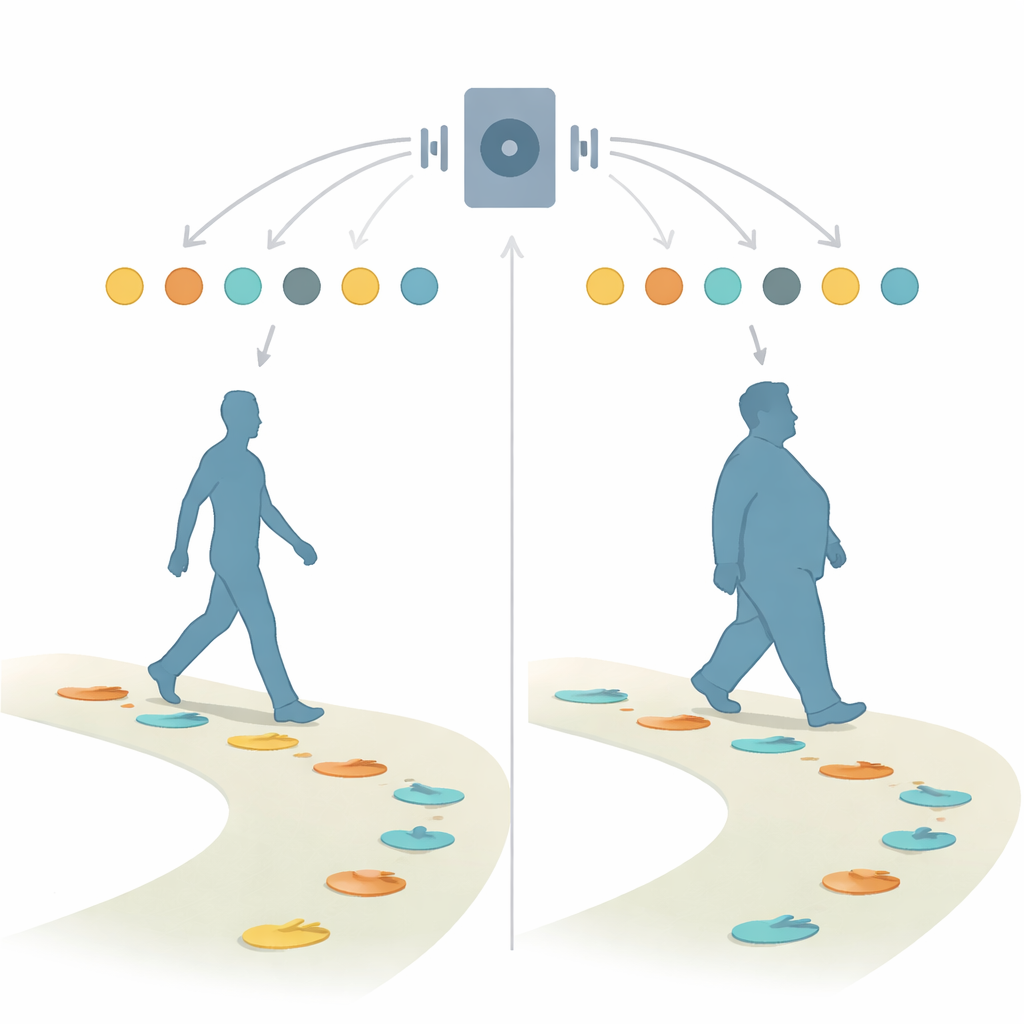
To explore this question, the team focused on “sensorimotor synchronization” – the ability to match movements to a regular beat, like a metronome. They recruited adults with obesity and adults of normal weight who could comfortably walk and tap their fingers. Everyone performed two tasks. In one, they walked around a circular path while listening to simple beeps set to each person’s natural stepping pace. In the other, they sat at a table and tapped their index fingers to beeps set to their own preferred tapping rate. In both tasks, the beeps occasionally jumped ahead or lagged behind, forcing participants to adjust and find the beat again.
How the experiment tested recovery
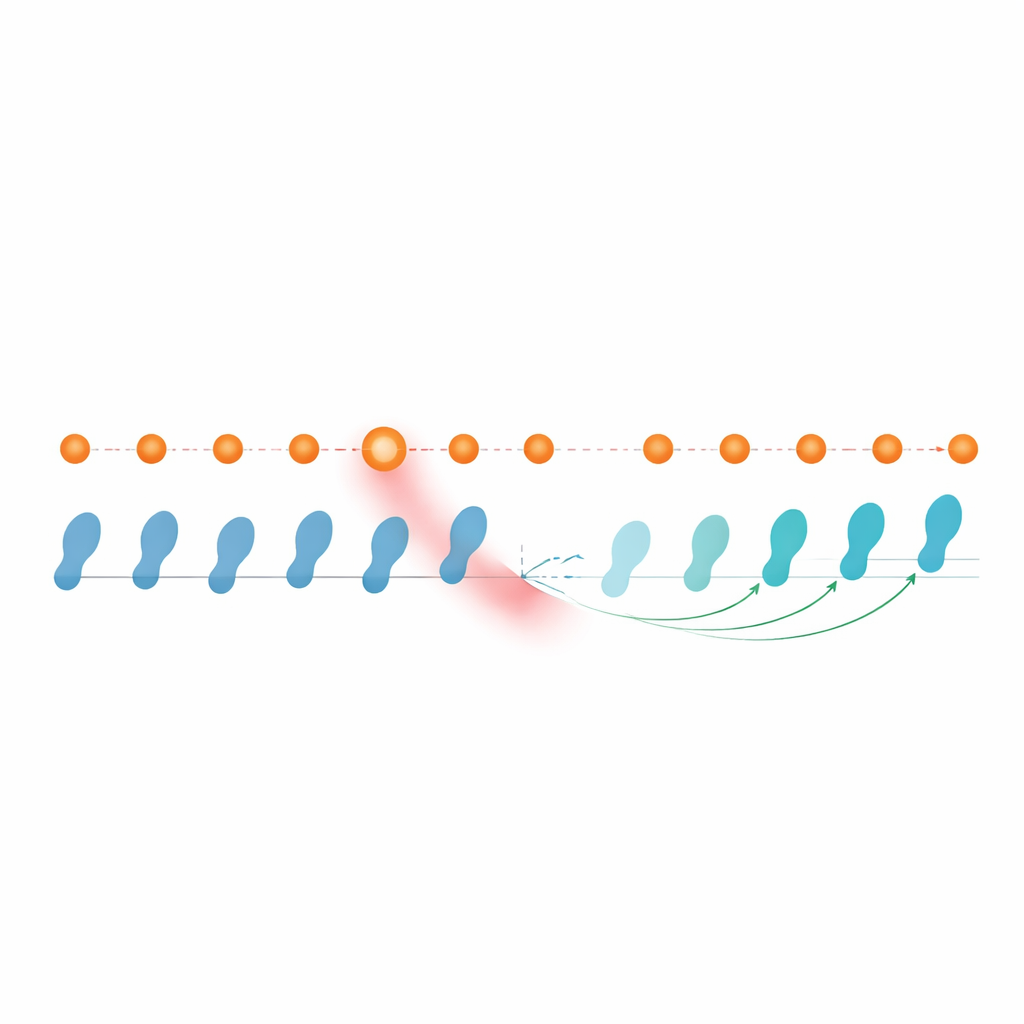
The key measurement was how quickly people’s movements “relaxed” back into sync after each surprise change in the beat. The researchers measured the timing difference between each beep and the nearest step or tap, then tracked how this gap shrank over the next several movements. By fitting these recovery curves with a simple mathematical function, they extracted a value that captured how fast a person settled back into a stable rhythm. A larger, more negative value meant a swift recovery; a value closer to zero meant slower, less stable adaptation.
Walking tells a different story than tapping
When it came to finger tapping, adults with obesity and those of normal weight behaved very similarly. Both groups tapped in time with the metronome and recovered from the sudden shifts at roughly the same speed, suggesting that fine timing of small, seated movements remains largely intact in obesity. The picture changed during walking. Here, people with obesity took longer to re-align their steps with the beat after a perturbation, indicating reduced dynamic stability in whole-body movement. This difference appeared regardless of whether the beep jumped ahead or fell behind, and it was not explained by simple differences in preferred walking speed.
Why extra body mass strains rhythm
The authors link this walking-specific difficulty to the mechanical and sensory challenges that come with carrying extra weight. In obesity, more force is needed to swing the legs and control the body’s center of mass, joints experience higher loads, and people often adopt a more cautious gait, with longer time spent with both feet on the ground and shorter strides. Past work has also shown reduced muscle strength, dulled sensation under the feet, and changes in brain structure and function in obesity. All of these factors can make it harder to quickly tweak each step when the timing of the cue suddenly changes, even if the person’s internal sense of rhythm is preserved.
What this means for health and rehabilitation
For a layperson, the main takeaway is that obesity seems to interfere not with the basic ability to keep time, but with how flexibly the whole body can adjust its movements when the rhythm shifts. This matters because real-life walking is full of small surprises – uneven ground, moving crowds, and shifting attention – that demand rapid, automatic corrections. The study suggests that rhythm-based walking exercises and wearable devices that gently cue steps with sound or vibration could help people with obesity build more stable, adaptable gait patterns. In short, tapping to the beat may be easy, but stepping to it under changing conditions reveals how our body’s size and mechanics shape the way we move through the world.
Citation: Bourdon, A., Damm, L., Gasnier, A. et al. Obesity is linked to impaired sensorimotor synchronization during walking but not tapping. Sci Rep 16, 13803 (2026). https://doi.org/10.1038/s41598-026-44239-4
Keywords: obesity, gait, motor coordination, rhythmic training, sensorimotor synchronization