Clear Sky Science · en
Implanted brain-computer interface functionality during nighttime in late-stage amyotrophic lateral sclerosis
Why being heard at night matters
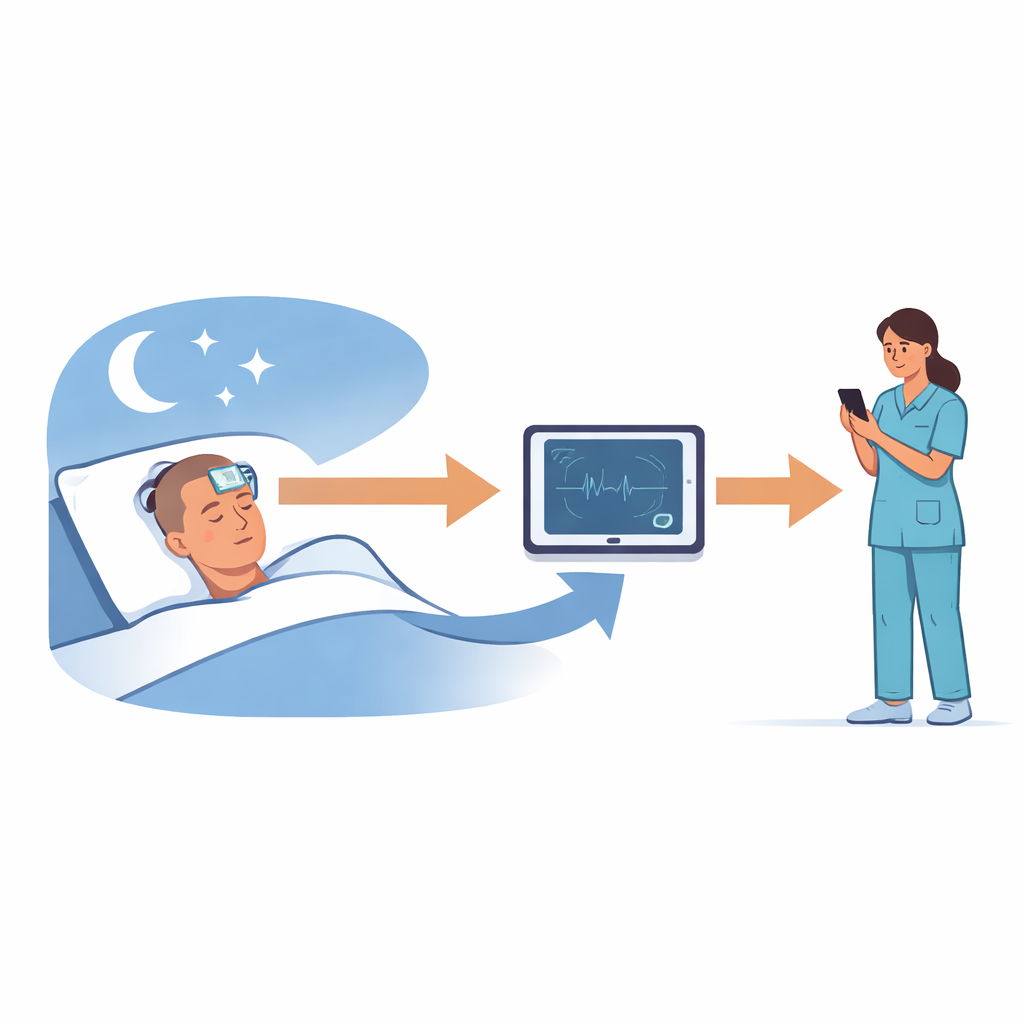
For people who are almost completely paralyzed but mentally alert, the ability to call for help is a matter of comfort, dignity, and sometimes survival. Brain–computer interfaces (BCIs) that read signals directly from the brain are emerging as powerful communication tools for such individuals. Yet most research has focused on daytime use, even though needs do not stop when the lights go out. This study follows a woman with late-stage amyotrophic lateral sclerosis (ALS) who used an implanted BCI at home, and asks a simple but crucial question: can this kind of system work reliably while she sleeps, so she can summon a caregiver at any hour?
From thoughts to calls for help
The participant in this study could no longer move her limbs or speak, but she remained fully conscious. Surgeons implanted thin strips of electrodes on the surface of her brain over the area that normally controls hand movement. When she tried to tap her fingers, the BCI detected brief bursts of activity in these electrodes and turned them into simple computer commands, like mouse clicks. A second algorithm looked for longer bursts of activity to trigger an “escape” action, which could quickly call a caregiver or wake up the communication system from standby. Over years of at-home use, this setup gave her a reliable way to communicate and to request help during the day.
What changes in the brain at night
To understand whether the same setup would work during sleep, the researchers compared brain signals recorded during the day and at night over many months. They focused on two ranges of brain activity: slower rhythms and faster, higher-frequency activity, both commonly used to drive BCIs. They found that, at night, both the average strength and the moment-to-moment variability of these signals were higher than during the day. In other words, the implanted electrodes picked up a “louder” and more fluctuating background pattern while the participant was resting or sleeping than when she was awake and using the system. These differences likely reflect natural sleep-related changes in brain activity, but they pose a problem for devices that expect calmer, daytime-like signals.
Daytime settings fail after dark
The team then asked what would happen if they simply reused the successful daytime decoding settings at night. They took recordings from nights when the participant was not trying to use the BCI and ran the daytime algorithms on this data. Any detected command in these tests was, by design, unintended. The result was alarming: on average, the system would have produced hundreds of false clicks and more than a dozen unintended caregiver calls every hour. Every single night in this test set contained errors. This meant that leaving the standard BCI running overnight would trigger almost constant, unwanted activations—waking both the user and caregivers and making the system unworkable for real-life nighttime use.
A custom night mode that listens differently
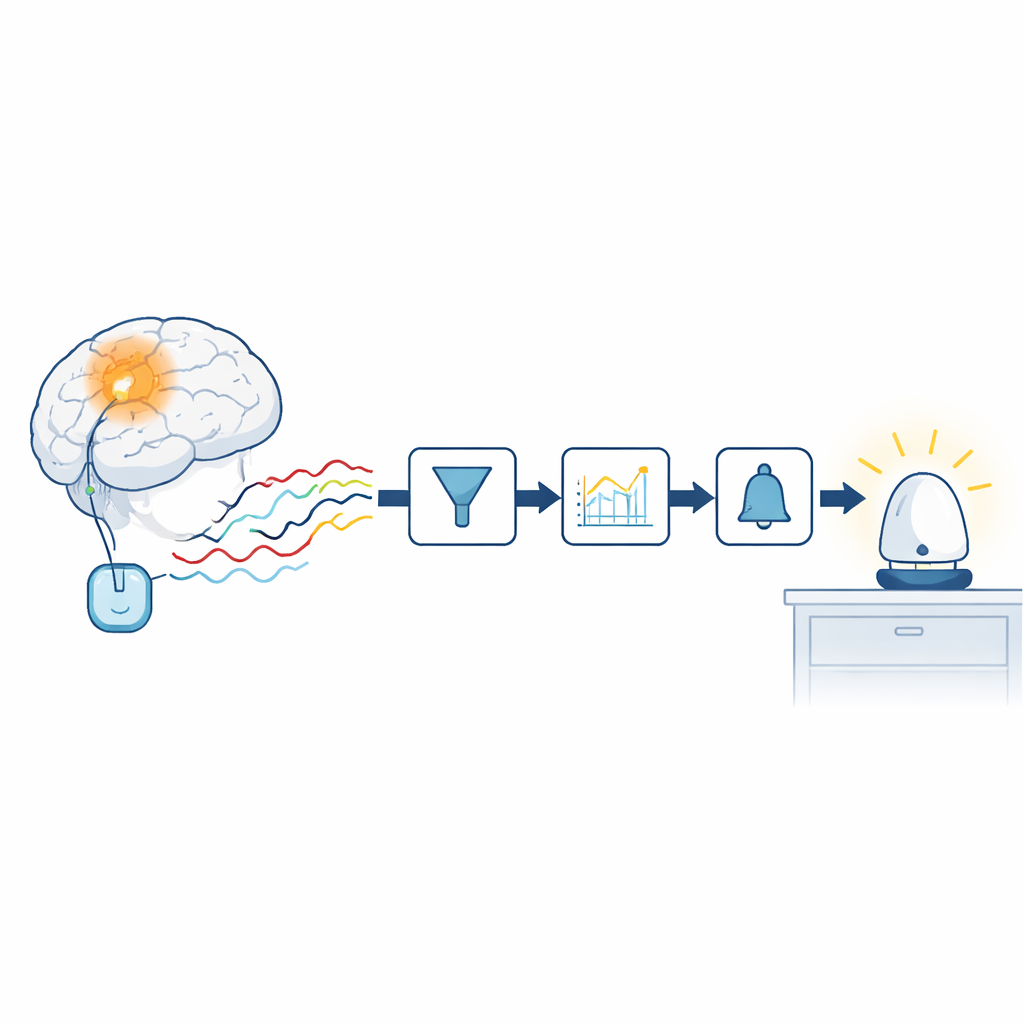
To solve this, the researchers worked with the participant to design a special night mode that listened for a very distinctive pattern in her brain signals instead of the brief changes used during the day. She synchronized her mental effort with the rhythm of her ventilator, which delivered breaths at a steady pace. During one breath cycle she tried to move her hand; during the next she relaxed. This alternating pattern produced a repeating rise in the slower brain rhythm after each effort, creating a series of “bumps” in the signal. The night mode algorithm looked for several of these correctly timed bumps in a row, within a specific time window. Only when the full sequence appeared did the system turn on and allow her to call a caregiver using the regular BCI commands. This demanding pattern was extremely unlikely to occur by chance during sleep.
Living with night mode over time
The participant used this night mode at home for about a year and a half, across nearly 500 nights. For 337 of those nights, caregivers carefully logged how well it worked. In roughly four out of five logged nights there were no errors at all: no missed attempts to call and no unintended activations. In about one third of nights, she did not try to call anyone and the system remained silent, as desired. In more than half of nights she successfully called a caregiver, typically a couple of times, for needs such as suctioning her lungs or receiving medication. False alarms were rare, occurring roughly once every dozen nights. As her disease progressed and overall BCI performance declined, night mode eventually became less reliable, and the team and family decided to stop using it.
What this means for round-the-clock care
This study shows that brain signals used for communication can change markedly between day and night, enough to turn a well-tuned daytime BCI into a source of constant false alarms after dark. It also shows that with careful design and close collaboration with the user, a dedicated night mode can work safely and reliably in the home over long periods. For future brain–computer interfaces to be truly life-changing, they will need to adapt to daily rhythms and sleep, so that people who depend on them can not only speak with their thoughts—but also sleep securely, knowing they can be heard whenever they need help.
Citation: Leinders, S., Aarnoutse, E.J., Branco, M.P. et al. Implanted brain-computer interface functionality during nighttime in late-stage amyotrophic lateral sclerosis. Sci Rep 16, 14001 (2026). https://doi.org/10.1038/s41598-026-44228-7
Keywords: brain-computer interface, amyotrophic lateral sclerosis, locked-in syndrome, assistive communication, sleep and circadian rhythms